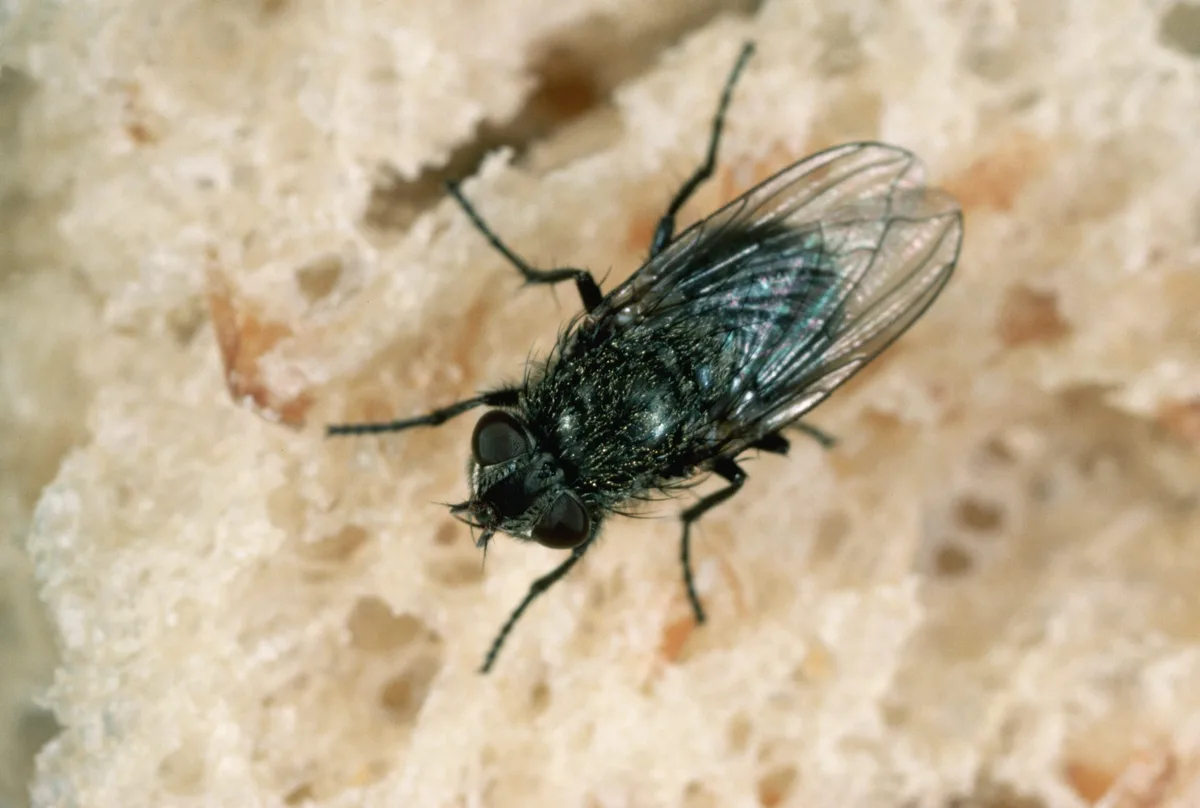
What happens when a fly lands on your food? It depends. The most common and widespread species of fly in the world, the house fly, is associated with over 100 pathogens including bacteria, viruses, fungi and parasites. They usually feed and reproduce in faeces, animal manure, and other decaying organic substances.
So, it’s not as much about the fly as it is about where the fly has been. There’s no way to tell what it landed on before touching down on your sandwich. And there’s a big chance it was poop.
Time is what matters here. The longer a fly has to stomp around your food, the greater the health risks associated with all the bacteria hitching a ride on the its body. If you manage to swat it away quickly, the risk for the average healthy person is not big.
If you let the fly stay on your meal too long, you’re giving it a chance to do its thing. And what is that thing? Pooping and vomiting. Naturally.
Most of the known fly species don’t have teeth, so they can’t take a bite of solid food. Instead, what a fly will do is spit out enzyme-rich saliva to dissolve the meal, and then suck up the digestive fluids and partially dissolved food.
To fit more food, some flies will try to reduce the liquid in what they already ingested - by regurgitating food into vomit bubbles to dry it out. This makes the food more concentrated and easier for the fly to ingest.
In simple words, don’t let a fly stay on your food too long, or else it will spit, poop and vomit on it, as well as potentially leave behind bacteria that could cause illness.
Here are some common flies that could end up landing on your meal.
- This wonderfully weird poop-eating fly with no wings or eyes had scientists miffed. Until now...
- How do flies mate?
Common flies that could land on your meal
House fly, Musca domestica Linnaeus
According to the CDC, each housefly can carry more than one million bacteria on its body. Some of the diseases it can spread to humans are dysentery, diarrhoea, typhoid fever, traveller’s diarrhoea, and cholera.
Horsefly, Tabanus sulcifrons
Horseflies are not drawn to the smell of food, and if one lands on your sandwich, it’s probably not actually interested – it’s more just taking a pit stop.
They often land on livestock and humans to bite and feed on blood. A horsefly bite can be painful due to their scissor-like mouthparts, and it can trigger an allergic reaction.
However, they don’t commonly transmit diseases to humans. The key disease spread by the horsefly is tularemia, often called rabbit fever, most often spread through the bite. It’s very rare, and even rarer to come from the horsefly landing on your food.
Fruit fly, Drosophila melanogaster
Fruit flies are so small they’re almost invisible, and they’re drawn to rotting and overripe fruit and vegetables. They don’t live long, but they reproduce fast, laying up to 2,000 eggs at once.
There are no diseases associated with the fruit fly, but just like the common fly, it does transfer bacteria from its body to your food.
Drain fly, Psychodidae
The drain fly can live anywhere water accumulates and stagnates, so sinks, drains, sewers and septic tanks are its playground. It’s also drawn to areas where mould and algae grow.
It might still land on your food, though, since it’s attracted to organic matter. Drain flies don’t bite, but – once again – they do carry bacteria such as E. coli and Salmonella.
Phorid fly, Phoridae
They’re around the same size as the fruit fly, known for very annoyingly hovering around your face. The reason for that is simple – they’re attracted to the moisture produced by your breath.
Phorid flies are often found in mausoleums and dumpsters as they’re drawn to decomposing flesh and organic materials. Most commonly, they feed on decaying organic matter and breed in human corpses – they can even continue living in closed and buried coffins.
Because of this, they obviously may transport various disease-causing organisms to your food – but it’s rare.


