In his blog, Hyenas in Harar, anthropologist Marcus Baynes-Rock recalls a memory from his time spent in a farming hamlet in West Shewa, Ethiopia writes Katie Stacey.
For the most part, his blog investigates the relationship between people and urbanised spotted hyenas in Ethiopia’s city of Harar, but in this entry, Marcus is sitting inside a mud hut, eating a plate of stir-fried meat, crumbly cheese and a hunk of kocho (a traditional flatbread).
- Could a hyena take on a lion? Nail-biting video shows close and fiercely-fought battle between these carnivorous predators
- Why female spotted hyenas rule the pack
“It would have been like a family camping trip, if not for the sound of a donkey urinating on the floor directly behind me,” writes Marcus. There were other livestock there, too – goats, donkeys, horses, cows – sleeping just across the other side of the small room. The reason that the animals were inside the house at night, was what lurked outside: hyenas.
“In West Shewa, hyenas are considered a sort of sinister society – a population of creatures of both physical and supernatural power who hold sway over the land whenever it is dark. People here are very afraid of hyenas.”
It is not just in West Shewa that hyenas are feared. “Hyenas are big predators and they are more than capable of taking people’s livestock and even killing people,” says PhD student Arjun Dheer, who is studying spotted hyenas’ adaptability to human activity in the Ngorongoro Conservation Area, Tanzania. Among the carnivores there, hyenas rank as the main predator of livestock and there have also been numerous incidents of hyenas attacking people in the area.
Yet there is one place where hyenas and humans co-exist, seemingly conflict free. “I think Harar is probably the one example where hyenas and humans can be described as living alongside each other harmoniously,” states Arjun.
Could it be possible to co-exist with a predator as large and as potentially dangerous as a hyena? It was this question that found me in the dead of a December night, wandering the rabbit warren of Harar’s old town. I was accompanied by Hailu Gashew, a local expert on the city’s unique urban wildlife.
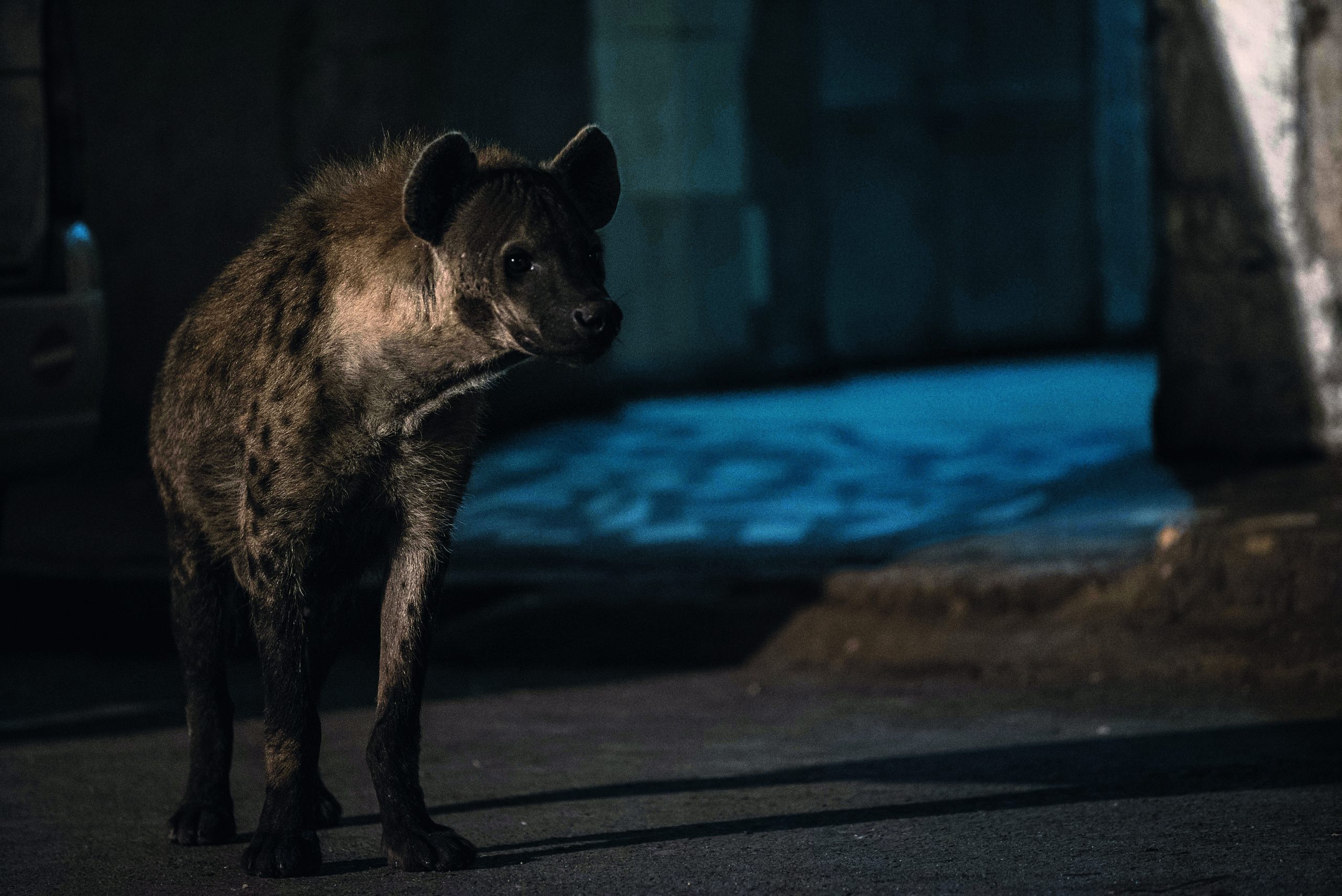
Hailu led us to the edge of Harar’s meat market, which was still a hive of human activity – some were clearing up from the day’s work, others huddled in the doorways, ready for bed. With so muchgoing on, I was sure our chances of seeing a hyena were slim, but then, at the end of the square, a sandy-coloured face with large round ears appeared. It was a female spotted hyena, peering around the top of the staircase.
Scraps of meat lay discarded around the marketplace, and tentatively she began to approach each one, sniffingit delicately before either wolfing it down or ignoring it. “They like goat the best,” explains Hailu.
A small crowd gathered, not to watch the hyenas, for their presence was normal, but to watch the ferengis (foreigners). My amazement at the hyenas encouraged the locals, and they began to appear with tied-up bags of guts and gristle for the creatures.
Soon there were four brazenly waiting for the gathered group to throw more food. A few feral dogs came and tried to chase the hyenas off, but the men held them at bay.
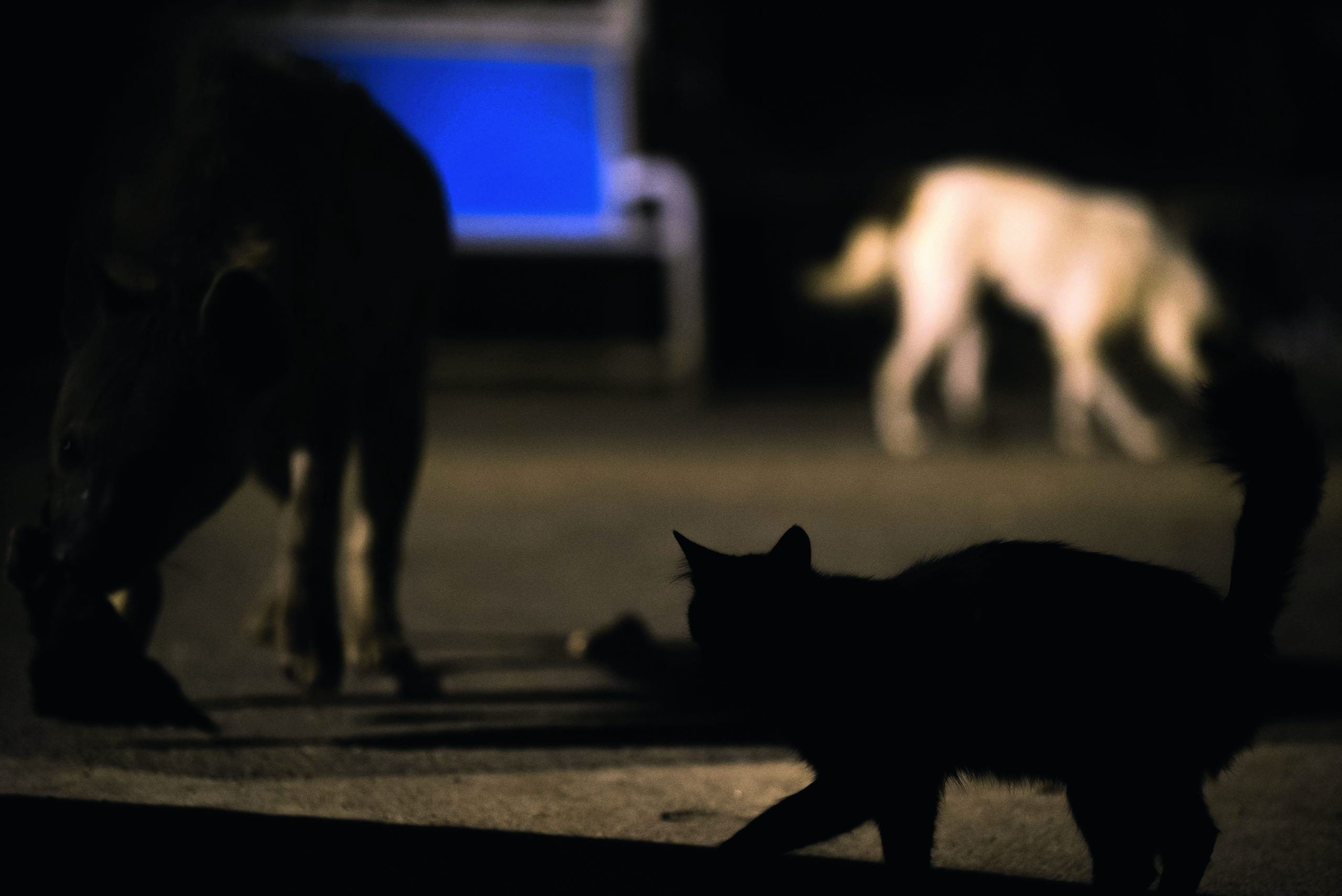
Two stray cats also joined in on the feeding, hissing and scratching whenever the hyenas got too close and, surprisingly, the hyenas stayed clear. In general, hyenas will kill dogs and cats, but in Harar they were all eating from the same pile of food – there was plenty to go around, so the domesticated animals were generally left alone.
Sometimes a chunk of meat landed beside the people asleep in the doorways of the butcher shops, and the hyenas would venture over to give them an exploratory sniff. The sleepers responded with kicks.
“Hyenas are very curious – they use their mouths to explore and what often happens is they will bite someone on the face.”
Arjun tells me when I ask him about these interactions. “In any other situation, hyenas would see the sleepers as an easy meal. They’re not stalk and ambush hunters at all, they will take any opportunity that they can. But in Harar it shows in their behaviour that they are well fed and therefore tolerant of people.”
Much like the history of the city, the origins of Harar’s relationship with hyenas is shrouded in legend. Hailu tells me that people first began feeding the hyenas about 300 years ago as part of the Ashura ceremony, which takes place in the first month of the Islamic calendar.
The people would prepare large portions of porridge made from cereals and butter, which they would leave up on the hill for the hyenas to feed on. The amount that was eaten by the hyenas would predict the coming year’s fortunes. The more they ate, the more hopeful the year’s prediction: no war, good rainfall, successful harvests, and Harar would be kept safe from evil spirits.
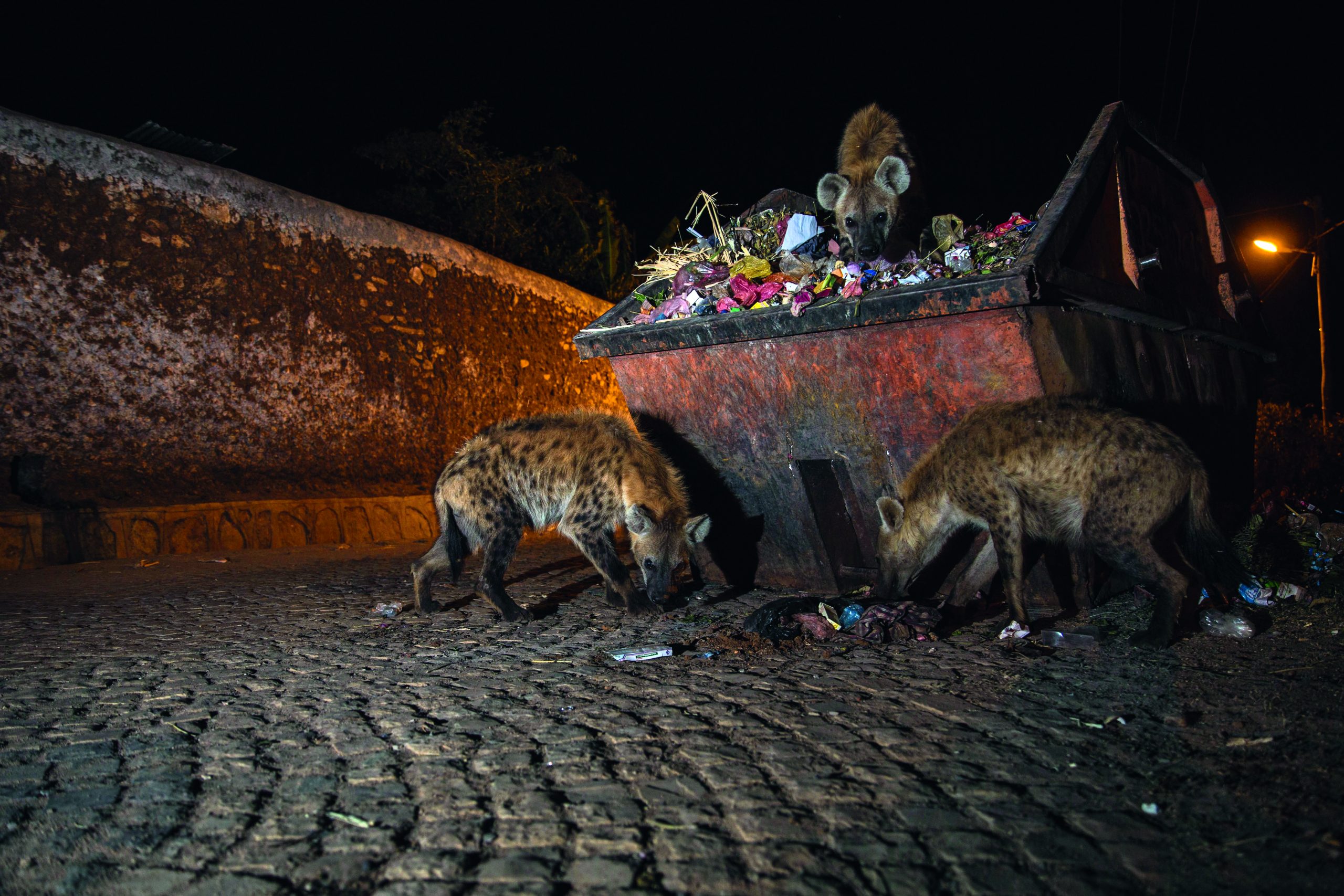
Then came the king’s order for hyena gates to be built into the city walls. “At the time, five human gates existed, which opened around sunrise and closed around sunset,” says Hailu. “But these didn’t allow for the hyenas to enter after dark, so the king ordered that they make small hyena gates that could stay open all the time.”
It is said that the king did this so that the hyenas could come in to clean the rubbish from the old city. “That was definitely one of the reasons,” explains Hailu, “but the main reason was that people believed the hyenas would devour the evil spirits from the old city.”
In Harar the hyenas’ close association to the spirits is seen as positive, but across the rest of their range, the cultural beliefs surrounding hyenas are invariably negative. “They are thought to be associated with witchcraft and other evil spirits. They are reputed to be grave robbers and kidnappers.
Because they are generally nocturnal and they make unearthly, eerie sounds – haunting cackles, whooping and giggling – you can see why such associations have been made,” says Arjun. And these dark beliefs are not just limited to Africa, it is also the same with striped hyenas in India for example. “Yet, in Harar, their spiritual beliefs tolerate hyenas, as they are seen to keep bad spirits away.”
Nowadays it is not just the city that is feeding the hyenas, but individuals too. Known as hyena men of Harar, a tradition has unfolded where men are hand-feeding the animals. And this practice has only hrived off the back of widespread media attention, most noticeably on the BBC’s Planet Earth II.
Yusuf Mume Saleh is perhaps the most famous of the hyena men. “People believe he has the power to speak with the hyenas,” Hailu says.
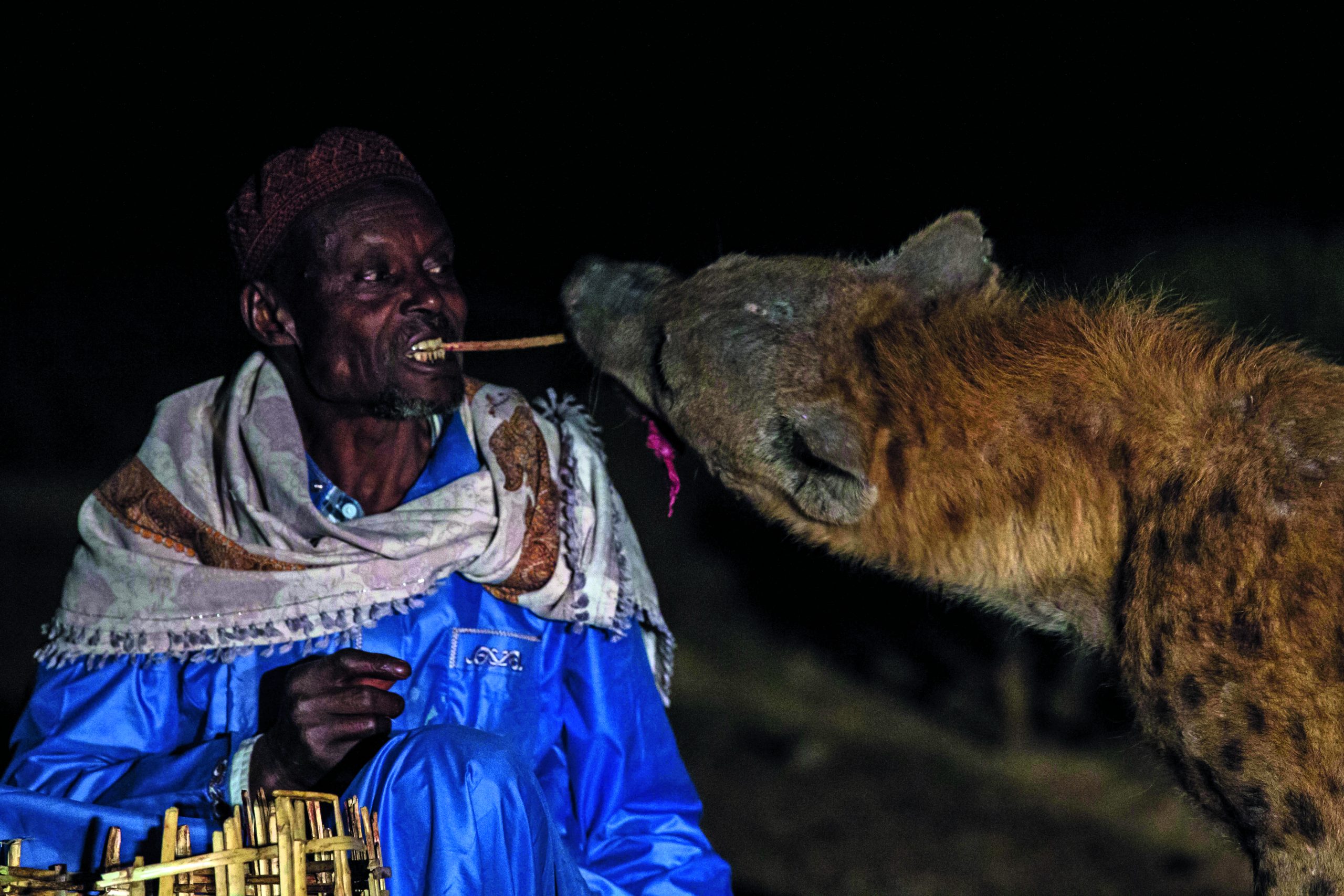
We were fortunate enough to meet Yusuf, who had continued the tradition on from his great-grandfather. Watching Yusuf feed the hyenas was a very spiritual experience. He was elegantly dressed in a blue silk robe and white cotton scarf. The hyenas approached him calmly as he called them gently by name. He began with ‘Kute’ the alpha female of the clan and once she’d fed from the wicker basket, the next hyena approached. After he finished, I asked Yusuf what he thought would happen if they stopped feeding the hyenas entirely:
“If we stopped, they would punish us. It would bring very bad luck.”
Yusuf only co-ordinated one feeding that night. The rest were carried out by Abbas, his son, who has now inherited the role, and his approach was quite different to that of his father’s. Abbas fed the hyenas first from a stick like his father and then from his mouth.
He then invited a minibus-load of tourists to have a go for themselves, and they did. Abbas wafted a chunk of meat over a tourist’s head, inviting the hyena to jump onto the person’s shoulders and the volunteer crumpled under the hyena’s weight. The carnivore devouring the chunk of meat was inches from the tourist’s face, who was perhaps taking the risk to get an exciting, new social media profile picture.
“I would not do it myself,” says Arjun. “I’ve seen what hyenas can do with those crazy strong jaws. One wrong move… you just never know.” He tells me that there was a hyena man in Harar in the 1970s who was eaten by a hyena. “Hans Kruuk mentions it in his book, The Call of Carnivores.” But Abbas and his hyena show have become a lucrative business. Tourist safety didn’t seem to concern him as he rode away on his shiny new motorbike.
There is also natural hyena behaviour to be witnessed in Harar. We came across two clans of hyenas having a showdown in front of a primary school, in the early hours one morning. Territory had clearly been invaded and, as we watched from the sidelines, now feeling alarmingly calm in the hyenas’ presence, we observed completely natural behaviour more often seen in the wilds of the African bush, instead played out in the heart of a city. Interestingly, Marcus writes in his blog that, in Harar, “The socio-political worlds of these hyenas are not a single species affair.
The human populationis inextricably caught up in the ways that hyenas are organised, and beyond feeding hyenas, the things that they do can have profound impacts.
“While the government of Harar is very much pro-hyena and adamant that the hyenas are important in terms of heritage and tourism, [it is] also pro-development and not very cognisant of the effects that development will have on the hyenas. So, the town keeps expanding and the hyenas’ territories are being made to accommodate more roads, buildings, and humans.”
These spotted hyenas may have learnt to thrive in this heavily human-modified landscape, but for how much longer can they continue to adapt?
- Meet the charismatic and cheeky raccoon: how the cute mammal has become an adept city dweller
- 61 black mambas captured in African city. Here's what experts found in their scales – and why it matters
- How peregrines have adapted to urban living
Photos: Luke Massey