There’s no doubt that the common dolphin’s gregarious nature and willingness to engage with people played a large part in it appearing in the earliest attempts at species classification.
Founding natural history scholars Aristotle and Pliny the Elder described it in detail a couple of millennia ago, plus it was the first species to be scientifically described by the father of modern taxonomy, Carl Linnaeus, in 1758.
- “I can’t express to you how rare this behaviour is”: 'tail walking' dolphin filmed in California
- Dolphin vs shark: what's the difference between these charismatic ocean dwellers?
Befitting its ‘common’ name, this cetacean has an estimated global population of around six million, which makes it the most abundant of all the world’s dolphins.
This is primarily due to its cosmopolitan distribution across both warm temperate and tropical waters, and its ability to inhabit anything from shallow coastal locations to deeper offshore waters.
- “Not expected at all”: dolphin researchers just made a surprising discovery in the Mediterranean Sea
What do common dolphins look like?
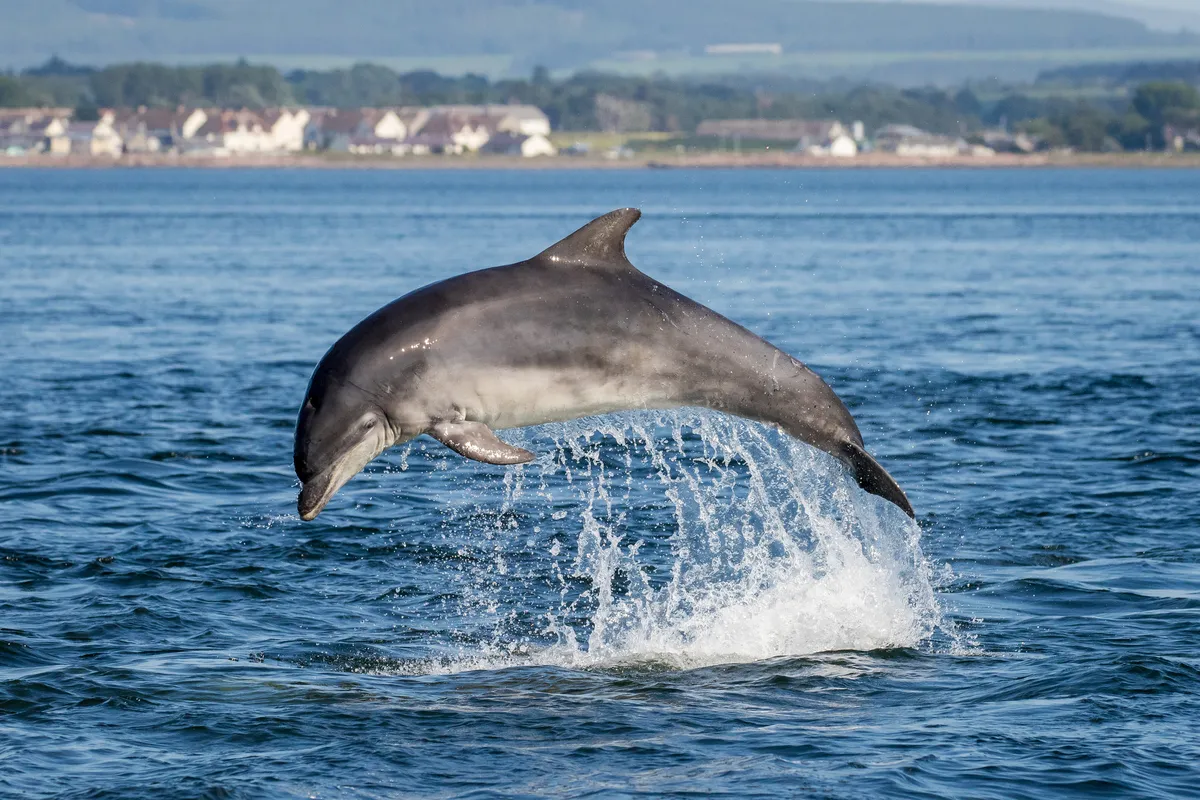
A good view of the flanks of this relatively small dolphin should reveal a striking yellow and grey hourglass or criss-cross pattern directly below a curved, dark dorsal fin with a paler centre. If you’re lucky enough to be following a pod, you shouldn’t have to wait too long to check this, since the animals frequently leap clear of the water.
How sociable are they?
Well known for their sociable nature, common dolphins can form pods of anywhere between 10 and 10,000 individuals, with group sizes seemingly driven by a range of factors, such as the availability of prey, and the age, sex and reproductive status of the dolphins present.
This fin of friendship is also extended to other cetacean species – pilot whales and Risso’s and striped dolphins are often happy to swim alongside common dolphins if the location suits them.
How do they forage and hunt?
This power of the collective is particularly helpful when it comes to the dolphins’ foraging and hunting strategies. Their main food source – the schooling fish of mid-water depths, such as mackerel, herring, anchovies and sardines – tends to be patchily or unevenly distributed across the sea.
So, it’s a case of the more the merrier when locating prey, which the dolphins also know will be plentiful enough to go around.
Such levels of cooperation may not necessarily break down as soon as a meal has been located, either. Researchers have found that, like orcas and bottlenoses, common dolphins use feeding strategies such as ‘carouselling’. Working as a team, often with clear divisions of labour, they corral and herd fish shoals up to the water’s surface, where they are easier to pick off.
How acrobatic are common dolphins?
Both when feeding and during the rest of their regular activities, commons are at the acrobatic end of the dolphin scale. While regularly leaping out of the water is par for the course, somersaults are not uncommon, and ‘pitch-poling’ sees the dolphins exploding vertically out of the water, slamming back down on their sides to produce the largest possible splash.
They also appear to be super-enthusiastic bow and wake-riders of nearby boats and any larger whales that find themselves mixed in among the pod.
How fast are common dolphins?
Common dolphins are impressive accelerators and have been clocked at speeds of around 60kph. Their ‘top gear’ mode, known as porpoising, involves them continuously leaping out of the water in spectacular bursts, which reduces drag.
Since air is so much less dense than sea water, these animals can cover distances incredibly quickly, and often do it when they’re travelling, hunting or sprinting to catch up with a boat. On those lucky occasions when you come across a large, active pod, the water can look like it’s been whipped into a froth by the sheer number of individuals breaking the surface at any one moment.
Thanks to these attention-grabbing antics, common dolphins will hopefully keep holding our fascination for many centuries to come.
Where can you see common dolphins?
As the name suggests, you can common dolphins in plenty of places around the world.
The Sea of the Hebrides, Scotland
This small and partly sheltered section of the North Atlantic is rich in cetaceans, such as common dolphin pods. Boat trips run from Mull and Skye.
Near St Davids, Pembrokeshire
Boat trips from St Justinian’s regularly encounter superpods of between 300 and 1,000 common dolphins. Hotspots are around Stumble Head and the Celtic Deep.
Dana Point, California
Commons are considered the most abundant of five species of dolphin seen from this renowned cetacean hotspot. Superpods, known as ‘stampedes’ by locals, are a regular occurrence.
The Azores, Portugal
Trips out of the islands São Miguel and Pico offer the best opportunity for a dolphin encounter, boasting a 98 per cent success rate in July and August.
Algoa Bay, Gqeberha (formerly Port Elizabeth), South Africa
It’s referred to as the ‘bottlenose dolphin capital of the world’, but common dolphins along the coast here are probably more numerous.