
This should be a safe space. Female elephant seals and sea lions come to beaches of the Peninsula Valdés to birth and nurse their pups. The waters here are calm and full of food, such as fish and squid. But there’s something lurking in the shallows.
Orcas are the undisputed rulers of the ocean. They can grow as long as a shipping container, weigh as much as a school bus and have no natural predators. Their enormous black-and-white bodies are superbly adapted for hunting in water.
Their streamlined shape helps them slice through the waves, sophisticated echolocation allows them to locate prey, and interlocking, golf-tee-sized teeth grip, tear and hold on to slippery victims. Which makes what some orcas do at Peninsula Valdés, in Patagonia, all the more baffling: sometimes they hunt on land.
- Can any animal kill an orca, the ocean’s undisputed apex predator?
- “No other predator is able to challenge them” – this deadly, intelligent ocean killer works in a team to stun, submerge and launch at its prey
At the start of each year, female sea lions haul themselves onto these beaches to give birth. By March, hundreds of new pups are starting to cut loose, splashing in the shallows and gambolling along the shoreline. For the orcas patrolling offshore, it’s too much to resist.
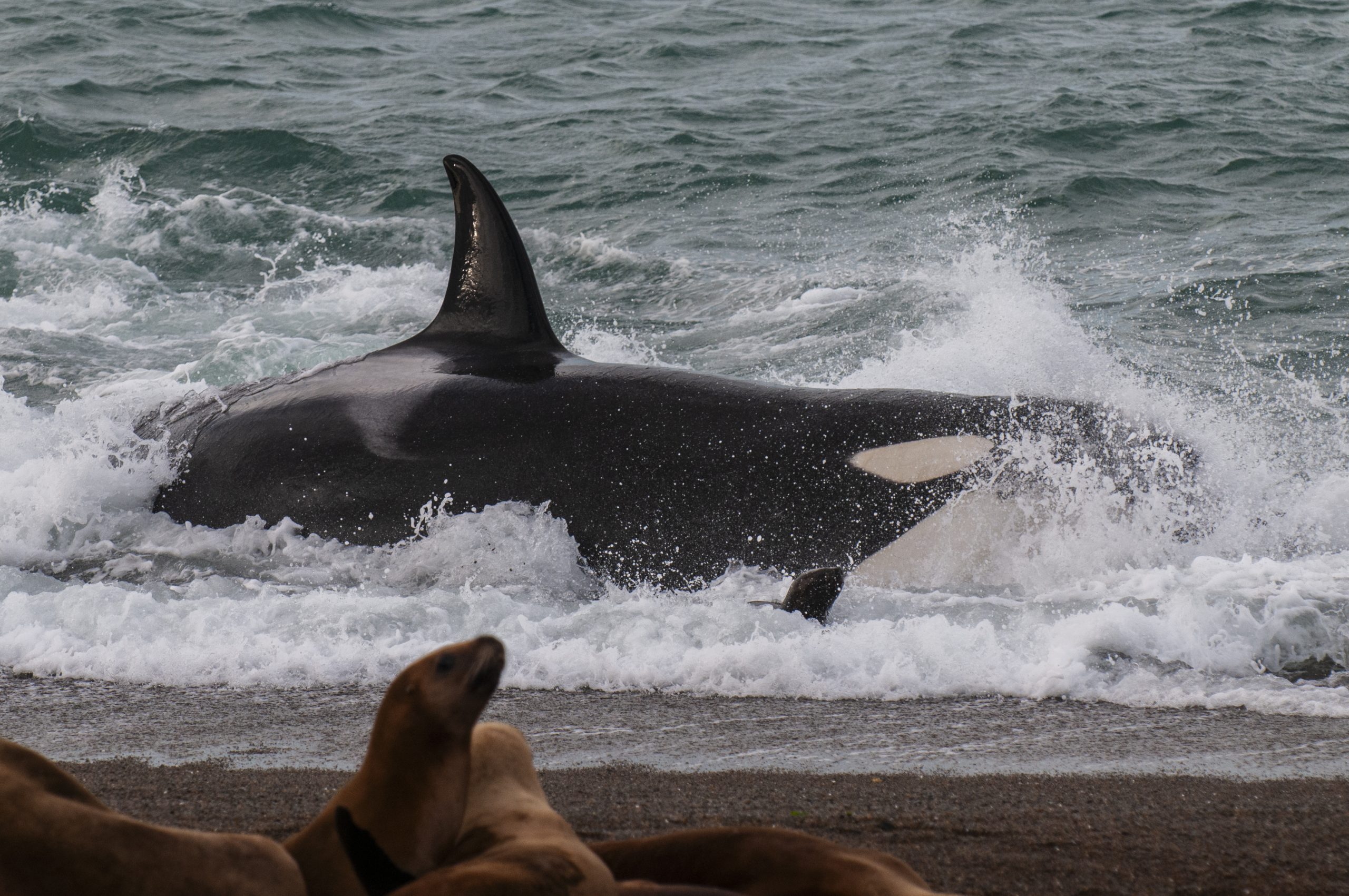
As the mother sea lions roar, orcas zero in on pups near the water’s edge, then accelerate hard towards them. Using the channels between reefs and the steeply sloping beaches, they deliberately strand themselves on the shore. Then they grab their prey and manoeuvre back into the water.
This distinctive hunting style, known as intentional stranding, is a high-risk, high-reward strategy. Get it right, and it’s easy pickings. Get it wrong, and the killer whales risk becoming stranded. For this reason, the orcas time their attacks. At Peninsula Valdés, they occur only within the two hours either side of high tide.
The extraordinary technique is practised by a small population of orcas in this area, but it isn’t unique to Patagonia. Intentional stranding has also been documented on Possession Island in the Crozet Archipelago, in the sub-Antarctic Indian Ocean, and in the Salish Sea off the coast of Washington State, USA.
The practice pays off. A study of hundreds of orca attacks at Peninsula Valdés found that around 35 per cent of intentional strandings resulted in a capture, compared with just 6 per cent of interceptions at sea. Beach-wide, around 10per cent of the sea lion pups born on the Peninsula Valdés lose their life this way.
But the youngsters that survive learn quickly. By the beginning of May, the new generation of sea lions has wised up to the orcas’ hunting technique. As the pups grow larger and more wary, hunting opportunities dwindle, and the orcas turn to other prey.
- 10 most powerful whales on the planet – are these the ocean’s smartest killers?
- Killer whales are using dramatic hunting techniques to catch large marine animals in California
- Why do whales hurl themselves out of the ocean? 6 theories behind their spectacular aerial acrobatics
- “They bore the marks of an attack, including rib fractures, internal haemorrhages and specific teeth marks.” 5 animals that kill excessively – seemingly just for fun


