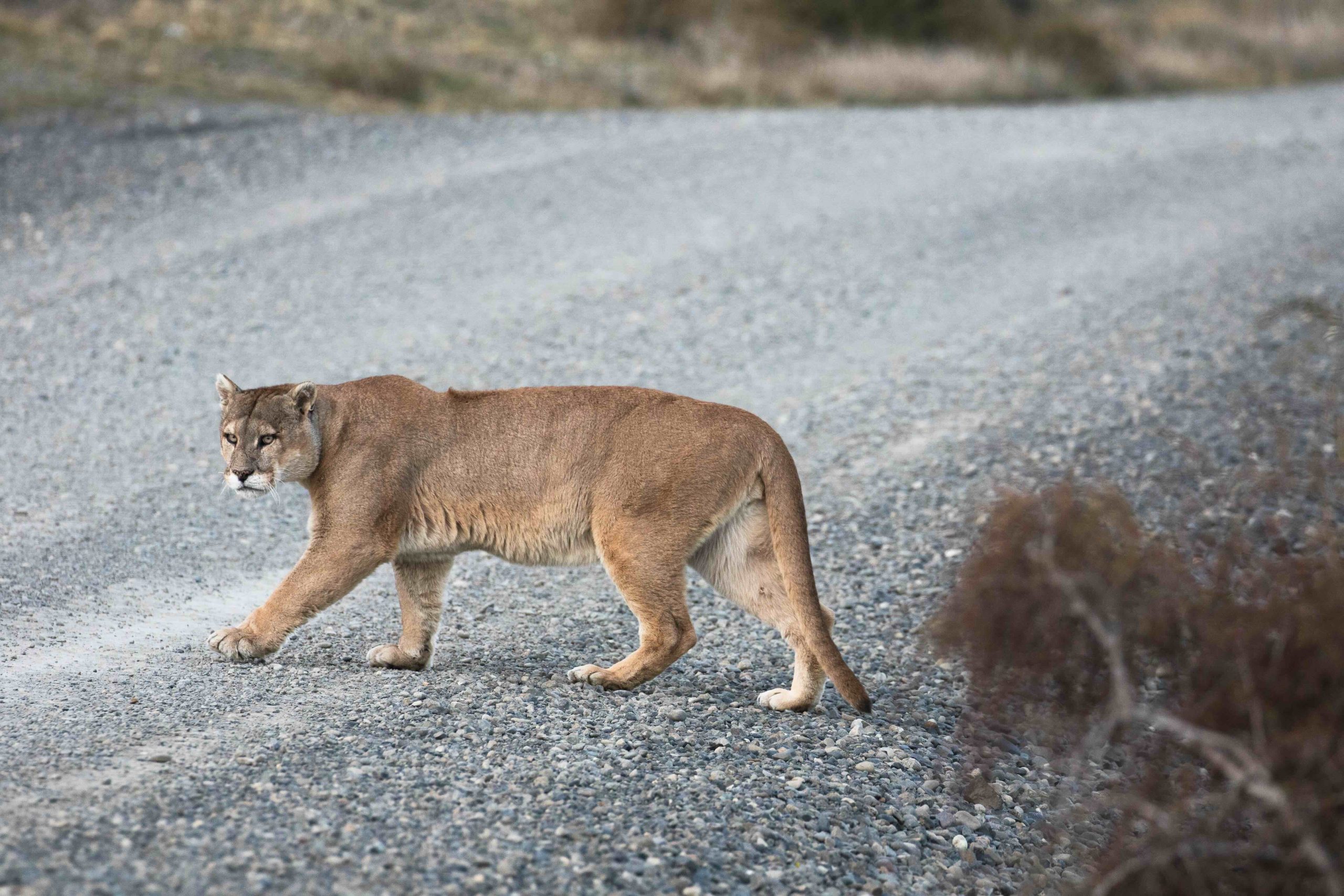
The presence of pumas, also known as cougars or mountain lions, across the Olympic Peninsula of Washington State in the northwest USA is predicted to reduce vehicle collisions with deer by 76 per cent over a five-year period, according to new research.
The cons of living with large carnivores as a result of their predation of livestock, for example, is well-known but the pros are far less well understood.
Now, according to Justin Suraci of Conservation Science Partners who was the lead author of the study in Current Biology, it can be shown they provide unequivocal social benefits.
The reason for this is that pumas change deer behaviour. “Pumas select for moderately developed areas relatively close to roads when hunting ungulate prey,” says Suraci. “They are ambush predators and edges are great places to hunt because they provide both cover and good sight lines.”
Deer and other herbivores therefore avoid these areas in response, especially at night when pumas are more active.
This has considerable benefits for the humans that drive along those roads – a collision with a large ungulate weighing up to 300kg can not only write off your vehicle, it can be fatal.
- "They can eat almost anything." Pumas caught hunting surprising prey on coast of Patagonia
- Why 8 Texan pumas were released in Florida – and what happened next
A previous study published in 2016 found that reintroducing pumas to the eastern USA, where they are absent, could prevent 21,400 injuries, 155 fatalities and $2.13 billion in avoided costs over a 30-year period.
Suraci and his colleagues now plan to investigate whether it will be possible to assign a monetary value to the ecosystem services provided by the pumas in Washington State.
“Our results indicate that communities are experiencing the value of coexisting with predators right now, but this has been unmeasured and poorly articulated to date,” he says.
Similar ecosystem services can be applied to other carnivores. A study published in 2021 found that in the average county in Wisconsin, the presence of wolves reduced deer-vehicle collisions by 24 per cent, “yielding an economic benefit that was 63 times greater than the costs of wolf predation on livestock.”
Suraci also points to the value of leopards keeping feral dogs under control in Mumbai in India, reducing the risk of local people catching diseases such as rabies.
“The net value of coexisting with large carnivores will vary across space and among different stakeholders,” Suraci says. “But I would suggest that some level of predation service is the norm rather than the exception wherever they are present.”
Top image credit: Glen Kalisz, WSDOT
More wildlife stories from around the world
- 'Ghost sharks' are lurking off the coast of Washington – and they have teeth growing out of their foreheads
- More than 1,000 rattlesnakes caught in Michigan wetlands. What scientists find in their DNA is concerning
- There’s a bizarre animal in Oregon that looks and smells like a sock – and scientists are feeding it sardines. Here's why
- Remote cameras catch rare predator in Californian forest. There are only 500 left on the planet