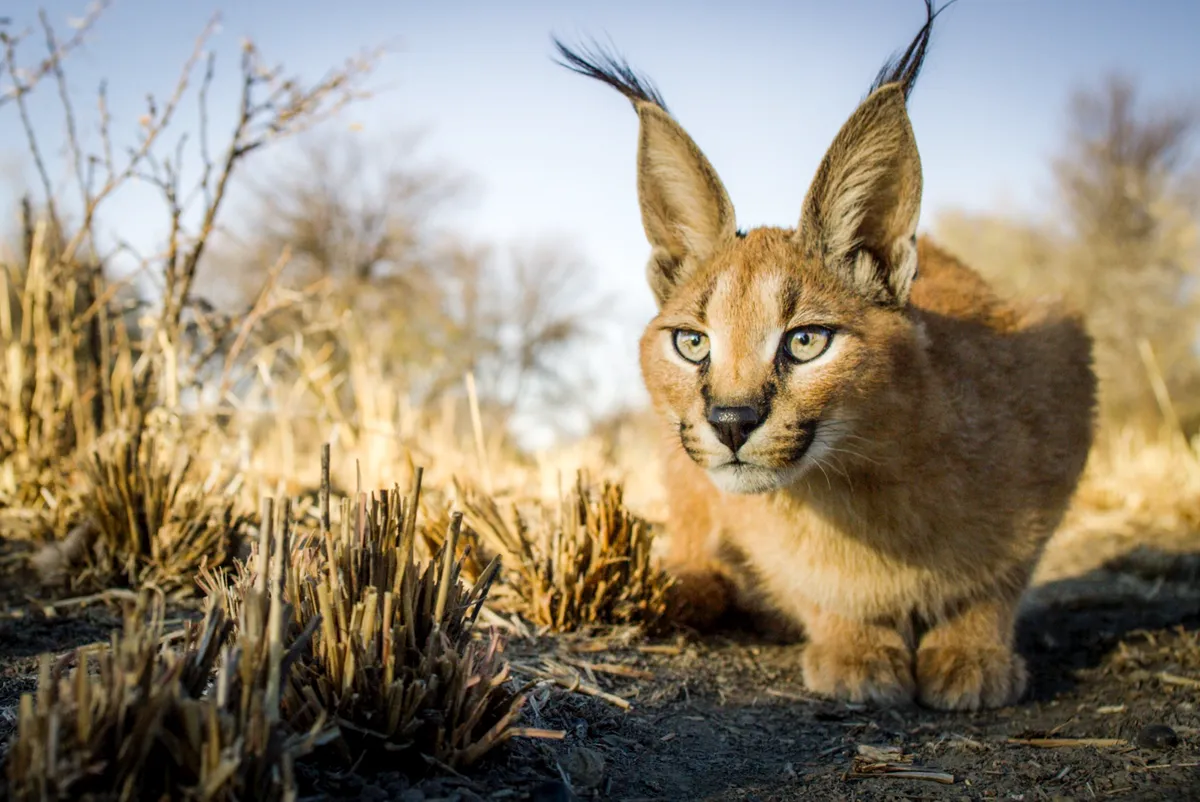
As a group, cats appeared approximately 30 million years ago, diverging from several other groups of cat-like carnivorans, such as hyenas, mongooses, fossas, and civets. The first in this long list of furry felines was Proailurus, whose name comes from the Greek pro, meaning 'before', and ailuros, meaning 'cat'.
What was Proailurus?
Proailurus is an extinct cat that lived in Europe and Asia from the Late Oligocene (30 million years ago) to the Early Miocene (25 million years ago). It’s widely considered to be the first ‘true’ cat and the ancestor of the entire cat family, which includes everything from extinct sabre toothed cats to living lions, tigers, and leopards.
Proailurus is known from three different species, two of which - P.lemanensis and P.bourbonnensis - were roughly the size as a house cat, weighing in at 7-10kg. The third species, P.major, is thought to have been more than twice as large, but it's only known from a single specimen and, as a result, is shrouded in mystery.
What did Proailurus look like?
Looking somewhat like a miniature cougar, Proailurus had a lengthy, low-slung back, relatively short limbs and a long, flexible tail. These features suggest it lived an arboreal lifestyle, hunting, resting, and perhaps even playing high up in the tree canopy. It may have also hunted on the ground, just like the modern Geoffroy’s cat (Leopardus geoffroyi).
This bodyplan and arboreal behaviour bears remarkable similarity to the fossa (Cryptoprocta ferox) - a cat-like predator found only on Madagascar.
- How wild is your cat? 6 key behaviours that reveal the wild ancestry of your cat
- How can I stop my cat hunting – and killing – wildlife?
While these strange-looking mammals are distantly related Proailurus, belonging to a family of carnivorans known as Eupleridae, their similarities aren’t inherited from a common ancestor. Instead, they are the result of convergent evolution - a process where species arrive at nearly identical solutions to the same evolutionary challenges, despite being unrelated or only very distantly related.
Where did Proailurus live?
The first remains of Proailurus were described in 1879 by French naturalist Henri Filhol who found a handful of small, cat-like fossils at a site in Saint-Gérand-le-Puy, Central France.
Since this discovery in the late 19th century, fossils of Proailurus have been unearthed in neighbouring Spain and Germany and, surprisingly, Mongolia. This suggests Proailurus had a very wide range and occupied a niche that had very few, if any major competitors.
Several fossils believed to belong to Proailurus, or at least a Proailurus-like animal, have been found in North America, including the famous Ginn Quarry cat. This specimen is represented by a complete skull, which has dentition very similar to the type species (P.lemanensis) originally described by Filhol.
The jury’s still out on whether the Ginn Quarry cat was truly a Proailurus, but its discovery suggests that cats - or at least cat-like animals - had already dispersed from Eurasia into North America, establishing a lineage that, millions of years later, would give rise to some of the largest cats that ever lived.
What did Proailurus eat?
Based on their teeth and jaws, researchers think Proailurus ate a variety of small mammals, as well as birds and small lizards.
This is a similar diet to that of several modern arboreal felines, such as the margay (Leopardus wiedii) and the marbled cat (Pardofelis marmorata). These elusive wild cats are a similar size to Proailurus and offer researchers a unique glimpse into how their predecessor may have lived.
While Proailurus was primarily a meat eater, like all living cats, its jaws retained a few extra premolars, suggesting it may have also been partial to some plant-based snacks. These robust teeth would have helped it grind up tougher foods and were likely evolutionary leftovers from carnivoran ancestors with more varied, omnivorous diets.
What did Proailurus originate from?
Proailurus is widely considered the first ‘true’ cat and the basal member of a family known as Felidae. This furry family is nestled within a larger mammalian order known as Carnivora, which includes everything from cats and dogs, to bears,mustelids, hyenas, and seals.
The origins of Carnivora can be traced back to the Early Eocene, roughly 52 million years ago and just 12 million years after the extinction event that wiped the non-avian dinosaurs from the face of the Earth.
The earliest carnivorans would have resembled small weasels or genets and, like many living carnivorans, would have likely been nocturnal. From these small, stealthy predators, two large sub-groups emerged: the feliforms and the caniforms.
While the caniforms diversified into an astonishing array of shapes and lifestyles (just look at how different skunks are from walruses, for example), the feliforms largely retained a sleek, agile body plan and exhibited far less diversity in terms of their morphology, diet, and behaviour.
And it’s from Feliformia that Proailurus, and its lineage Felidae, eventually emerged 30 million years ago.
Another group of tree-dwelling carnivorous mammals emerged at a similar time. These cat-like predators are known as linsangs (Prionodontidae) and they’re considered the closest living relatives to cats, making them sister families.
Why did Proailurus become extinct?
The last Proailurus lived approximately 25 million years ago in the Early Miocene, during a time when Eurasia’s forests were retreating and its grasslands were expanding.
This major ecological shift may have forced Proailurus into new, open environments that it was less suited to, resulting in a gradual decline that eventually culminated in extinction.
The extinction of Proailurus marks the beginning of a strange period in North America known as the ‘cat gap’. As its name suggests, this seven-million-year-long period is marked by an absence of cats, or cat-like animals.
Before cats temporarily ‘disappeared’ from North America, two cat-like families lived on the continent: Felidae (through Proailurus) and Nimravidae. The nimravids are often called the false sabre-toothed cats and while they may have sported the same oversized canines as sabre-toothed cats, they weren’t true cats. Instead, they evolved their fangs independently.
There are several theories as to why felids and nimravids were absent from North America for seven million years, including climate change, increased volcanic activity, and perhaps even competition with early dogs.
Some researchers argue the so-called ‘cat gap’ may just be a product of a poor fossil record during the Early Miocene. If the conditions needed to preserve cats aren’t present, then their remains won’t be preserved - this doesn’t necessarily mean they weren’t there.
Regardless of the causes of the ‘cat gap’, cats ‘re-appeared’ in North America 18.5 million years ago with Pseudaelurus - a pioneering genus comprising three or four different species, ranging in size from house cats to cougars.
What came after Proailurus?
Pseudaelurus is widely considered a direct ancestor of Proailurus. Like Proailurus, it also had a wide range, with remains found across Europe, Asia, and North America.
Since it was discovered in the mid 19th century, Pseudaelurus has been split into separate sub groups, each of which are considered to have given rise to later felid lineages.
The eponymously named Pseudaelurus lineage spawned a family known as the machairodonts, or sabre-toothed cats. This extinct family has many famous members, including Smilodon, Homotherium, and Megantereon.
Another evolutionary branch of Pseudaelurus led to the emergence of Styriofelis - a lynx-sized cat that had relatively short forelimbs and long hindlimbs. While Styriofelis is long extinct, its sister groups - Felinae and Pantherinae - are still alive today and comprise all living cats.
Felinae is the scientific name for the small cats, which are generally small in size and cannot roar. Pantherinae, on the other hand, includes the big cats, which are renowned for their powerful, fear-inducing roars.
Every member of these two groups, from house cats, cheetahs, and cougars (Felinae) to lions, tigers, and jaguars(Pantherinae), can trace their roots back to Pseudaelurus and, in turn, Proailurus.
Without these pioneering cats, there’d be lions prowling the African savannah, no tigers stalking the jungles of Eurasia, and no contented tabby lounging on the back of your sofa.