
Endemic to North America, the passenger pigeon (Ectopistes migratorius) was once thought to the most abundant bird in the world, and certainly the most abundant pigeon. Around 3-5 billion (25-40 per cent of the continent's entire bird population) of the birds flew over the forests of North America in the mid-1800s, but by 1914, there were none left.
Martha the passenger pigeon was the final member of her species and died in Cincinnati Zoo and Botanical garden. She has come to represent the story of how easy it is to lose a species.
Who was Martha the passenger pigeon?
Martha the passenger pigeon was something of a celebrity, who lived at Cincinnati Zoo and was born in 1885. She was named in honour of the first lady of the United States between 1789 to 1797, Martha Washington.
Although there are several accounts of Martha's story of how she eventually arrived at Cincinnati Zoo, many believe she was originally owned by Professor Charles Otis Whitman, who was keeping passenger pigeons to study their behaviour. Wild populations had been in serious decline with the last lost from the wild in 1900. Martha was sent to Cincinnati Zoo in 1902 and by 1910 she was the final passenger pigeon left on Earth. The population of passenger pigeons had gone from billions to 1 in decades.
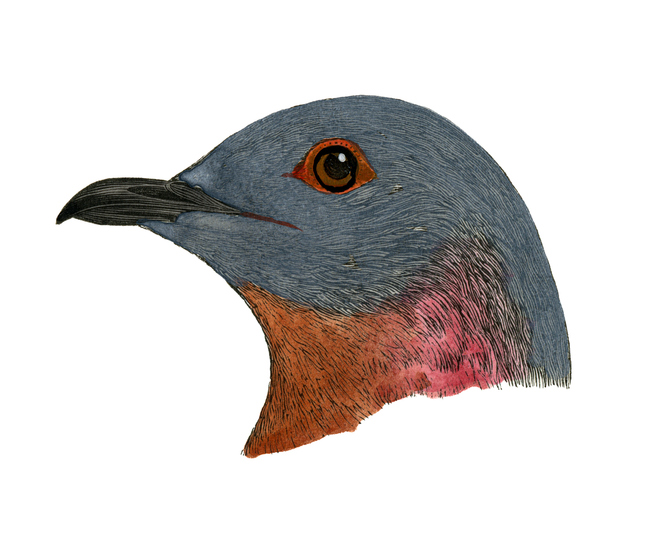
The quest to find Martha a mate was a long and complicated one, with many attempts at getting Martha to breed in captivity. When the final male passenger pigeon died in Cincinnati Zoo there was a $1,000 reward offered for another one to pair with her. The reward was never claimed.
- New trial gives hope to Britain’s endangered curlews
- Britain’s cirl buntings are back from the brink
- Which birds gained the most from Britain’s lockdown?
What happened to Martha the passenger pigeon?
Having suffered a stroke a few years before she died, Martha was found on the floor of her cage in Cincinnati Zoo around 1pm on 1 September 1914. She was scooped up, held by her feet, frozen in a 300-pound block of ice and transported to the Smithsonian to be photographed and later stuffed and preserved in the National Museum of Natural History. Now a symbol of the threat of extinction, Martha is often put on public display as part of exhibitions highlighting the need for conservation.
- 8 extinct animals that could be brought back to life
- So why did passenger pigeons suddenly become extinct?
In 2014 clocks were stopped to mark the moment that Martha the Passenger Pigeon died. There have been numerous songs written about her, including by bluegrass singer John Herald called 'Martha (Last of the Passenger Pigeons)'.
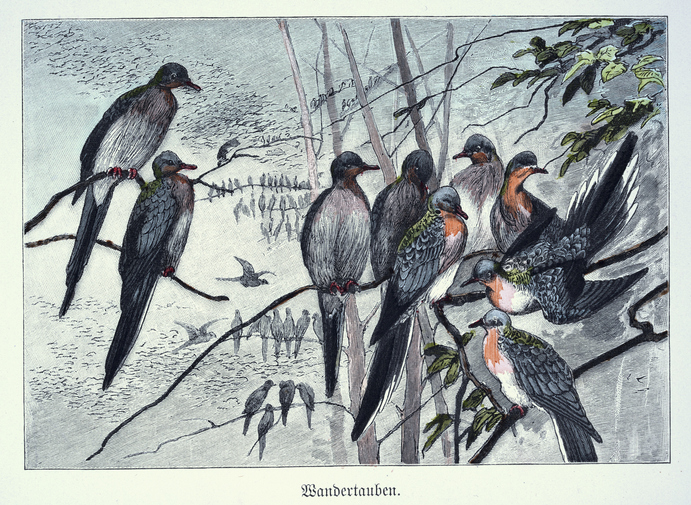
What is a passenger pigeon?
Not to be confused with a carrier pigeon, a passenger pigeon is a species of pigeon with migratory characteristics. Breeding mostly around the Great Lakes in North America, the passenger pigeon was able to fly speeds of up to 100 kph - exceptionally fast for a pigeon.
With bright colours, a little like the related Mourning Dove (Zenaida macroura), the passenger pigeon was larger than most pigeon species seen today. They lived in huge social colonies, often with around 100 nests in a single tree.
Why did passenger pigeons die out?
There's rarely just one reason why a species becomes extinct. For the passenger pigeon, the main factor was the loss of forests. About half of the USA's native forest was felled by 1872, for firewood, house construction and to clear land for agriculture, thus removing half of the species' habitat.
- Woodpigeon guide: species facts, how to identify, and how they can eat so much
- What is the most intelligent bird?
Passenger pigeons were a good source of meat, with young, flightless pigeons easy to kill. In 1900 Congress passed the Lacey Act as a response to the decline of the passenger pigeon. It was the country's first wildlife law and prohibited the trade of illegally killed animals. The endangered species act was passed in 1966. A campaign to try to bring back the passenger pigeon began in 2012, which could see the creation of a bird with all the genes of the passenger pigeon.


