
For the first time, Pampas foxes have been documented clambering into trees and hunting a species of raptor known as the chimango caracara.
The behaviour, observed near the city of Santa Rosa in La Pampa province, Argentina, was caught on camera as part of a long-term study on chimango caracara populations in the South American country.
The cameras captured two predation events in which Pampas foxes – South America’s most abundant wild canid – climbed trees, entered the nests and removed chicks.
The observations, published in the Journal of Raptor Research, shed light on the predatory behaviour of foxes – in particular the role they can play as nest predators of arboreal birds.
Foxes are common ground-nest predators; in South America, the crab-eating fox is the most frequently reported nest predator among foxes. Next on the list is the grey fox (or gray fox), followed by the Pampas fox and the Andean fox.
Yet, prior to this study, South American foxes had not been documented preying on the nests of tree-nesting birds. This is striking given the foxes’ wide distribution, abundance and co-occurrence with many bird species. These include the chimango caracara, a medium-sized raptor ranging from Peru to Argentina.
The authors have been studying suburban chimango caracaras in a long-term research project since 2008. “Despite being one of the most common raptors in southern South America, little is known about [chimango caracara] nest predation,” they say in the study.
As part of the project, the team set up camera traps at a breeding colony on the outskirts of Santa Rosa. Positioned 50–60cm from the nests, the cameras took a photograph every 30 seconds. This sequence of images provided an ongoing record of nesting activity at each sampled nest.
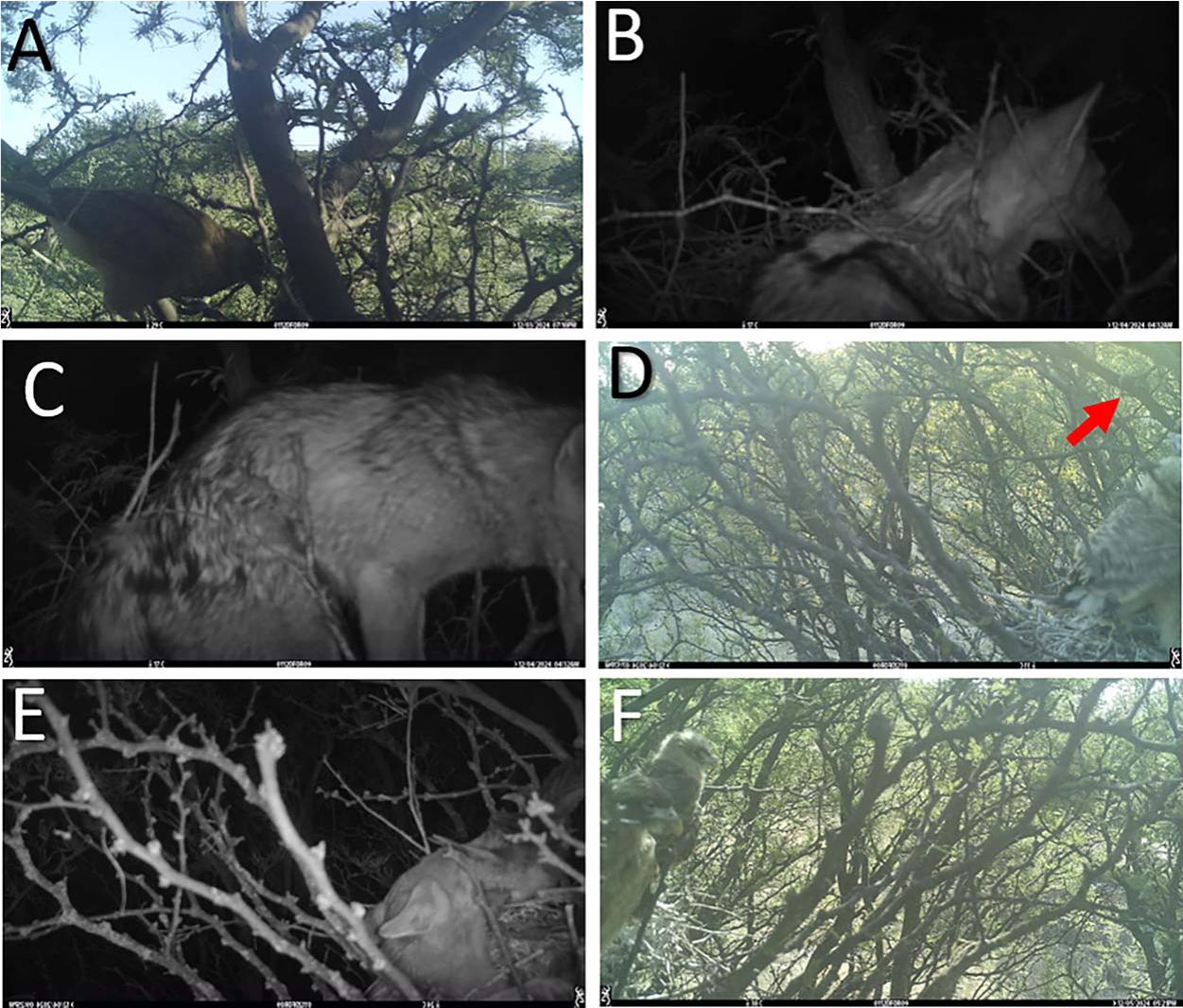
It was in December 2024 that the cameras recorded the two Pampas fox predation events.
The first predation involved a 3.2m-high nest that contained three 10-day-old chimango caracara nestlings. The camera captured a Pampas fox preying on all three nestlings.
The second nest stood 4.25m above ground level and contained three 20-day-old nestlings when the Pampas fox attack occurred. On this occasion, a fox entered the nest and preyed on one chick. The other two survived the attack.
The researchers do not know what prompted the attacks or whether the same fox was responsible for both. “If it was the same fox, we do not know why all nestlings were consumed at nest 1, but only one was consumed at nest 2,” they say. They suggest that the first nest’s lower height and its smaller, less mobile nestlings offer one possible explanation for the different outcomes.
“The observations raise broader ecological considerations for the demography of tree-nesting birds,” say the authors. “If fox populations increase stemming from ecological processes and interactions, the potential impact of foxes on nesting birds could be significant and jeopardise species persistence in suburban environments.”
The authors call for future studies to examine how changes in fox abundance might affect the breeding success and community structure of different bird species.
Find out more about the study, published in the Journal of Raptor Research.
More wildlife stories from around the world
- In the 1980s, California condors went extinct in the wild. 7 were just released near the California-Oregon border
- Scientists discover bald eagle nest on banks of Michigan river – and are stunned at what they find inside it
- Gigantic 10ft-wide raptors released in Patagonian mountains
- Rare 9ft-tall 'camel birds' released into Saudi Arabian desert
Top image credit: image adapted from Luis Cueva et al., Journal of Raptor Research 2026, under the CC BY-NC-ND 4.0 license.


