
Mantis shrimp may look like a hybrid of a praying mantis (at the front) and a shrimp (at the back) but these creatures are much more than just a mash up of body parts.
They’re also the proud owners of the most complex eyes in the animal kingdom and an impressive claw that can deliver the world’s fastest and most powerful punch. There are thought to be around 450 species of mantis shrimp in tropical and subtropical waters around the world. The prismatic peacock mantis shrimp is the most famous of them all.
- Mantis shrimp have the most complex eyes in the animal kingdom. Here’s why
- "It delivers a fatal stab with a barbed tip that impales the prey ready to be dismembered..." The world's fastest, deadliest punch
- Devouring prey alive and biting off a mate’s head – these 9 praying mantis photos are jaw-dropping
Most species of mantis shrimp live in burrows which they dig out of the soft seabed using their massive front claws.
Scuba divers may be familiar with the sight of mantis shrimp peering out of their burrow. This is much more common to see than an individual scuttling across the seafloor because these crustaceans spend most of their lives in their home base.
Their burrow offers shelter, protection from predators (despite their tough shell, larger predators such as octopuses and sharks do try to take them on) and a safe place for their eggs. Only important activities like hunting and mating tempt them to leave their sanctuary.
Different species employ one of two key hunting tactics: spearing or smashing their prey. Smashers typically go looking for their victims while spearers wait at home until something tasty comes close enough for them to pounce. “To hunt, these shrimps often dig themselves into shallow, u-shaped burrows and remain almost completely still until an unsuspecting victim passes by,” writes National Marine Sanctuary Foundation on its website.
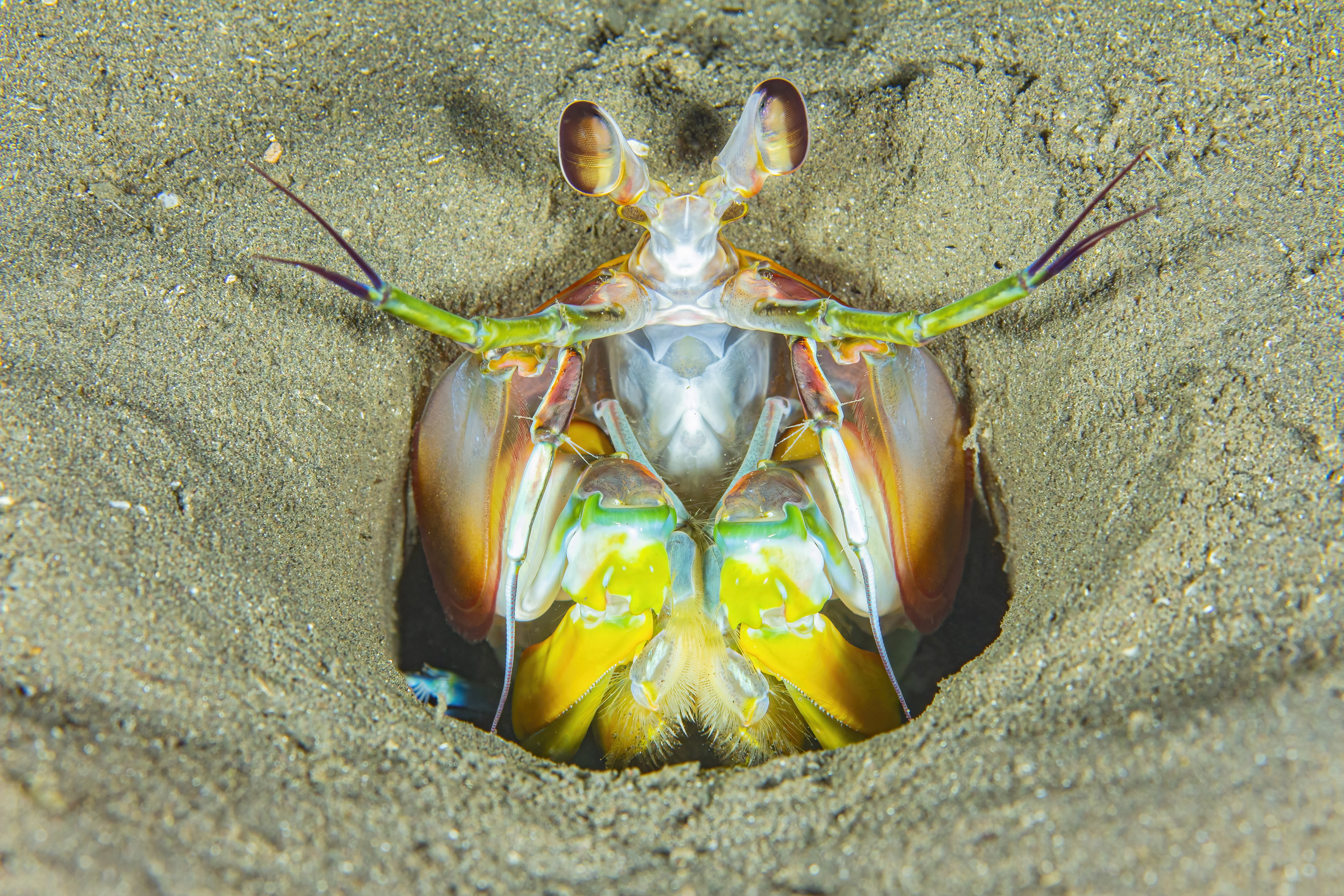
When scientists watched zebra mantis shrimp (which are spearers) hunting, they observed how important these burrows were. “Prior to a strike, an individual’s eyes were visible peeking out of the burrow entrance,” write the authors of a 2012 study in The Journal of Experimental Biology. “When the prey was within striking range of the burrow, the individual would lunge out of the burrow such that the abdominal segments were visible and then it would snare prey.”
Spearers sometimes create a trap door out of mucus and cover it with sand to make them harder to spot.
Smashers tend to forage further from home. Rock mantis shrimp (Neogonodactylus genus) can travel around four metres from home – impressive considering their diminutive size: up to around 7cm in total.
Knowing how to get home is vital because these territorial animals can sometimes live within 10cm of a rival. “Due to the aggressive territoriality Neogonodactylus (and many other stomatopods) exhibit when defending their burrows and the powerful weaponry they possess, accurate navigation back to the correct home burrow is an important task,” write the authors of a 2020 Current Biology study.
California mantis shrimp (Hemisquilla californiensis) use sound to warn others away from their homes. This species makes a low frequency rumble like an elephant to tell intruders to back off. And if they want company, this species makes their den look pretty. “During the mating season, males decorate the edges of their burrows with shells, presumably to attract female,” according to the authors of a 2011 Aquatic Biology study.
- “It’s effectively ripping apart the water.” It's only an inch long but this creature creates shockwaves of over 200 decibels
- Can a person outrun an elephant?
To find out what these burrows are like under the ground, marine scientists made polyester resin casts of the burrows of spot-tail mantis shrimp (Squilla mantis) and reported their findings in the journal Marine Ecology.
These U-shaped dens had two entrances (one slightly larger than the other) and they were often more than one metre long, around 26cm deep and had a steep downward slope of around 74° when led to the central den. This horizontal plateau wasn’t always right in the middle; sometimes it was closer to one of the entrances. The scientists cast 13 burrows and were surprised to find caridean shrimp present in five of them.
They also watched how mantis shrimp excavated their tunnels from sand or mud in an aquarium setting.
“A typical digging cycle consisted of the animal somersaulting from a head-up to a head-down posture,” they write in the study. It used its swimming legs (pleopods) to dig down, grabbed a bundle of sediment with its front limbs (maxillipeds), did a little somersault at the bottom and came out headfirst, tossing the sediment outside the burrow. Sometimes it kneaded the walls of its burrow with its maxillipeds, which could be to compress the sand so the den doesn’t collapse.
Some mantis shrimp can construct a new burrow in just half an hour.
Depending on the species, either mantis shrimp live alone in these tunnels or bunk up in pairs. Monogomous zebra mantis shrimp couples live together for their whole lives.
When they grow, mantis shrimp can get too big for their burrows and need to move onto a larger abode. Their abandoned dwellings are often put to good use by other marine animals, which move into the vacated premises themselves.
Top image: Peacock Mantis Shrimp (Odontodactylus scyllarus) standing on the sand. Photographed in Anilao, Philippines. Credit: Brent Durand/ Getty Images
More wildlife stories from around the world:


