
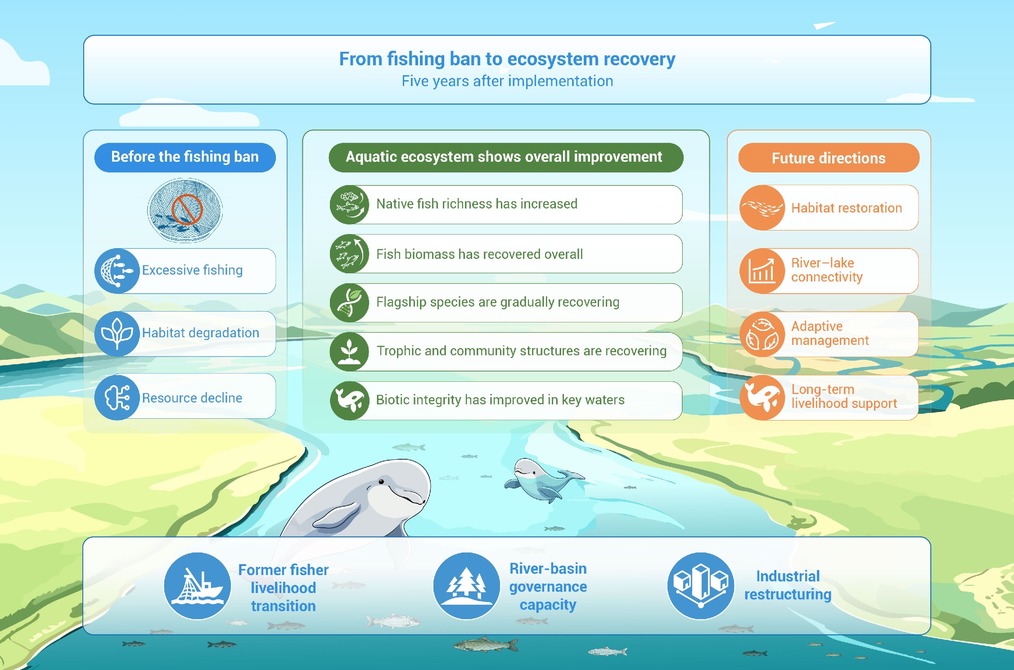
Midway through a ten-year suspension of commercial fishing in the Yangtze River basin, survey work in the area has found signs of ecological recovery, with fish now larger, and occurring with greater diversity and abundance.
The assessment, published in the journal The Innovation Water, collated data from more than 100 aquatic-life monitoring stations, and included surveys of former fishers and fishery industry statistics.
Among the findings was the doubling of fish stock abundance and an increase in mean fish length from 21.7 cm in 2021 to 24.3 cm in 2024. However, the lead authors of the report, Qin Li, Jia Kuang and Juan Du, note that the recovery is not geographically consistent and that factors beyond the cessation of fishing must be tackled in the future.
“Though the fishing ban can reduce direct fishing pressure,” the authors observe, “underlying constraints such as habitat fragmentation, altered hydrological regimes, limited river–lake connectivity, extreme climate events, and reproductive bottlenecks of threatened species remain unresolved.”
The Yangtze River is the third longest river in the world, rising in the Tanggula Mountains on the Tibetan Plateau and flowing, mainly eastwards, for 3,900 miles before meeting the East China Sea.
The river has long been an important source of food, but as the population of China expanded through the 20th century, so the impact on fish stocks increased. Fishing records maintained since 1954 showed a severe decline across seven decades, with five key causes identified; overexploitation of resources, habitat destruction, pollution, climate change and the presence of invasive species.
In 2021 a ban on commercial fishing was implemented by the Chinese Government, with 231,000 fishers instead supported through alternative employment, pensions or social assistance. Those individuals whose livelihoods were impacted have been monitored as part of the study, and since 2022, household income per capita for the former fishers has approached or exceeded the local average.
While fish stocks are showing signs of recovery in the five years since the suspension of commercial fishing, so too are other aquatic species such as the critically endangered Yangtze finless porpoise (Neophocaena asiaeorientalis).
The report recommends that for such recovery to continue, the next five years should focus upon habitat restoration and adaptive management.
“The Yangtze case thus highlights that mega-river conservation must move from single-pressure control toward integrated socio-ecological governance,” the authors conclude. “Such an integrated governance approach may help sustain ecological recovery, support affected communities, and accommodate spatially heterogeneous river-basin conditions.”
More wildlife stories from around the world
- Megafish of the Mekong River are shrinking – and this is why
- Sturgeon found in "unprecedented" numbers in Georgian river
- This “unique and crazy” prehistoric fish is the size of a door. Now thousands are being released into a remote Swedish river
- 1,000 giant fish are mysteriously circling in this South African estuary. Scientists may finally know why
Top image: Yangtze River. Credit: martinhosmart/Getty Images


