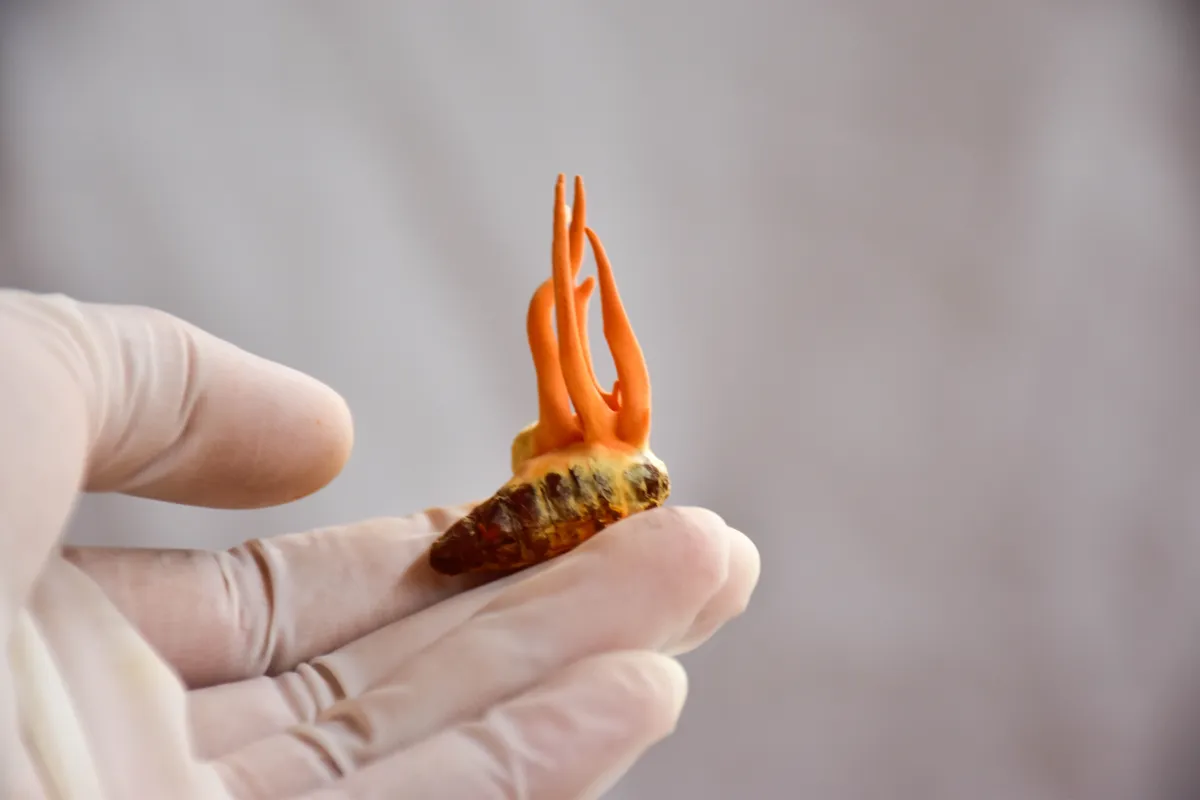
The weevil beetle Lixus subtilis is a persistent problem for farmers. It’s known for tearing through crops – particularly sugar beets – across large parts of the world, including Central and Eastern Europe, the Caucasus, Anatolia and China.
- There’s a parasitic ‘Alien’-like wasp that bursts out of its bug host – and it could save modern crop farming
- At 7cm long it's not only the biggest wasp in the world but the deadliest thanks to its 6mm stinger – just how deadly is it?
So, when researchers set out to map its natural predators in the sugar beet fields of Yining City and Qapqal Xibe Autonomous County in China’s Xinjiang region, they were hoping to find something that could inform pest control efforts.
The collaborative study involved researchers from Xinjiang University in China, the French Agricultural Research Centre for International Development (CIRAD), and the Zoological Institute of the Russian Academy of Sciences.
Through careful collection of damaged sugar beet petioles (the offshoot that connects a leaf to the main stem’s nodule) and rearing parasitoid-infected beetle larvae in a laboratory, they made two important discoveries.
First, they confirmed a known predator: Eurytoma curculionum, a wasp already documented by science that parasitises weevil larvae – though this was its first confirmed recording in China.
Then things got stranger. Digging into the same fields, the researchers turned up a wasp species that had never been documented anywhere – and it doesn’t attack the weevil at all. Instead, it parasitises E. curculionum.
Many wasp species are parasitoids: parasites that eventually kill their host. Females lay their eggs inside the larvae or eggs of various insects. The wasp larvae then eventually bursts from the host’s body as a fully developed adult, Alien-style.
Hyperparasitoids in the field
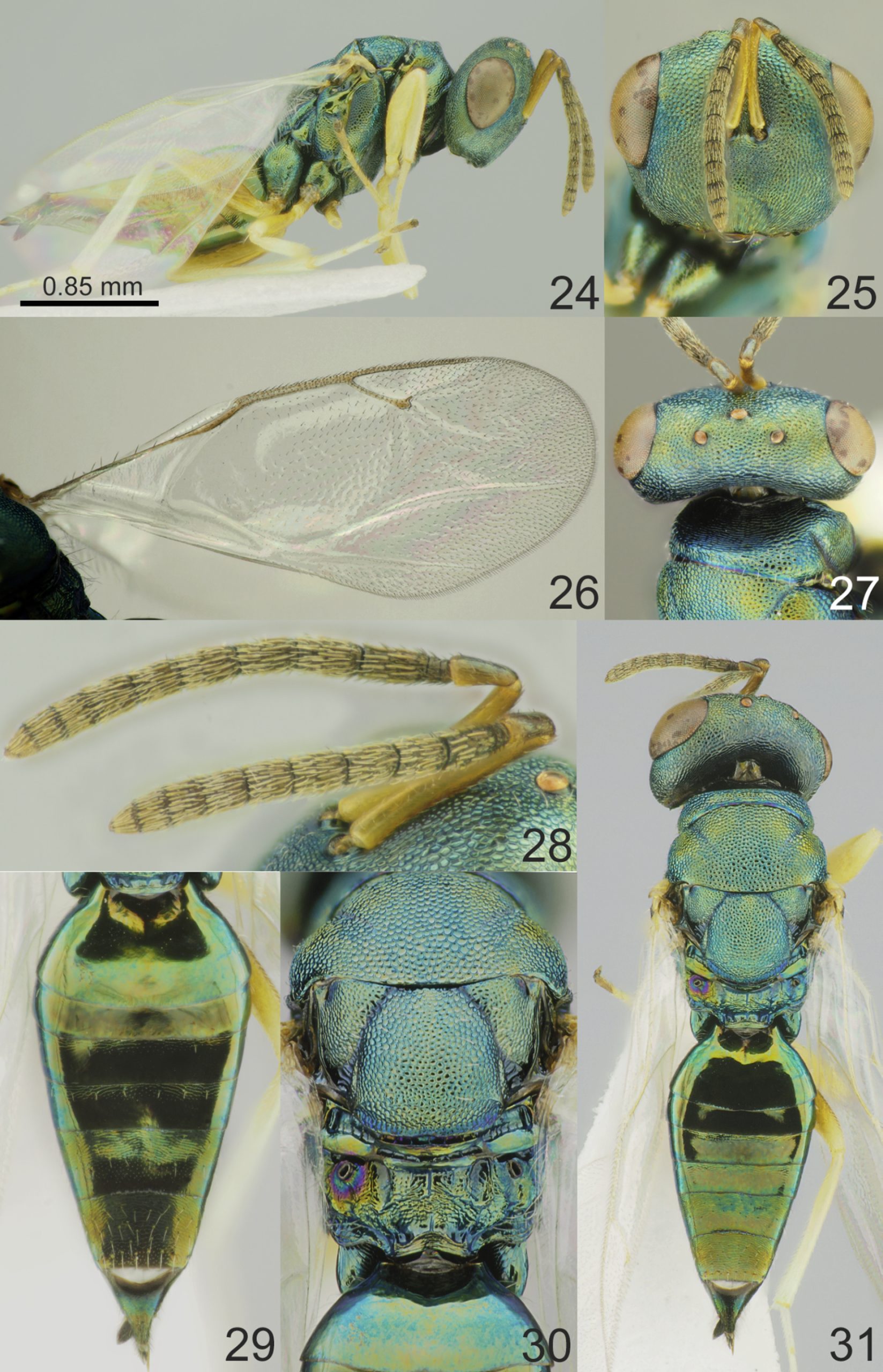
This new species (Chlorocytus papahemii), a small, iridescent-coloured wasp belonging to the Pteromalidae family, takes being a parasite to another level. It’s a hyperparasitoid – a parasite of a parasite. So, the pest is preyed on by a parasitoid wasp, which is in turn preyed on by this newly-discovered species, placing it at a fourth trophic level of the food chain.
This new wasp is crucial for pest control, since hyperparasitoids can kill off the very wasps farmers are relying on to keep weevil numbers down – killing off the natural check before it can do its job.
The researchers named the new species Chlorocytus papahemii, in honour of Ernest Hemingway – specifically a nod to the author’s well-known nickname “Papa.”
The study, published in the open-access journal ZooKeys, lays out detailed descriptions of both wasps, giving researchers a clearer picture of the weevil’s full food chain – and a better chance at keeping it in check.
Read the full findings here.
Top image: Chlorocytus papahemii Tselikh & Li, sp. nov., female, holotype. Credit: Li et al., 2026.