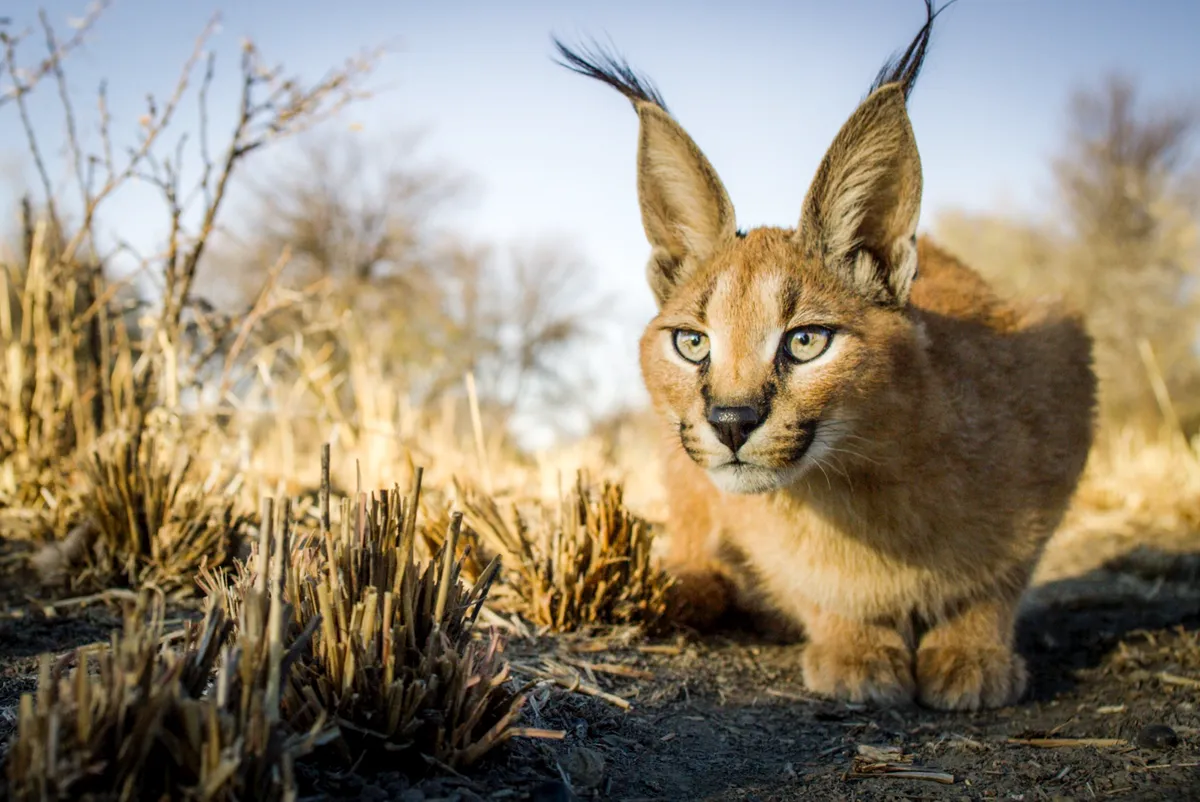
The jaguarundi is one of the strangest-looking cats in the Americas. Long-bodied, short-legged and sleek, it has more than a hint of otter or weasel about it, which explains why it is sometimes called the otter cat.

Yet this elusive hunter is very much a felid, and a close relative of the puma. Found from northern Mexico right into South America, the jaguarundi is unusual not only for its shape but also for its habits, being more active by day than many of its feline neighbours.
- Odd-looking, tiny killers, expert underwater swimmers and the grumpiest cats: 10 weirdest wild cats in the world
- Why cats have slit-shaped pupils, why some cats roar and some purr and the feline that can leap 9 metres – 19 wild cat facts that will boggle your mind
Where do jaguarundis live?
The jaguarundi ranges from northern Mexico through Central America and across much of South America east of the Andes, reaching as far south as central Argentina. Historically, it also occurred in southern Texas, though it is now thought to have disappeared from the USA.
This cat is remarkably adaptable. It lives in forest, desert, dry scrub, savanna and mangroves. In open country it tends to favour places with vegetative cover, such as thickets or cacti, and it is often found near running water. Although most common in lowland habitats, it has been recorded at elevations of up to 3,200m in Colombia.
What does a jaguarundi look like?
The jaguarundi has an elongated body, relatively short legs, a small flattened head, a short snout and a long tail, giving it a low-slung, streamlined profile.
Unlike many neotropical cats, the jaguarundi does not have spots or rosettes as an adult. Instead, its coat is usually plain, with three main colour morphs: brownish-black, grey and yellowish red. Kittens may briefly show spots, and different colour forms can occur in the same litter.
How big are jaguarundi

Adults measure about 36cm at the shoulder and weigh between 2.5-7.6kg.
Is it related to the jaguar?
Despite their very similar names, no. The jaguarundi is more closely related to the puma than to the jaguar, or other neotropical wildcats. Together with the cheetah, these cats belong to what biologists call the puma lineage, an ancient branch of the cat family tree.
- Meet the fisher cat, which is not a cat and doesn't eat fish
- What’s the world's smallest cat? Meet the tiny felines barely bigger than a ruler
What does it eat?
The jaguarundi is an efficient predator of small prey and does much of its hunting on the ground. Its diet includes rodents, reptiles, frogs, arthropods, ground-feeding birds and even fish occasionally. It will also take larger prey when it can, including rabbits, armadillos and domestic poultry.
What makes it unusual among small tropical cats is its timetable. While many of its feline neighbours are most active at night, the jaguarundi is often active during the day and in the evening.
Can it climb and swim?
Yes to both. Although it is mainly terrestrial, the jaguarundi is a capable climber, aided by it long tail. It is also known to swim and has been recorded crossing rivers. This agility and adaptability helps it to live in such a wide range of habitats.
Does it live alone?
The jaguarundi is usually solitary, but sometimes seen in pairs. These may be a mating couple or females with older young. Individuals have vast home ranges and occur at low densities. They are known to cover up to 7km per day.
However, when these cats do encounter one another they are surprisingly vocal. Researchers have recorded at least 13 different calls, including purring, whistling, chattering, yapping and even a bird-like chirp.
How do jaguarundis breed?
Females are sexually receptive several times per year so the jaguarundi does not have a peak breeding season. After a gestation of around 70-75 days, the female gives birth to a litter of one to four kittens in a sheltered den, such as a dense thicket or hollow tree.
The kittens are well furred at birth and can show spots on the underside, which act as a camouflage but fade as they grow. They begin eating solid food at around four to five weeks and continue suckling until they are a couple of months old. Jaguarundis generally reach sexual maturity at between one and three years of age.
How long do jaguarundis live
Their average lifespan is between 10-20 years
Do jaguarundis face any threats?

The jaguarundi is listed by the IUCN as Least Concern, but that does not mean it is secure everywhere. Populations are thought to be declining in many parts of its range, mainly because of habitat loss and fragmentation, which can in turn lead to road collisions.
It is perhaps at most risk in Brazil where industrial agricultural expansion is dramatically altering its favoured savanna habitat. Human persecution and exploitation is another issue; in some areas jaguarundis are hunted for food, medicine or in retaliation for taking poultry. The IUCN Cat Specialist Group notes “an urgent need for further research on its ecology, demographics and natural history in order to identify threats and their impacts, as well as to ensure adequate conservation measures can be implemented.”