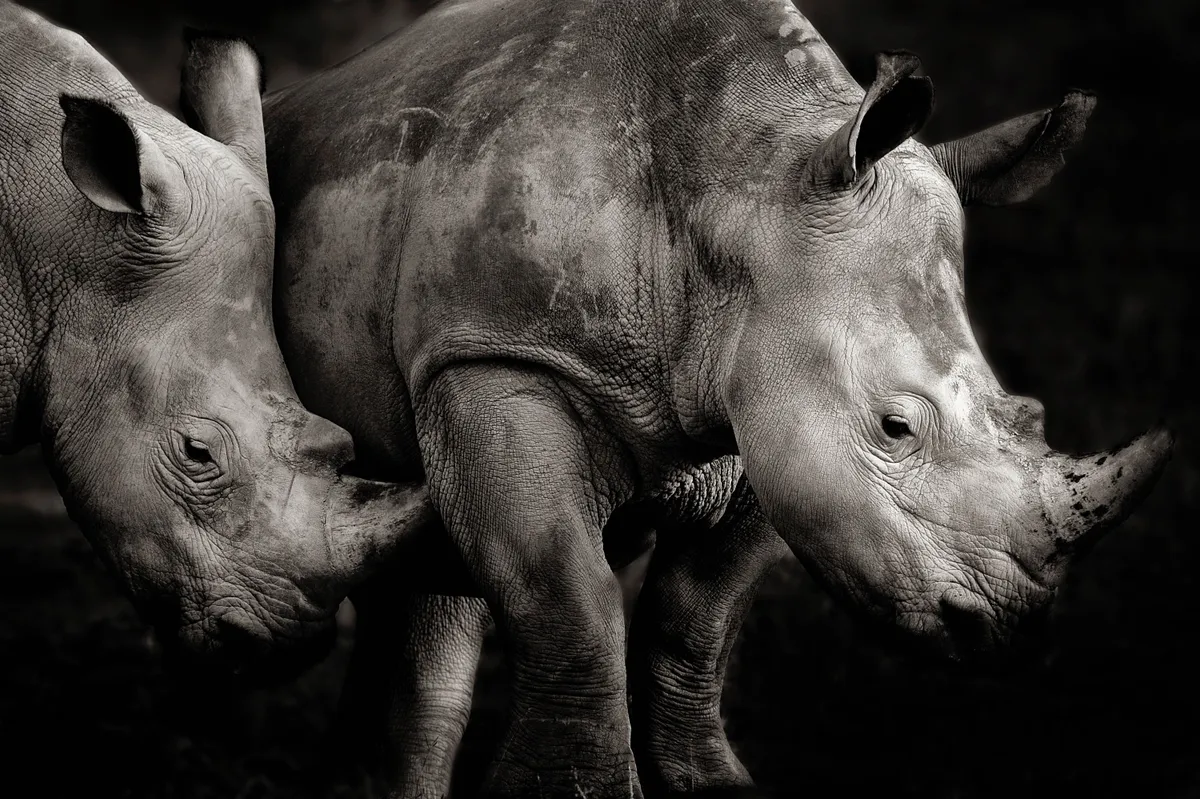
There are five surviving species of rhino. They’re all built like tanks, with robust frames, thick skin and powerful horns.
The white rhino (which comes in northern and southern subspecies) is the biggest. The largest bulls weigh up to 3,500 kg, making them as heavy as a standard 4-to-6 berth motorhome. Even the smallest species, the Sumatran rhino, boasts an impressive maximum weight of 1,000 kg, equivalent to two grand pianos.

- 9 extraordinary rhino photos reveal just how powerful and intimidating these animals can be
- Rhino guide: how to identify, where to see and why they're endangered
By and large, rhinos are peace-loving herbivores. Due to their heft, adults have no natural predators. They spend most of their time mooching about on their odd-toed feet (rhinos have three toes per foot, placing them in the “odd-toed ungulate” club, alongside horses and tapirs), munching vegetation.
They’re also famously short-sighted. Anything further than 15 to 20 metres away is a blur, so if they become startled by a sudden noise (say, a starting pistol) or an object that appears suddenly (say, a human sprinter), they will often react by charging.
- Is it really safe to airlift rhinos by their ankles, dangling two-tonne giants in midair?
- Why rhinos have horns
This is when the animals reach their top speeds. They may be chunky, but they are surprisingly deft on their feet. Adult white rhinos can reach speeds of up to 40 miles per hour, black rhinos can reach up to 35 miles per hour, and even Sumatran rhinos can clock up a respectable 25 miles per hour.
It doesn’t last long, however. Rhinos are sprinters rather than endurance athletes. They can run at top whack for a few hundred metres at most, before tiring and putting on the breaks.
Casting aside the prowess of God-like athletes, such as Usain Bolt and Florence Griffith-Joyner, most ‘mortal’ adults can sprint at speeds of up to 15 miles per hour. So, even though rhinos can’t run fast for long, they can still leave most humans for dust.
Which raises the question, what to do should you find yourself having to outrun a charging rhino? Here, advice is mixed.
First, try not to get yourself into the situation in the first place. What were you thinking?
Second, take advantage of their myopia. Duck behind a large obstacle, like a rock or a tree. Alternatively, if there are no obstacles, run in a zig-zag pattern. Because of their bulk, rhinos aren’t so good at pivoting or changing directions quickly. It could buy you valuable seconds of escape time.
Third, and this is a high risk strategy, stay calm and hold your ground. According to the Rhino Resource Center, most rhino charges are bluffs, designed to intimidate but not escalate. If you’re lucky, the rhino will veer off course at the last moment, leaving you shaken, stirred and determined never to cross paths with a charging rhino again.
- "Both are large, heavy, beefy animals with thick skin, pillar-like legs and enormous heads..." How do rhinos and hippos differ?
- "The dreaded call came: a rhino cow was killed for her horns, and her calf was missing..."
- “The huge shadow of an irate black rhino emerged. My only option was to pretend to be a tree.”
Top image: James Warwick / Getty Images