
Warning: this story contains an image that some may find distressing
Among the fascinating behaviours observed in chimpanzees and bonobos, infant corpse carrying is one of the more unusual ones. But mothers will sometimes carry their infants for days, weeks and even months. One chimpanzee in the Mahale Mountains, Tanzania, was recorded carrying her deceased infant for perhaps as long as 126 days.
Now a study, published in the journal Biology Letters, has explored why this behaviour might vary among primate mothers. Researchers from the University of Oxford, UK, analysed 83 recorded cases of the behaviour spread across 15 distinct western chimpanzee, eastern chimpanzee and bonobo communities.
“Historically, much of what we know about animals reacting to deceased group members has come from isolated, mostly anecdotal observations rather than structured, cross-site research,” say the study’s authors, Thomas A. Püschel and Reece Hammond.
“So, shedding some light on the drivers of this fascinating behaviour in chimps and bonobos was genuinely very exciting!”
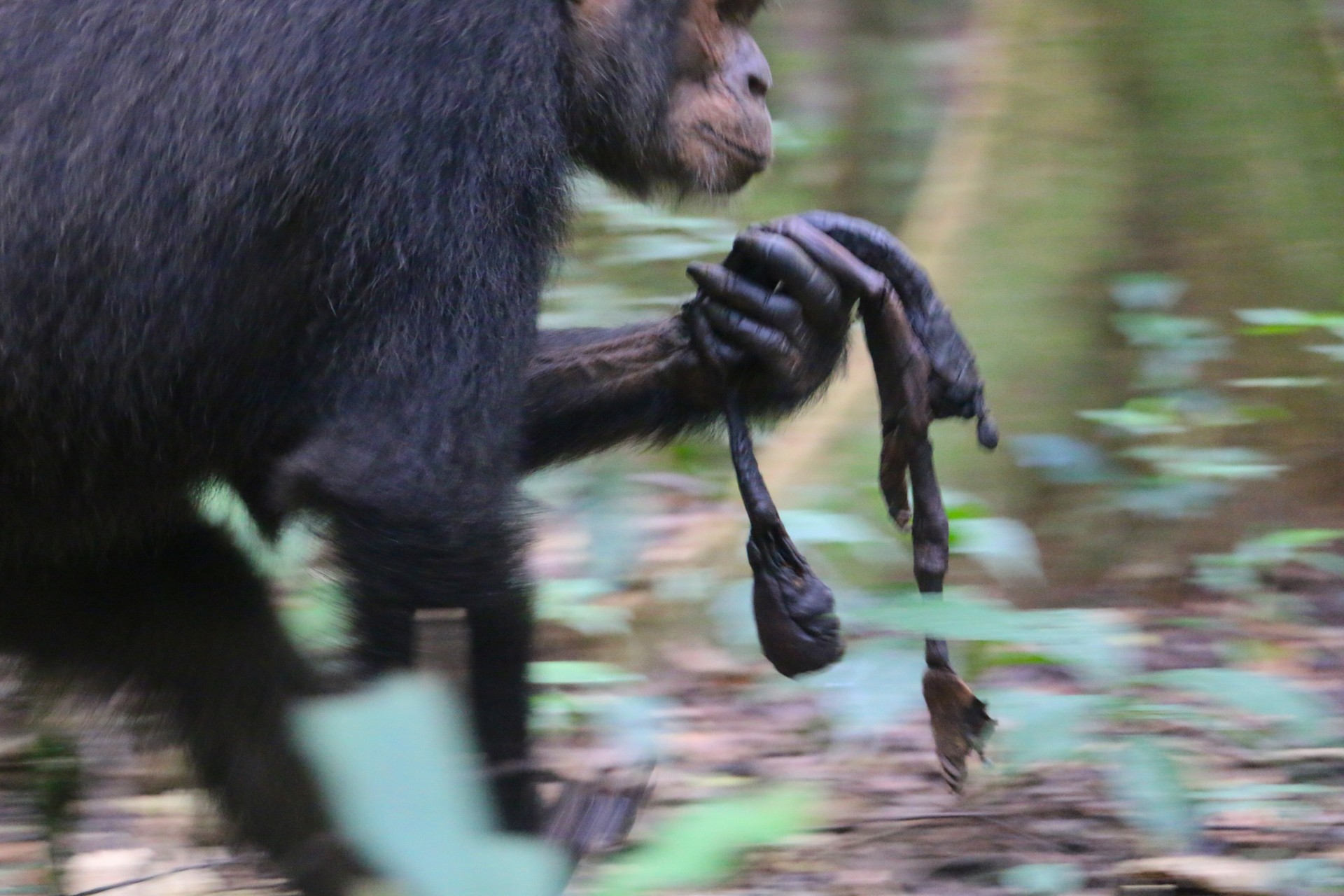
Do primates understand death?
The researchers note that “infant corpse carrying is best explained by maternal attachment and the infant’s cause of death”. Older infants were carried for longer, with the researchers suggesting that the behaviour may arise as a leftover of prolonged and intensive care – this doesn’t simply ‘switch off’ overnight.
Mothers carried infants for significantly longer following disease-related deaths in comparison to infanticide. No other cause of death category (such as accidental, injury or premature) showed significant association with the duration of the behaviour.
The scientists note that male primates may kill infants and if mothers continue to carry these infants, they may be exposed to more aggression. Using this interpretation, carrying after disease-related deaths carries less social risk for the mother within the troop.
“The emphasis on the strong mother-infant bond in driving this costly death-related behaviour in our closest living relatives may provide an evolutionary starting point for our own species’ extraordinary relationship with death,” explain Püschel and Hammond.
However, they conclude that none of the patterns observed provide clear evidence that mothers recognise death as an irreversible biological state in the way that humans do. Despite chimpanzees and bonobos being our closest living relatives, this suggests that the mental frameworks required to recognise death’s finality emerged after we diverged from our shared ancestor approximately 2.3 million years ago.


