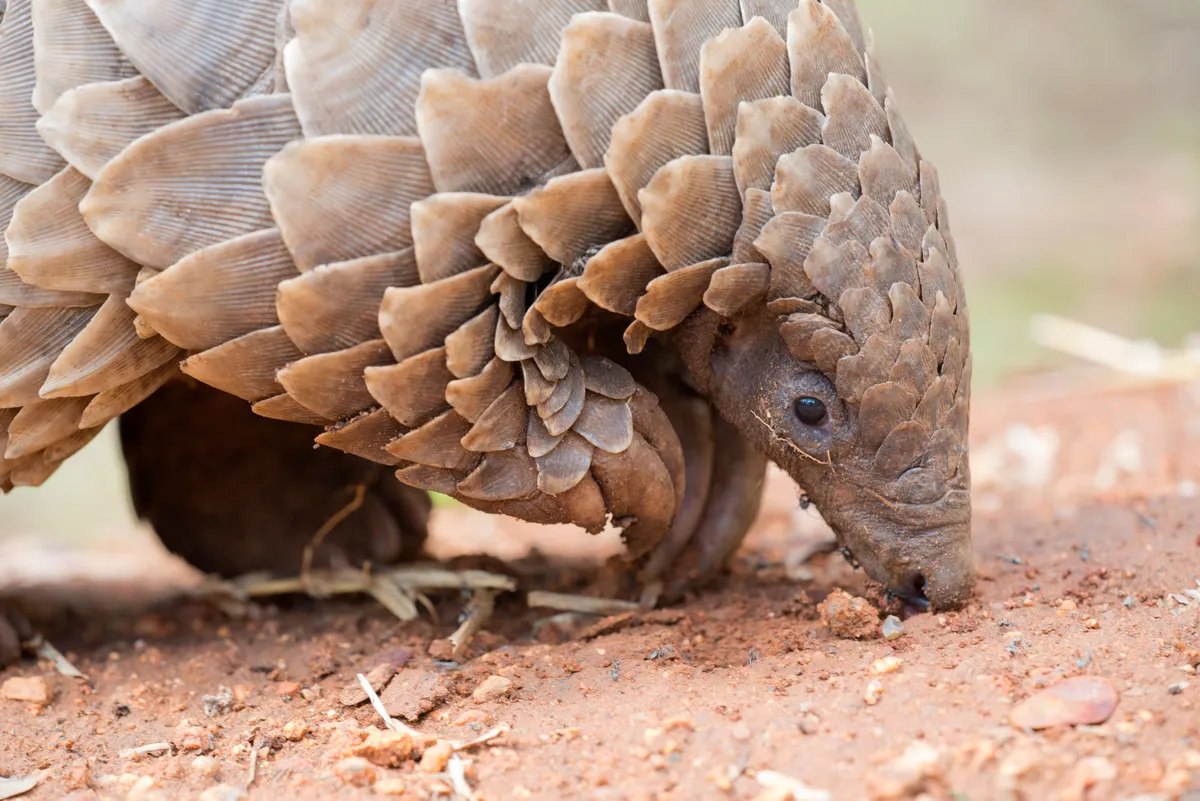
When curled up into ball – its defensive position to deter predators – the pangolin’s overlapping scales make it look similar to a pinecone.
And it’s these scales that have earned it the moniker of the most trafficked mammal in the world, as pangolins are illegally poached for them. This has led them to being at high risk of extinction.
Now, a global team of experts have described an unrecognised species of Asian pangolin: Manis aurita, which is found among the trees of Nepal and northern India.
Not only does this improve understanding between the different species, but it may help prevent poaching before it even happens.
Eight species of pangolin have been long-recognised and can be broadly split into those that live in Africa, and those in Asia. (Manis mysteria was identified as a new species in 2023 through genetic analysis, although it hasn’t been seen alive.)
Researchers at Nepal’s Pokahara University first documented evidence more than five years ago that suggested Chinese pangolins (Manis pentadactyla) weren’t all the same.
One population of the pangolins lives primarily in China, whereas the other is found in the foothills of the Himalayas, spreading into parts of Nepal, India, Bhutan and Myanmar.
The Himalayan species was given the new name Manis indoburmanica: the Indo-Burmese pangolin.
DNA puzzle
Anderson Feijó (the assistant curator of mammals at Chicago’s Field Museum) and his colleagues were in the middle of a decade-long analysis of the pangolin family tree, using DNA and physical traits to classify the different species and their evolutionary history.
They read about another species, Manis aurita, that had been described in 1836 but had been subsequently downgraded to a subspecies of Chinese pangolin.
“This left us with a core taxonomic riddle: what’s the relationship between indoburmanica and aurita? Are they the same species or different species?” says Kai He, one of the paper’s co-authors and a researcher at Guangzhou University, in south China.
“The ultimate, most thrilling piece of the puzzle came from the Natural History Museum in London. Thanks to their incredible expertise and assistance, the team successfully sequenced the DNA directly from the historical type specimen of the Nepalese subspecies (aurita). This specimen dates to 1836, making it nearly 190 years old.”
The modern specimens found in the Himalayas matched aurita – meaning the species described as Manis indoburmanica should be classified as Manis aurita.
A new species
The researchers say there are subtle differences between the Himalayan pangolin and the Chinese pangolin.
“Compared to the Chinese pangolin, the Himalayan pangolin has a bigger body, a longer tail and smaller ears,” explains Feijó.
The two species are also found in different geographical regions that don’t overlap.
This taxonomic clarification can play an important role in conserving such an endangered mammal. These new DNA analyses can help conservation scientists pinpoint the exact species of pangolin being poached – just by testing their scales.

These species can then be traced back to specific regions where poaching is occurring. This clarification can also inform reintroduction efforts.
“Before, you might have introduced Chinese pangolins into Nepal, because you didn’t know the difference,” says Feijó.
“By defining the differences between the species and the limits of where each species is found, we can make better conservation decisions.”
The finding is the culmination of years of work from multiple organisations.
“The confirmation of Manis aurita as a valid species demonstrates the importance of long-term research, international collaboration and museum collections,” adds Narayan Koju, the study’s first author and a researcher at Pokhara University.
“Most importantly, it provides a strong scientific basis for conservation planning, wildlife forensics, and efforts to protect one of the world’s most trafficked mammals from extinction.”
Read the full paper here: Revalidation of Manis aurita based on integrative genomic and morphological evidence