
Porcupines and hedgehogs are both mammals that have evolved an eye-catching defence system: a wall of sharp spikes across their body. But apart from that, the two species have distinct diets, behaviours and appearances.
What are the similarities between porcupines and hedgehogs?
The obvious similarity between porcupines and hedgehogs is that they are both covered in spines which are used for defence against predators. However, the spines work differently in each animal.
Porcupines are covered in soft hair but have sharp quills on their back, sides and tail. These lay flat until a porcupine feels threatened.
Biologists once thought that porcupines could shoot their quills at predators, but this isn’t true – although the quills can detach when touched. Porcupines can also grow new quills to replace the ones they lose.
When a hedgehog feels threatened, it rolls up into a protective ball, exposing its spines to a predator. Hedgehogs have a muscle that encircles their body, from neck to rump, within which their spines are embedded. As the hedgehog curls up, this muscle (as well as several smaller ones) contracts its body parts in a similar way to a drawstring bag.
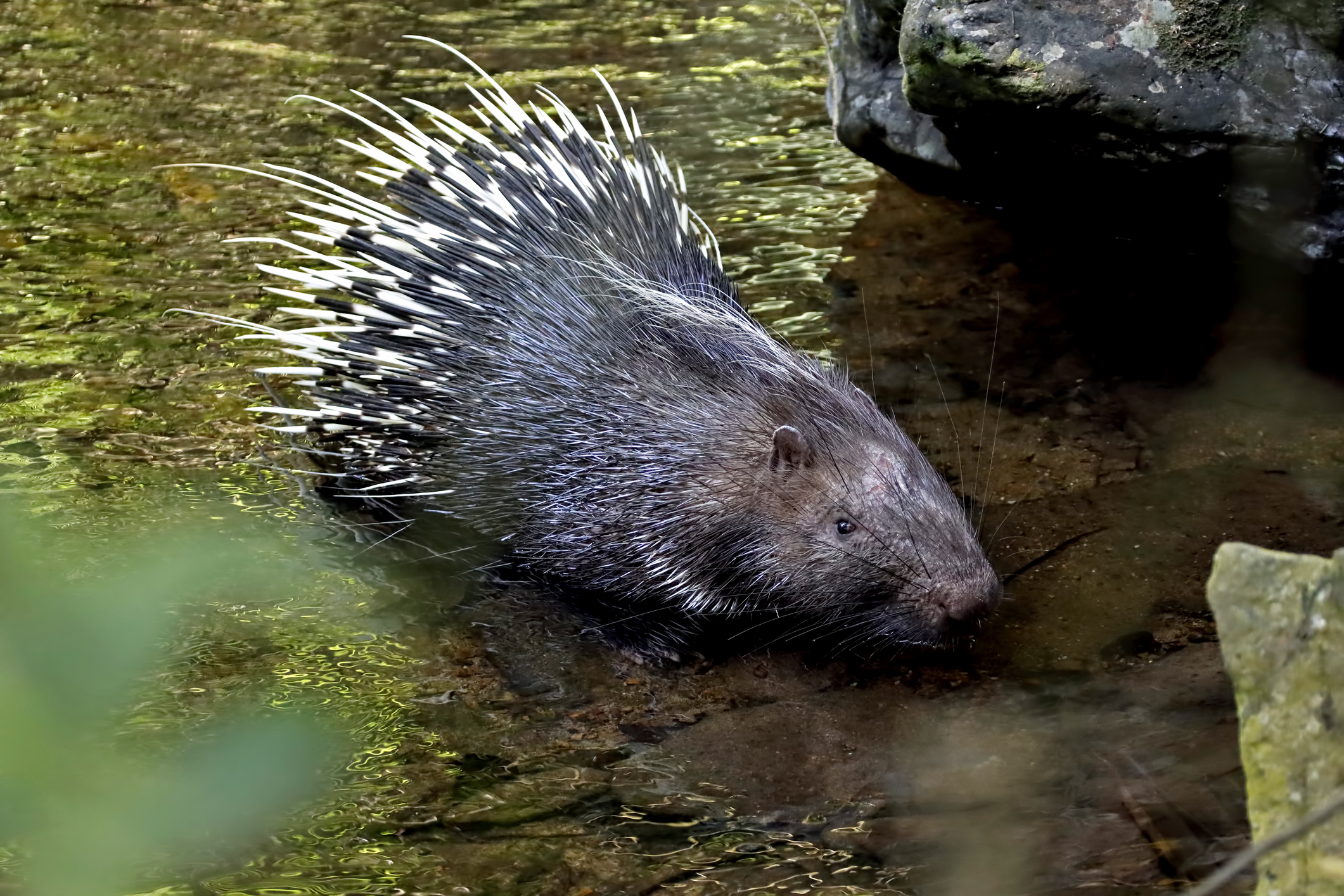
What are the differences between porcupines and hedgehogs?
The major distinction between these animals is that porcupines are rodents, whereas hedgehogs are not. Rodents are characterised by continuously growing incisor teeth on their upper and lower jaws, whereas hedgehogs have four types of teeth (incisors, canines, premolars and molars).
Hedgehogs use these teeth to eat insects, other arthropods, frogs and toads, snails, slugs, lizards, snakes, bird eggs and fallen fruit. Hedgehogs have also been frequently observed carrying out self-anointing behaviour.
During this, they lick or chew a substance or object and produce a frothy salvia, which they spread over and between their spines. Scientists currently don’t know why they do this.
Porcupines are herbivores, mainly eating plants, flowers, berries, seeds, nuts and bark. However, they have been known to gnaw on bones and antlers to obtain extra calcium and other essential minerals.
There are more than 24 porcupine species, and they can be found across North and South America, Africa, Europe and Asia. They can inhabit forests, grasslands and deserts. There are 17 species of hedgehogs which are found in Europe, Asia and Africa. The western European hedgehog has been introduced into New Zealand, where it has become an invasive species.
Hedgehogs, unlike porcupines, hibernate during colder temperatures. In deserts, they can also sleep through heat and drought in a process called aestivation (lungfish and crocodiles also do this). While porcupines don’t hibernate, they do remain in their dens during particularly cold or stormy weather.
- What is hibernation, how does it work, and which animals do it?
- Do hibernating animals need to go to the loo?
Top image: a desert hedgehog (Paraechinus aethiopicus). Credit: kristianbell/Getty Images


