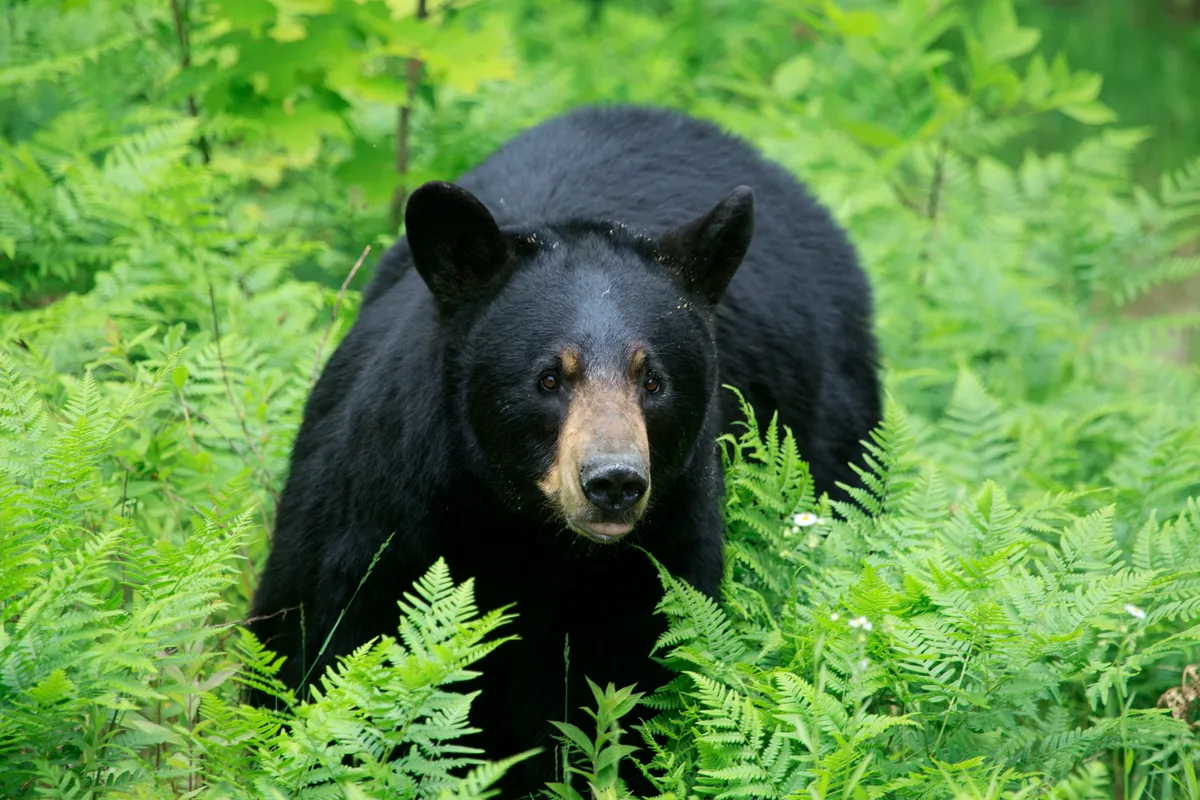
Humans have always had a dichotomous relationship with bears.
On the one hand, we see them as endearing, cuddly creatures, immortalised as objects of childhood comfort in the form of teddy bears, or as benign and often fumbling characters in TV shows and films – the fictional bear list is long and ranging, from Winnie-the-Pooh and The Jungle Book’s Baloo to Yogi Bear and the characters in Help!… It’s the Hair Bear Bunch!
- The deadliest animal you could encounter in a national park probably isn’t a bone-crushing, 300kg apex predator – it’s something much more surprising
- Can a human outrun a bear?
But another side to this relationship often comes out in art, literature, folklore and mythology. Here, the animals’ ferocity and strength is immense, and the overriding message is to give them a wide berth.
Back to real life, and in Japan, the Ussuri brown bear – a subspecies of the brown bear found across North America, Europe and Asia – is the country’s largest terrestrial mammal, with a surprisingly nuanced character.
On Hokkaido, the northernmost of Japan’s main islands, it reigns as an apex omnivore, roaming river valleys and alpine forests, feasting on salmon runs, berries and roots in a seasonal rhythm as old as the island itself.
Further south, on Honshu – home to Tokyo, and around 80 per cent of Japan’s population – its presence is more fragmented, its movements more constrained by the press of human life.
Bear attacks have been on the rise on both islands in recent years. To understand this, we must first step into the bear’s world.
Brown bears are not, by nature, aggressors. They are solitary foragers, guided by an acute sense of smell and a deep instinct to avoid confrontation. But when food becomes scarce, or when the landscape shifts in ways that favour encounters, their behaviour changes.
Across parts of northern Akita Prefecture in northwestern Honshu and Iwate Prefecture (northeastern Honshu), reports of brown bears straying into towns have become more frequent. On Hokkaido too, bears have been seen wandering through suburbs, occasionally with tragic consequences.
These are not random acts of aggression by the bears, though; they are symptoms of a deeper ecological imbalance. Japan’s forests, once rich with mast-producing trees, such as oak and beech, have, in many places, been replaced by commercial plantations.
These neat ranks of cedar and cypress may satisfy economic needs, but they offer little sustenance for a hungry bear. Add to this the increasing unpredictability of climate patterns in the shape of late frosts and poor nut harvests, and the bears are left with a simple choice: move or starve.
- What is the biggest bear in the world? Clue: it towers overs humans and weighs almost a tonne
- What is the most numerous bear in the world?
And so they move, following scent trails that lead them into a human world brimming with opportunity. Unsecured bins, fruiting orchards, even livestock, all become part of a new, risky diet. It is here, in these liminal zones between forest and town, that the ancient dance between man and bear becomes fraught.
Efforts are underway to manage the situation. Wildlife corridors, allowing bears to move through landscapes without entering human settlements, are being studied, while education campaigns encourage residents to secure food waste and understand bear behaviour.
Researchers are also tracking bear movements more closely, using GPS collars to anticipate and mitigate conflict. For me, the presence of the brown bear is also a reminder that the ‘wild’ in our homogenised lives hasn’t retreated as far as we might think.