
More than 50 researchers have collaborated to reveal how underwater acoustic enrichment (the playback of sounds from healthy reefs) could help the recovery of degraded coral reefs and their fish communities.
The University of California San Diego’s Scripps Institution of Oceanography led two studies on the topic – one focusing on coral larvae and the other on fish larvae. It says they are the first studies to field test the effects of underwater sound on both larvae simultaneously, alongside other restoration methods such as artificial settlement surfaces.
Creating the soundscape
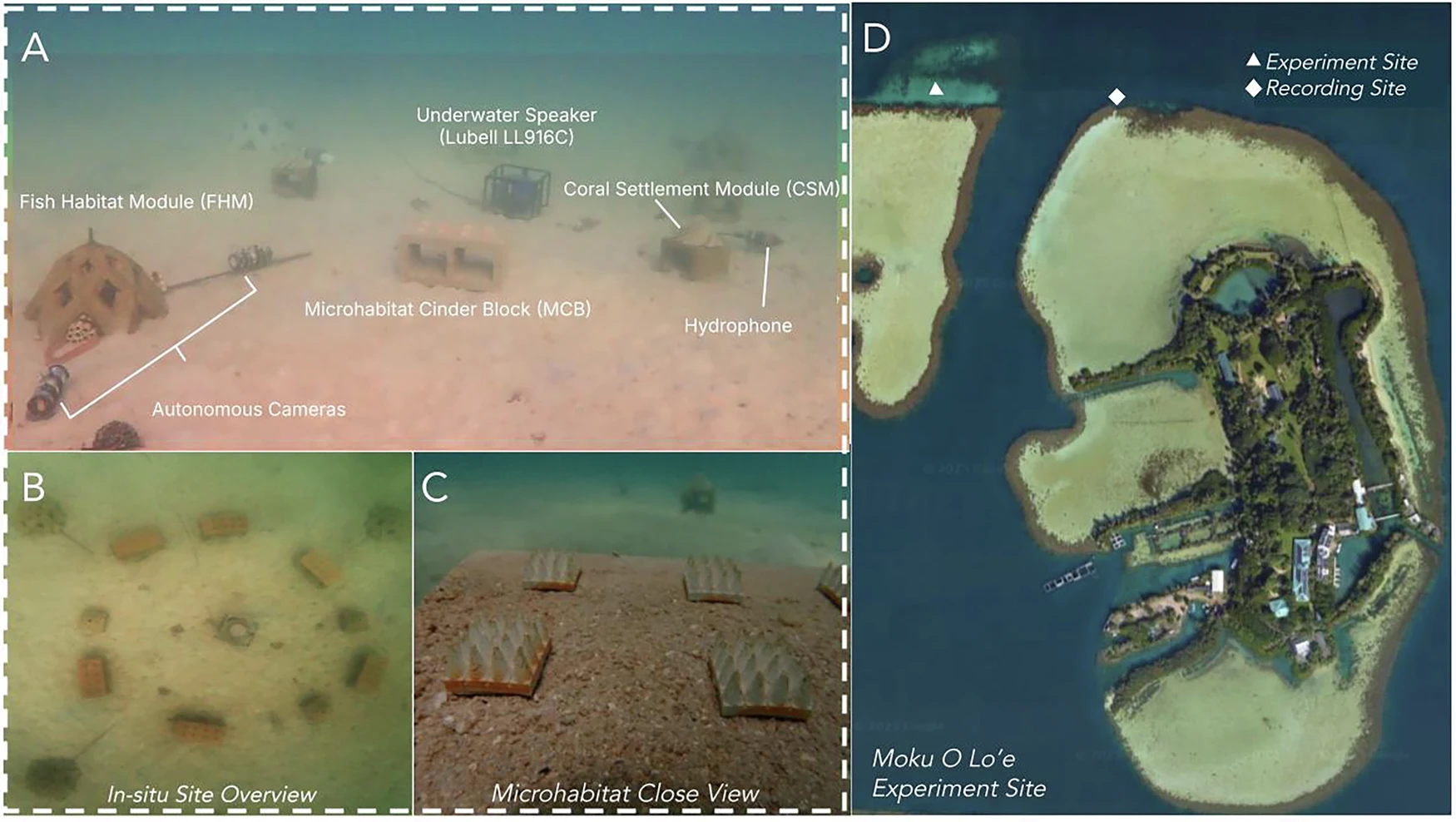
The research team recorded sounds from a healthy reef environment off O‘ahu, Hawaiʻi, over the course of a lunar cycle (around 29.5 days). They captured noises produced by animals such as fish, snapping shrimp and other crustaceans.
The team then played the recordings from an underwater speaker – placed in a flat, sandy area off the small island of Moku o Loʻe – for two weeks, from sunrise to sunset.
They also put 37 artificial structures on the seafloor at distances between 1-42m (3-138 ft) around the speaker. The structures varied in shape and surface properties, and some of them included BRINK: a bioactive ‘reef ink’ containing living bacteria.
Over two years, divers measured coral larval settlement one and two weeks after the new moon – when spawning occurs. This is a critical stage in reef formation, as free-drifting larvae begin to search for somewhere to attach and build a reef.
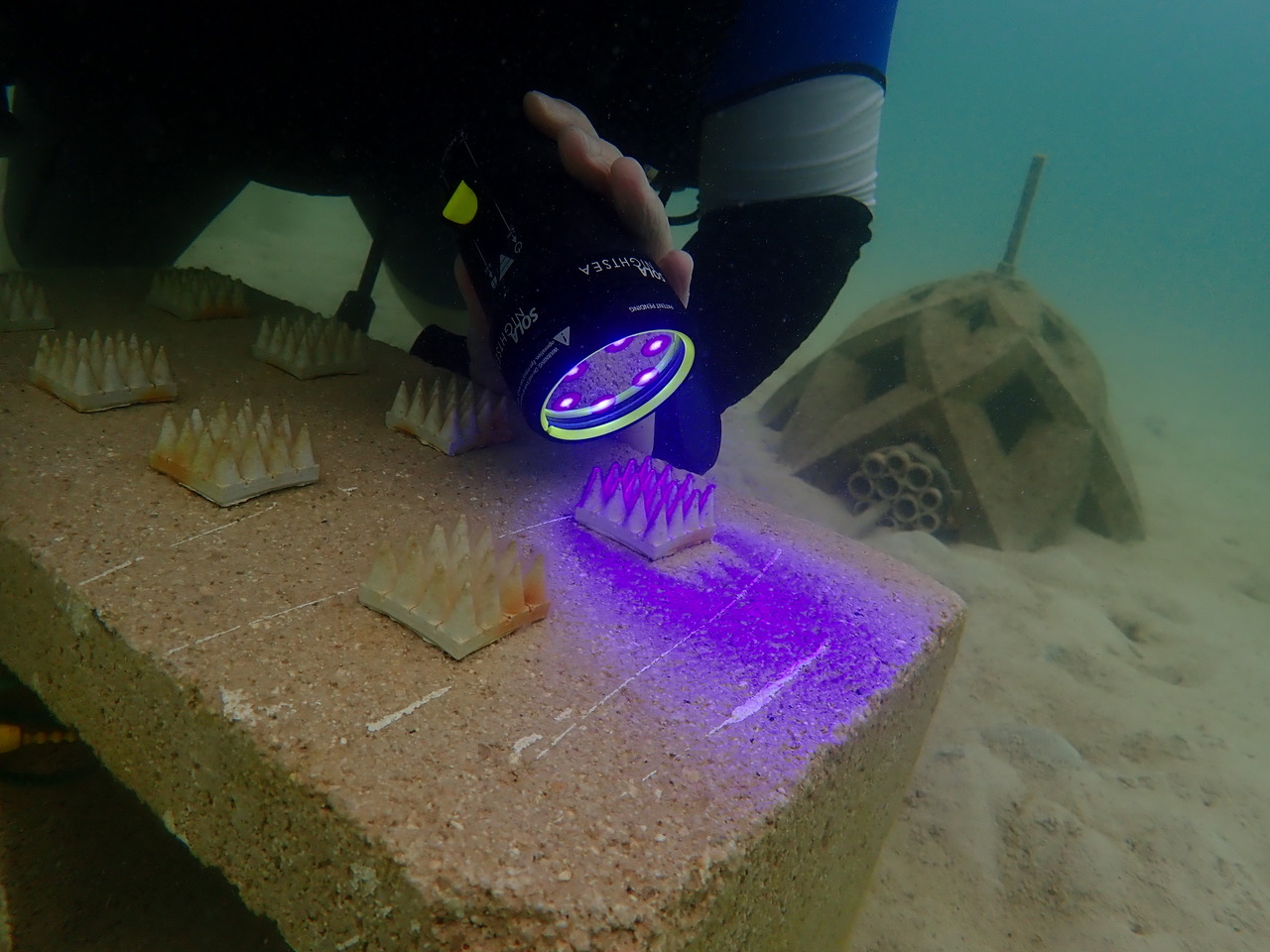
Using a handheld blue light and yellow filter, the divers meticulously counted the individual larvae that had settled on each structure.
The findings, published in Communications Biology, demonstrated that the artificial structures closest to the speaker had the highest levels of coral settlement. Among these, the structures treated with BRINK had the best results.
“Our data indicates that when these drifting organisms detect a lot of sound from a reef, it signals to them that this is a good place to settle,” says Aaron Thode, a Scripps Oceanography researcher and lead author of the study.
“Our analysis also provided strong evidence that synthetic chemical cues attract these organisms to reefs.”
It’s hoped that the results will inform further use of the technology in the field. “It brings us closer to the vision of hybrid reefs: a new class of living coastal infrastructure that combines engineering and biology to protect our shores while supporting the growth and recovery of reef ecosystems,” explains Daniel Wangpraseurt, a Scripps Oceanography researcher and co-author of the study.
Studying fish communities
Another Scripps Oceanography research team used cameras to monitor fish larvae during the deployments of the underwater speakers.
“Fish are important components of healthy coral reefs because certain species feed on smothering microalgae that would otherwise make it difficult for coral larvae to settle and grow,” says Océane Boulais, the lead author of the study, which was published in the journal Scientific Reports.
To make sure the team didn’t disturb the fish, Boulais developed cameras that could continuously detect and count fish larvae for up to three weeks. The cameras were deployed at two sites: one near the underwater speakers emitting the recordings, and one at a control site with a speaker that didn’t emit any sound. The cameras were positioned at the entrances of the artificial reef structures and documented fish as they entered and left, as well as tracked the presence of larvae.
They discovered that fish larval counts peaked around the new moon at both sites, but the acoustically enriched site attracted 4 to 14 times more fish larvae overall. The results were still reliable when the team swapped locations of the true speaker and control speaker.
“The cameras are relatively new, but they’re already helping us learn so much about the early life stages of reef fish, and how sound might enhance their presence on a reef,” explains Boulais.
The US governmental body Defense Advanced Research Projects Agency (DARPA), who helped fund the studies, plans to install a hybrid reef structure off Oʻahu later this year, with corals likely to be planted in late 2026 or early 2027. The Kalaeloa Hybrid Reef will measure 50m (164 ft) and incorporate some of the technologies tested in the studies, such as microstructures and an acoustic enrichment system.
Top image: damselfish swim near a separately located artificial reef ‘Stack’ structure which were also used in the acoustic enrichment studies. Credit: Nina Schiettekatte


