
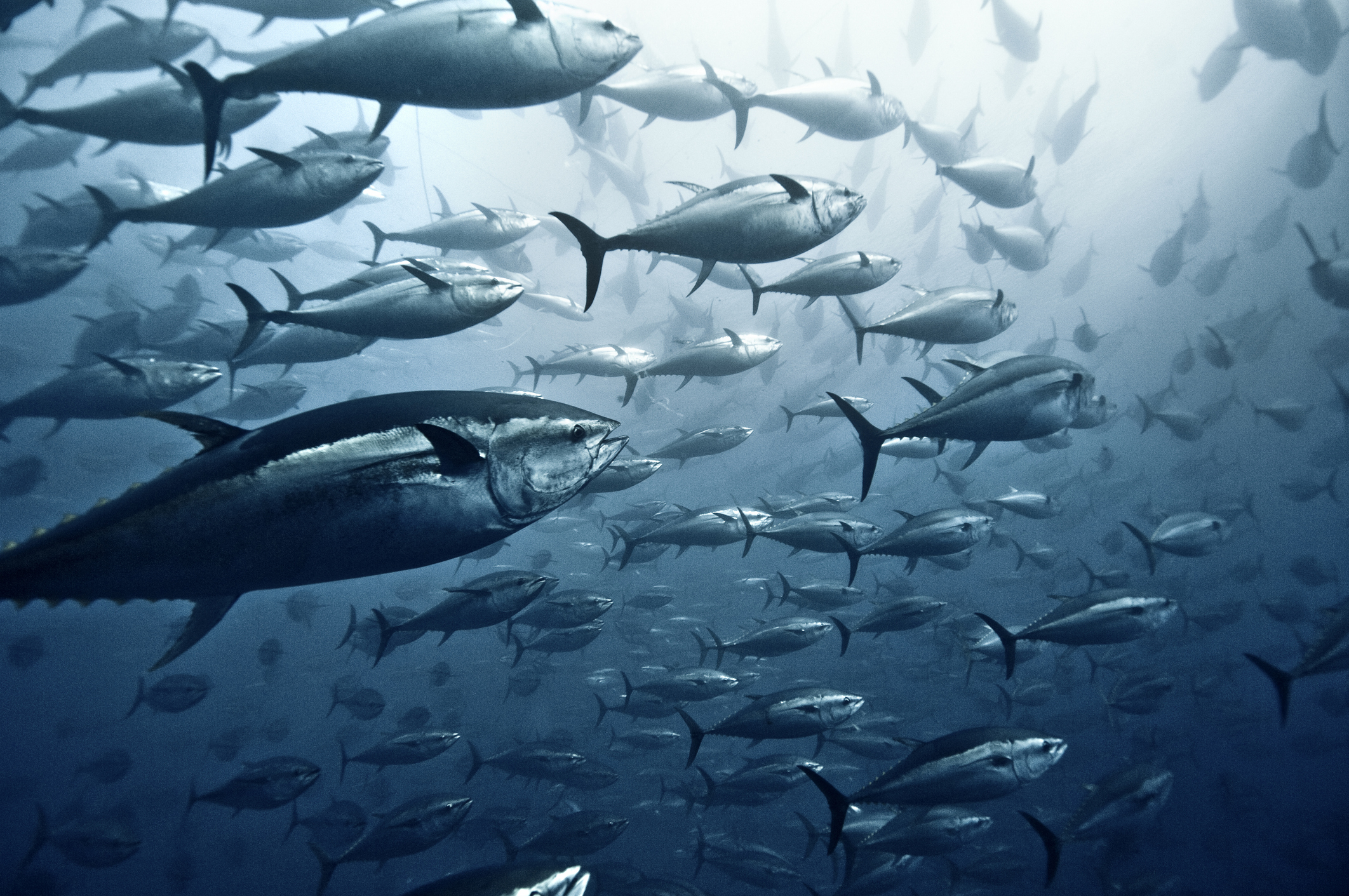
Tuna are capable of crossing entire oceans at great speeds and diving many hundreds of metres into cold depths – and among the best known of these ocean hunters are bluefin tuna and yellowfin tuna.
While they share the same sleek, torpedo-like bodies, their biology, habitats and conservation stories are strikingly different.
Along with bigeye tuna, bluefin and yellowfin are the types of tuna most likely to turn up on your plate in a restaurant, or make their way into your shopping basket in cans or as steaks.
Bluefin tuna is not actually a single species – it’s a group of three distinct species of fish: Atlantic, Pacific and Southern bluefin tuna. There is only one species of yellowfin tuna.
Did you know? Bluefin and yellowfin tuna are among the fastest swimmers in the ocean, reaching speeds of up to 50 mph.
At first glance, telling them apart can be tricky – the differences are often subtle.
Differences between bluefin and yellowfin tuna
Habitat
Yellowfin tuna generally prefer warmer, tropical to temperate waters compared to bluefins, which thrive in cooler seas. While their ranges occasionally overlap, their preferences diverge when sea temperatures rise or drop to extremes.
Size
The bluefin tuna is significantly larger than yellowfin. A mature bluefin can grow up to 2.5m long and weigh as much as 450kg. Yellowfins are smaller, typically reaching around 1.5m in length with a maximum weight of roughly 180kg.
Fins
The pectoral fin on a yellowfin tuna is much longer than that of a bluefin tuna, extending past the start of its second dorsal fin.
Colouring
Yellowfin tuna have a distinct bright yellow lateral line running from head to tail. On a bluefin, this line appears dark blue and green.
While both species have silver undersides, bluefin feature uneven, pale vertical lines and spots, whereas yellowfin display rows of faint silver spots alongside their yellow accents.
True to their name, yellowfin tuna feature a bright yellow second dorsal fin and anal fin, compared to a bluefin’s duller mix of grey and yellow. The tail fin also differs: bluefin possess a dark blue tail, while a yellowfin’s tail is a blend of yellow and grey.
Conservation and abundance
One of the most important distinctions between bluefin and yellowfin tuna lies in their population health and conservation status.
Yellowfin tuna are currently classified as Least Concern on the IUCN Red List of Threatened Species. In contrast, bluefin populations face varying levels of risk due to severe historical overfishing:
- Southern bluefin: Endangered
- Pacific bluefin: Near Threatened
- Atlantic bluefin: Least Concern (rebounding in some regions due to strict international quotas, though historically overexploited)
Tighter catch limits and international regulations continue to play a vital role in allowing bluefin stocks to recover.
Top image: A powerful yellowfin tuna leaps from the surface. Credit: Cavan Images/Raffi Maghdessian/Getty Images


