
Deep-sea scientists may be edging closer to solving a decade-long mystery: what’s been singing in open oceans around the world at night?
“In the past ten years, evening chorusing of unknown origin has been reported in deep water environments around the world,” write the authors of a new paper published in the journal Scientific Reports. “In each recorded instance, the chorus consistently occurs at sunset and lasts between 1 and 3 hours.”
The strange singing sounds like the white noise from the static of an untuned radio and has been detected in the deep waters of the Atlantic, Pacific and Indian Oceans.
There are so many sounds being made at once that they all blur together, making it hard to distinguish one single call from the overall ensemble. “You may have experienced this if you have listened to a chorus of distant crickets at night,” says Duane. “You hear continuous elevated noise rather than individual chirps.”
The singing starts as night draws in. “This chorus consistently begins at sunset and lasts for several hours,” says Daniel Duane, a scientist at the Naval Undersea Warfare Center Division Newport and one of the study’s authors.
Many scientists have heard this aquatic choir but no-one has yet been able to confirm what is singing. Suggestions have included marine mammals, free-floating invertebrates, lanternfish or large fish.
In the past, it’s been difficult to tell exactly where the noise is coming from. Putting down a single hydrophone (underwater microphone) can help experts record sounds but it can’t indicate where the noise is being made.
So, the scientists deployed a system with 64 sensors that would help them determine exactly where the noise is being produced. “We found the vocalising animals were specifically concentrated near the seafloor along the sloping edge of the Bermuda Rise, at depths of 800–900m,” says Duane.
- Does anything live in the Bermuda Triangle?
- This haunting sound was captured near Bermuda in 1949. It's the oldest known whale song recording
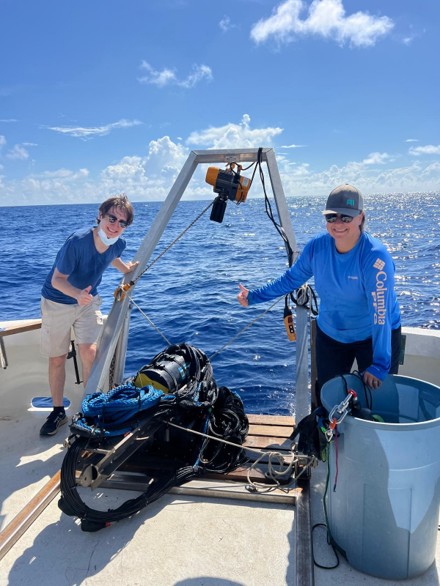
Although the researchers haven’t yet been able to prove what’s making the noise, they can eliminate some potential sources. “We’ve ruled out marine mammals, the frequency bands and types of signals received don’t match up,” says co-author Lauren Freeman, also a researcher at NUWC Newport.
They’ve also eliminated snappers and groupers from their list of likely suspects and the volume of the vocalisations seems too loud to be made by free-floating invertebrates.
Researchers had previously speculated whether lanternfish might be our masked singers, but the sound didn’t move in the way they would expect if it was made by this species. “These fish typically migrate toward the surface at sunset, and we observed that the chorus sources remained near the seafloor during this time,” explains Duane. “This makes us think that the chorus is produced by some other deep-water fish that stays near the seafloor.”
The most likely source, they say, is deep-sea fish. Some species, including cusk eels and grenadiers, can create sound by drumming on their swim bladders with special muscles. Could these be what’s making this inexplicable cacophony?
It’s too early to say. Finding proof of what’s making the noise is not easy because they need to catch the culprit on camera. “The best way to identify a biological sound is to get video recording along with the audio,” explains Duane. “This is especially difficult in the deep sea, where the environment is dark and high pressures require specialised equipment.”
The team now wants to put cameras into the deep waters where the chorus has been heard in the hope that they can film the source of the noise while it’s making the sound.
The scientists have noticed there’s a pattern of when the chorus occurs, which suggests it’s not just any old call – it might have an important purpose. “We are almost certain that there is not only a specific animal or group of animals involved, but a specific behaviour,” says Freeman. “That could be feeding, mating, or something else.”
For now, the identity of the singers remains a mystery but the researchers want to get to the bottom of the puzzle. Finding out the source of the sounds will help us understand what’s going on in the deep sea, says Duane: “For example, this chorus may act as a 'beacon', attracting larger predators, such as marine mammals, to feed on chorusing fish aggregations.”
Plus, everyone loves to finally reveal the truth behind the ocean’s long-held secrets. Freeman adds: “It’s exciting to go after a mystery that no one can answer!”
More wildlife stories from around the world
- Researchers sink listening devices 1,100m deep off Louisiana coast and hear sounds of elusive animal
- When the Titanic sank 3,800m into the Atlantic Ocean, strange animals moved into the wreck
- NASA officials sent over 2,000 baby jellyfish into space. Tens of thousands more came back to Earth
- Humans descend into huge deep-sea canyon for first time ever. What they find is astounding
Top image credit: nudiblue/Getty Images


