
If you’re snorkelling along a shallow seagrass bed and happen upon a chonky grey animal with a gentle bovine-like face, you may have come across a manatee. Or… is it a dugong?
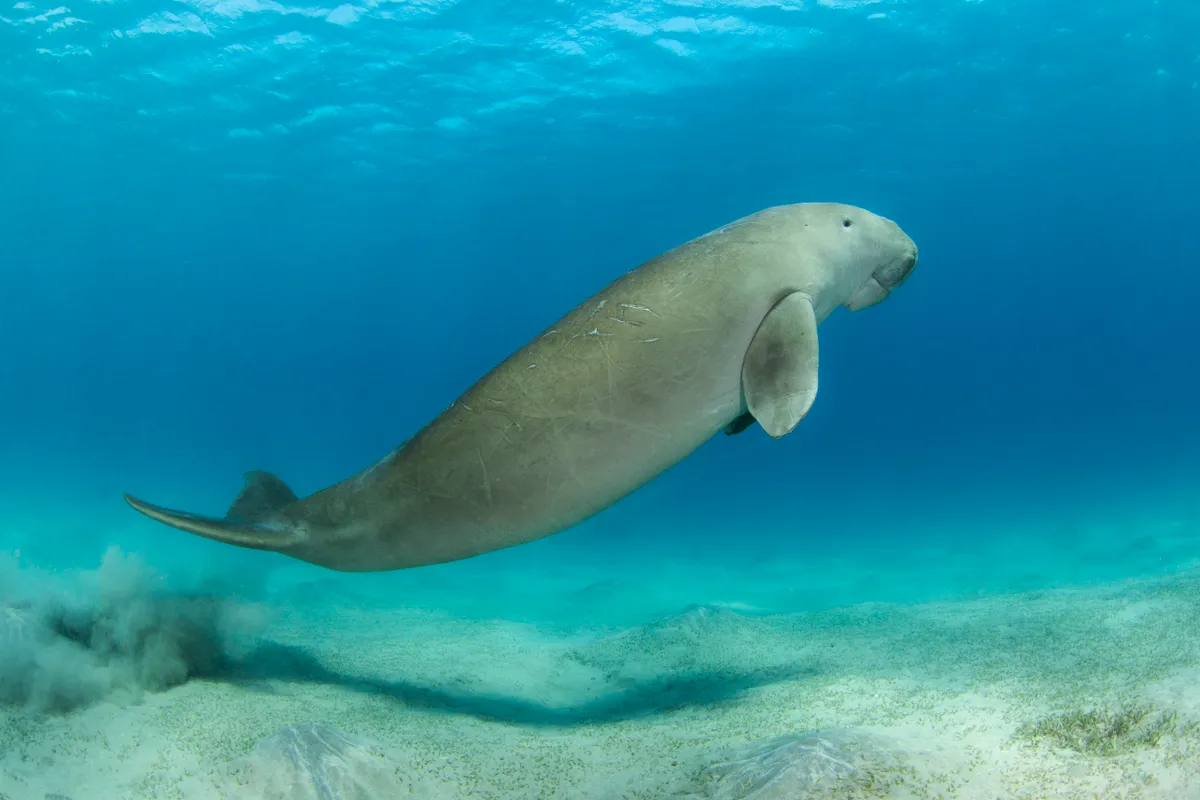
The kind-looking creature grazes contentedly on seagrass, coming up to the surface for air every few minutes. So far, so unhelpful. It could be either a dugong (Dugong dugon) or one of the three recognised species of manatee: the West Indian (Trichechus manatus), Amazon (Trichechus inunguis) or West African manatee (Trichechus senegalensis).
How to tell the difference between a dugong and a manatee
So, how do you tell one type of floaty potato from another? Take a closer look and you might spot a few clues that help you tell the difference between a dugong and a manatee.
The first thing to look at is the tail. Although both dugongs and manatees are credited with inspiring the legend of the mermaid (their scientific name, Sirenia, is a reference to the sirens from Greek myths), my money’s on the dugong being the true source. Take one look at their whale-like tail, with its fluke gracefully curving inward, and you’ll immediately see a resemblance to the lower half of mermaids from historic illustrations.
- Manatee guide: where they live, what they eat and why they're known as 'sea cows'.
- Mission manatee: how a spring clean in the Gulf of Mexico is creating an oasis for Florida's sea cows
Manatees, on the other hand, have a broad, paddle-like tail, shaped like that of a beaver. It does the job of helping them to move along but wouldn’t likely be mistaken for an elegant mermaid tail.
Where you find them can also give you a clue. While dugongs live in saltwater habitats in the Indo-Pacific – like shallow, sheltered coastal bays and mangroves – manatees can also live in freshwater. West Indian and West African manatees both move between salt, brackish and freshwater habitats and Amazon manatees are only found in freshwater.
There’s nowhere in the world where dugong habitats overlap with those of manatees so you won’t find these two sea cows in the same place in the wild.
Size also matters. Although the two animals grow to a similar length – around 3 metres for dugongs and between 3 and 3.5m for manatees – manatees are much heftier. An adult manatee can tip the scales at 400–500kg, so an individual could potentially be twice as heavy as a dugong, which typically weighs 250–400kg in adulthood. Manatees also have rougher skin than dugongs.
Their faces are very similar but dugongs have a downward-facing snout (to help them graze from the seabed) and some adult males grow short tusks. Manatees have a shorter but more flexible snout that they can use to grasp onto plants. Their ability to move each side of their upper lip independently from the other, like a pair of tongs, helps them to pick up vegetation wen they’re eating.
The key similarity is that all four species are vulnerable to extinction, according to the IUCN Red List of Threatened Species. If we don’t protect them, they could sadly be at risk of going the way of their relative the Steller's Sea Cow. This sub-Arctic animal was formally discovered in 1741 but had already been hunted to extinction by 1768.
Are they really related to elephants?
Yes! Dugongs and manatees belong to the super order Afrotheria, of which elephants also belong and they share a common land-based ancestor that lived approximately 50 million years ago.


