
Despite being some of the most hostile environments on Earth, with spewing boiling water and bone-crushing pressure, deep-sea hydrothermal vents teem with life.
These ecosystems can be hundreds of kilometres apart on the ocean floor, yet you’ll find an overlap in the species that inhabit them. So how do these tiny, poor-swimming creatures migrate between them?
- Underwater robot sent to toxic vents deep in Pacific Ocean. What it found stuns scientists
- One mile down, iron-rich waters, toxic fluids, and 81°C acidic vents made this volcano seem uninhabitable – yet scientists filmed something staggering
A team from the University of Tokyo conducted research to find out.
“Our previous studies suggested that plankton-feeding larvae of hydrothermal vent animals disperse in surface waters, where they can feed on phytoplankton and be transported by strong currents over long distances,” explains Takuya Yahagi, an assistant professor at the university.
“However, directly observing or tracking these microscopic larvae in the open ocean is extremely difficult,” they add.
As part of their latest research efforts, the team collected three species of limpet larvae from vents on the Kaikata Seamount in the Northwest Pacific using research vessels. Working in such extreme environments posed challenges, however.
“We needed animals that had retained tiny larval shells, and such specimens are not commonly collected from deep-sea hydrothermal vents. Fortunately, my colleague Yasunori Kano obtained suitable specimens during research cruises,” says Yahagi.
“The second challenge was analysing the larval shells themselves. These shells are less than 1 millimetre in size and only about 10 micrometres thick.
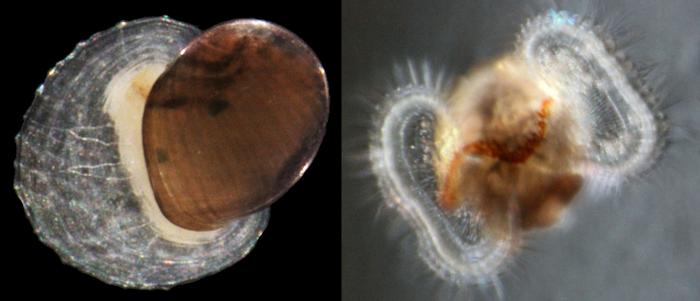
“We had to analyse them very carefully while avoiding contamination from shells formed after settlement. Advances in analytical technology allowed us to obtain reliable chemical records from these tiny shells.”
These small shells preserve chemical clues about the surrounding environment in which the limpet developed – not unlike the growth rings found within a tree.
A window through time
The scientists could measure the chemical signatures (such as oxygen isotopes, which are different forms of oxygen that have different numbers of neutrons) recorded in the shells using advanced technology. This would allow them to estimate the temperature of environments the limpet lived in – and they could even use this to reconstruct the limpet's early life histories.
Using these signatures, the team discovered that the limpets migrate to the upper layers in or near the euphotic zone (the ocean layer at 0 to 200 metres that receives enough sunlight for plants to make food) during their larval stage. After this, they likely settle back to their birthplace or establish at a new hydrothermal vent site thousands of metres below in the water column.
This discovery highlights how the sunlit zone’s temperature, current and food availability could play an integral role in how deep-sea vent systems form. Currents play a significant part in relocating the limpet larvae and as those currents are influenced by temperature patterns, climate change could affect their dispersal and any connectivity between vent sites.
However, the scientists note that further research is needed across different species as hydrothermal vent ecology is highly species-specific.
“In this study, we examined species living at depths of no deeper than around 2,000 metres, but hydrothermal vents occur as deep as 5,000 metres, so we are interested in whether animals from even greater depths also migrate to the sunlit upper ocean during their larval stage,” says Kano.
Further study with more detailed scales of environmental temperature estimates could not only allow the team to trace the ascent of the larvae to surface waters, but “also the return journey, including the descent into the deep sea and the search for a suitable hydrothermal vent where the larvae eventually settle, feed, reproduce and repeat the cycle again.”


