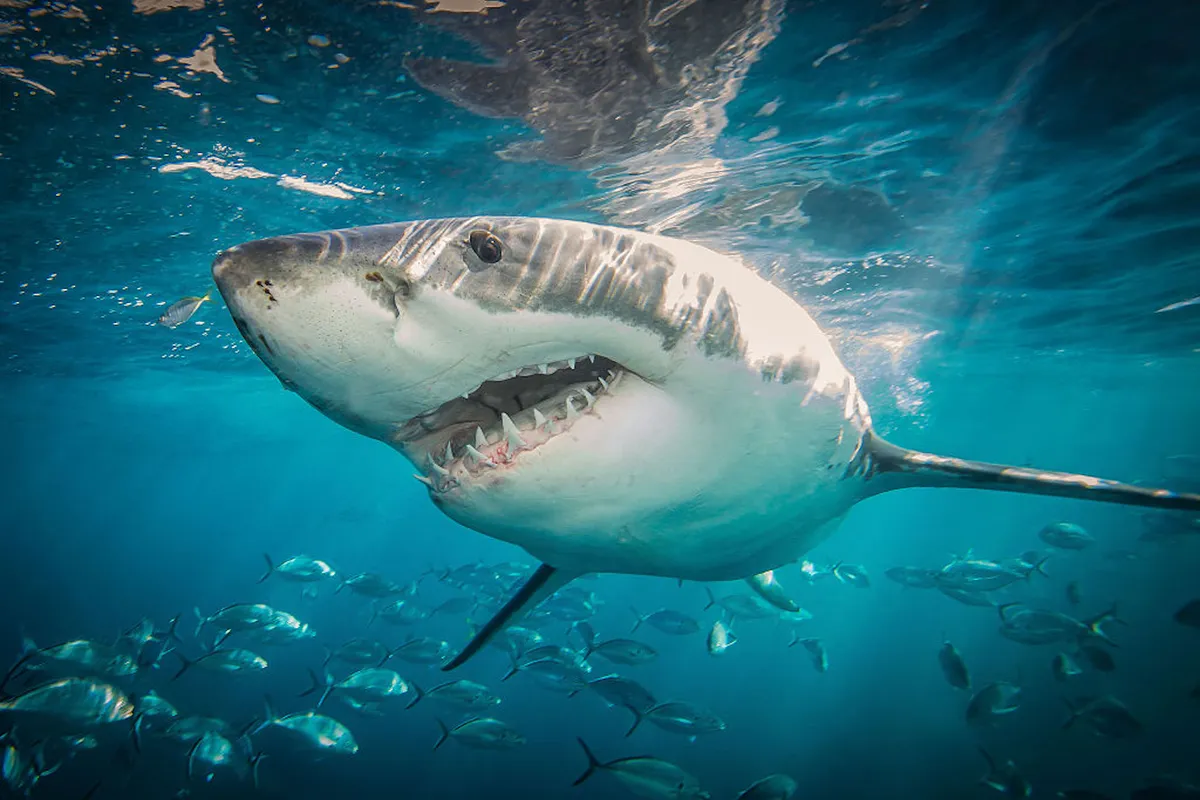
While fitting satellite tags to animals is a common way of tracking their migration patterns, a team of scientists realised that they can do far more than that: they can help with climate forecasting.
In 2021, a team of scientists from the University of Miami fitted satellite tags to 18 sharks in the Northwest Atlantic. They chose blue sharks (Prionace glauca) and mako sharks (Isurus oxyrinchus) which are abundant in its waters.
- When a mountain collapsed in Mexico, light fell upon an underground lake. What happened next was remarkable
- Robot sent deep into Atlantic Ocean. Its mission? To investigate the largest animal migration on Earth
But these species also travel lengthy distances and vary their depth within the ocean. Blue sharks in particular can dive to depths exceeding 1,000 metres, meaning they frequently experience temperature variations of up to 20°C.
When fitted with sensors that collect pressure, depth and temperature profiles, the sharks can help to record data from particularly remote areas of the Northwest Atlantic.
“Sharks are already moving through parts of the ocean that are challenging for us to observe,” says Laura McDonnell, lead author of the study while she was a doctoral student at the university’s Rosenstiel School of Marine, Atmospheric, and Earth Science and the Abess Center for Ecosystem Science and Policy.
“This research shows that data they collect can help fill important gaps and, when used carefully, can improve how we predict ocean conditions.”
The team say that their study is the first to integrate animal-borne sensor data into a seasonal climate model.
Shark sensors
The sharks transmitted more than 8,200 temperature-depth profiles (almost reaching 2,000 metres deep) across a range of locations.
A subset of this data was integrated into the University Corporation for Atmospheric Research’s Community Climate System Model. This simulates the Earth’s climate system and allows researchers to study the Earth’s past, present and future climate states.
This allowed the team at the University of Miami to compare the resulting climate conditions with the forecasted predictions using traditional models, as well as the ones that integrated the shark-collected data.
And the results, published in the journal npj Climate and Atmospheric Science, were significant. The shark-collected data showed measurable improvements in forecast performance – particularly in dynamic coastal and shelf regions.
Forecasts incorporating this data showed up to 40 per cent lower surface temperature errors than control forecasts when compared against satellite observations and ocean reanalysis products.
“For fisheries and coastal communities, small improvements in ocean forecasts can make a big difference,” explains Camrin Braun, one of the study’s co-authors.
“Reducing uncertainty helps people plan, whether that’s where to fish, how to manage resources, or how to respond to changing conditions.”
Ocean forecasts are usually least reliable in areas that change rapidly and where traditional observational data is lacking. And as marine predators such as sharks seek out these areas, such as fronts and eddies, they can be useful in complementing this.
However, the researchers warn that animal-based sensors aren’t a replacement for more traditional systems.
“Tagged sharks won’t replace conventional observing systems,” added McDonnell. “What the preliminary results do show is that tagged marine predators can provide complementary in-situ observations at the surface and at depth.”
Read the full paper: Improved seasonal climate forecasting using shark-borne sensor data in a dynamic ocean
Top image: Neil Hammerschlag, Ph.D. and Laura McDonnell, Ph.D. attach a satellite tag to a blue shark that transmitted location, temperature, and depth data. Credit: Nola Schoder, MPS