
Two and a half months before writing this, a young adult grey seal washed up on a beach in Kent, says Liam Drew. Two days ago, it was removed from a freezer at London’s Natural History Museum and, today, I’m going to watch it being dissected.
I’m currently wondering what exactly I’ll witness and looking at everyone on the Tube while thinking: ‘I bet you don’t have a date with a dead seal.’ My only guide is an email saying the museum’s staff will inspect the seal’s forelimbs and collect any parasites and plastic the animal contains.
- Sea lion vs seal: What's the difference between these two popular pinnipeds
- "No way!" Gob-smacking footage of a gigantic two-tonne elephant seal taking a rest on a South African police car
The last time I saw seals was in Norfolk – the local colony evoked perfectly these mammals’ dichotomous nature. On a shingle beach, about 100 of them lay like stuffed socks. Most remained motionless. And the few that crossed the beach bounced as seals do on land – near comically, like someone doing a sack-race lying down. In the bay, though, they swam in all their slippery grace – a majestic creature of the sea.
The windowless, concrete dissection room is busy. Five white-coated scientists are debating which scale would be best for weighing the seal. Three technicians
wait to help and two spectators from the museum’s admin departments watch – a large animal dissection is not an everyday event, even here.
The seal lies on a large metal table and looks much like it would when sprawled on a beach. But, up close, its large eyes are dark and dead, and its whiskers cracked and useless. One eyelid is badly damaged. Natalia Fraiji, a parasitologist specialising
in marine mammals, says it’s unclear whether it was torn by a fish post-mortem
or injured in life, potentially leaving the creature partially sighted. Natalia is here to collect the lifeforms that called this seal home. The solitary tick she found on its exterior was dispatched to the museum’s insect department for identification.
Consensus reached, Natalia helps heave the seal onto a pallet truck. Weight: 55kg.
10.00am: Evolutionary insight
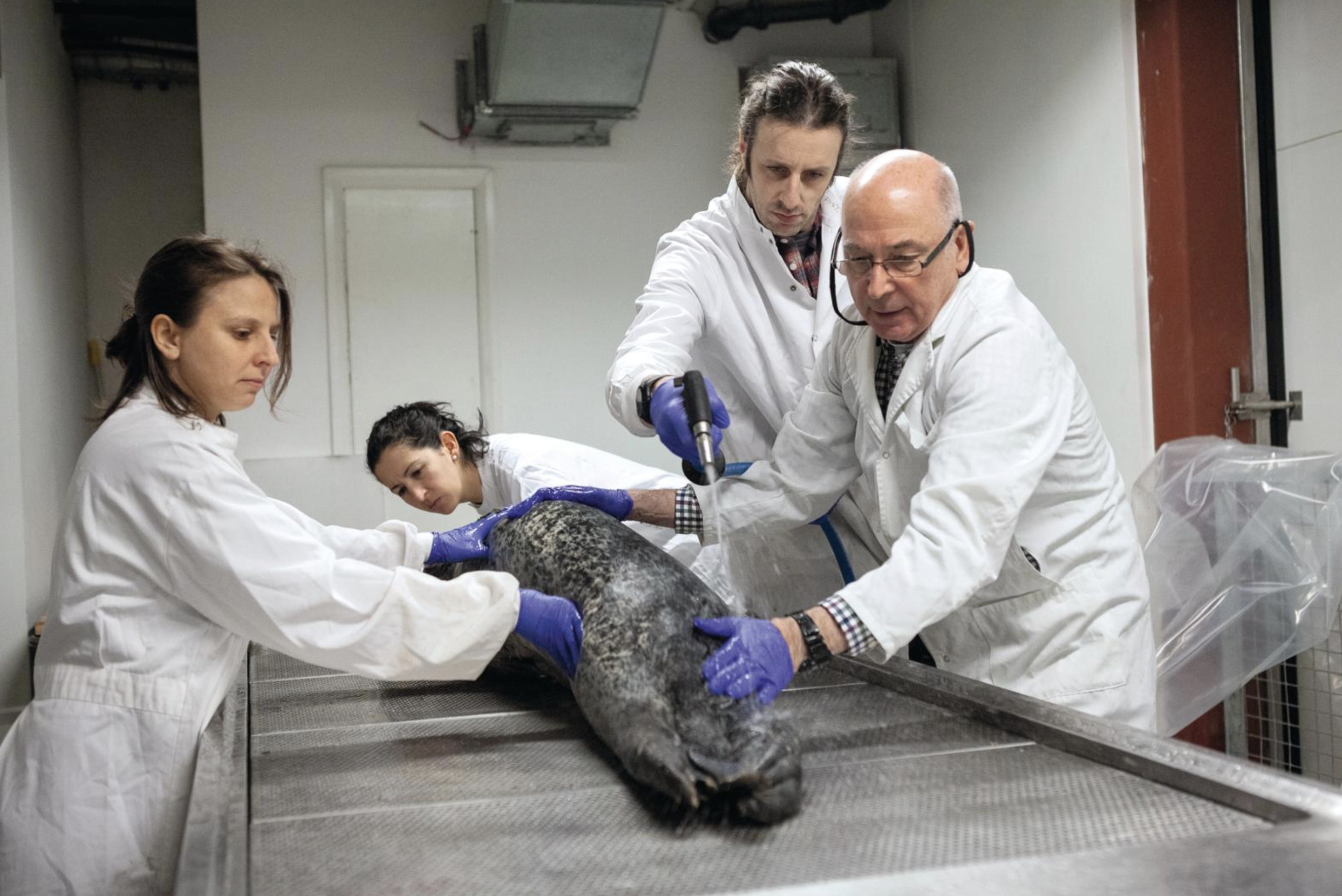
Anne-Claire Fabre, who studies how animals’ morphologies evolve with their lifestyles, and Travis Park, a palaeontologist working on marine mammal evolution, measure the seal’s forelimbs. The right one, spread wide, reveals five long, clawed fingers running through a heavy furred webbing. When Travis holds the limbs together, it’s clear the animal could’ve held things between them. Anne-Claire and Travis’s task is to describe the muscles that operated this limb. It’s part of a project defining the degree to which seals’ forelimbs are flippers – paddles with which to swim – or grasping paws that dextrously manipulate food items.
At the foot of the table, the museum’s head mammal curator, Roberto Portela Miguez, lays out scalpels with blades the size of your thumb, three kitchen knives, one large pair of wire cutters
and a screwdriver. Against the wall lean some heavy-duty garden secateurs with metre-long handles.
10.15am: Making an incision
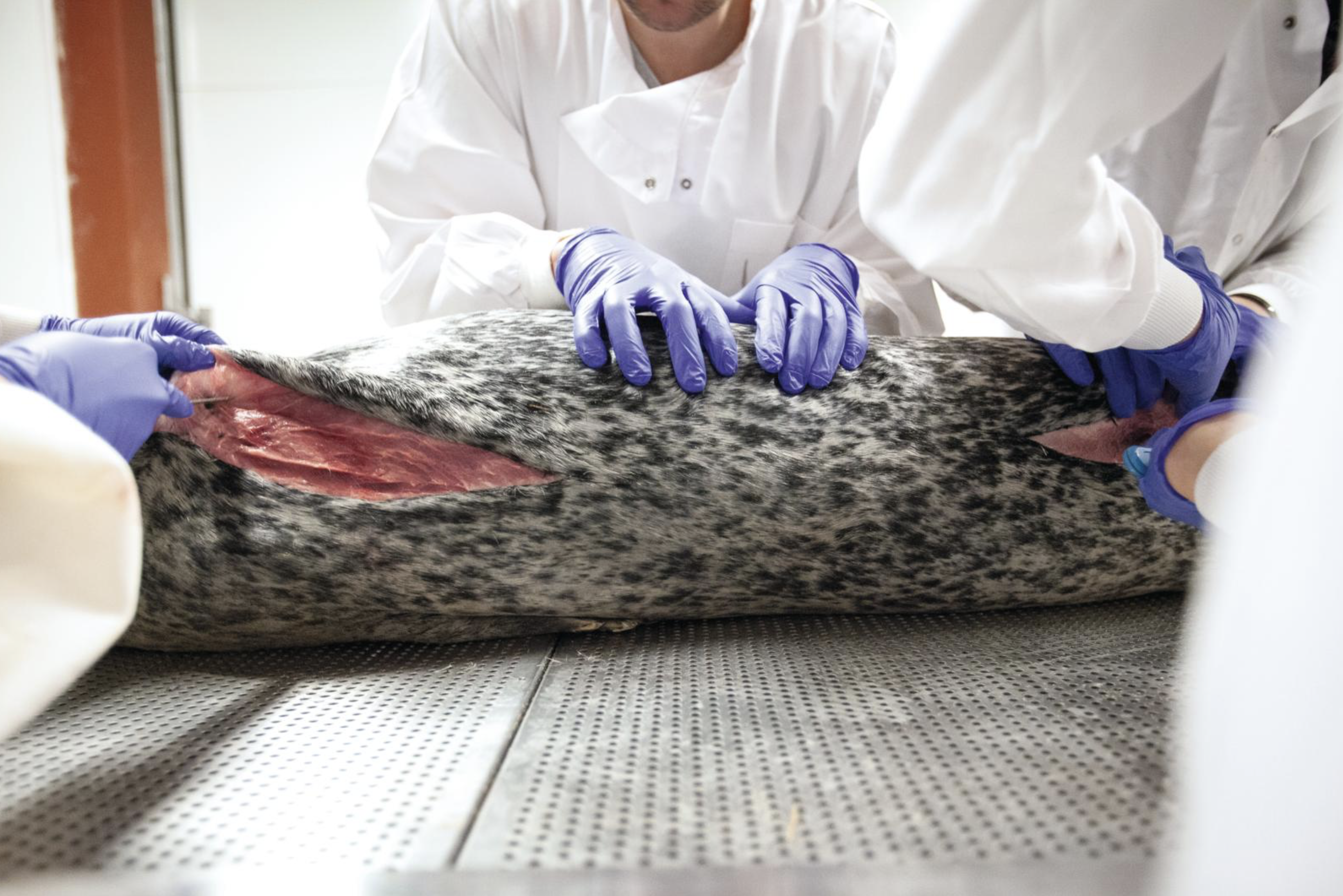
Alex McGoran’s scalpel pierces the animal’s tough skin between its shoulder blades. Alex is researching the effects of microplastics on aquatic food webs. As she cuts down the animal’s back, pink flesh is revealed. It’s the colour of pork, but this is blubber – it’s neither as fatty nor as thick as you might expect – and it must all go. It’s the muscles underneath that matter today – each one is
to be removed, measured and photographed.
11.00am: Taking samples
Roberto removes the animal’s golf-ball-sized eyes and puts them in heavy glass specimen jars. He then places tiny cubes of liver in plastic tubes for the museum’s frozen tissue bank, in case anyone wants to examine the seal’s genome. Meanwhile, six people – including the museum’s fish curator – continue removing the blubber. The closer they get to the underlying musculature, the more precise they have
to be.
12.25pm: Digestion dissection
Natalia’s parasitology and Alex’s microplastic studies centre on the digestive tract. Dressed in luminous orange plastic, they start to remove the part that runs from the stomach to the anus. A cut through the abdominal wall reveals a slithering mass of intestines. To retain its contents, the rectum must be liberated from the heavy pelvis without rupture. (Those who’ll continue dissecting the body are invested in this, too – still partly frozen, the animal is remarkably odourless, and everyone would like it to stay that way). A plastic ligature is tied around its bottom end, then after 20 minutes, Alex triumphantly lifts the intact rectum free, provoking a round of applause.
1.00pm: Digging for worms
In a separate room, Natalia cuts open the first 20 centimetres of intestine, pouring the contents into a tray. “Look!” she exclaims, “a worm already!” She deposits a centimetre-long worm – white and the thickness of string – in a petri dish. A parasite like this lives free in a seal’s intestines, she explains, while spiny-headed worms burrow into the gut wall and live there. Is it bad for seals to have worms? “A healthy environment is an environment for parasites,” she says, avidly describing their life-cycles as she looks for more. Her fascination is utterly infectious.
Worms removed, Natalia gives the intestinal contents to Alex, who filters them through a fine-mesh sieve. Any large plastic items would likely be stuck in the stomach – though a handful of previous studies have never found any, probably because seals are very visual and intelligent hunters. Alex is, instead, sieving for insidious, tiny plastic particles that are rife in the oceans and almost invisibly accumulating in aquatic animals.
1.30pm: A long way to go
Back in the main room, the seal lies on its side, skinned and blubberless, its flesh drying and darkening. When the team returns from lunch, Roberto pours water over it. The crowds are gone now – though two MSc students have come to observe and help. As Anne-Claire restarts the dissection, the mood is sedate and serious.
2.00pm: Exploring the museum
A technician, who’s been helping Natalia and Alex, bursts in to tell me Natalia’s found a spiny-headed worm. Soon, I'm peering through a microscope at what looks like a maggot with a trunk. Only when Natalia later emails some high-magnification shots of their intricately barbed proboscises, do I appreciate how fantastical these creatures are.
After viewing the worm, I join Brian Smith, who co-ordinates the collection of stranded marine mammals for the museum. Brian takes me into the room adjoining the dissection room, where, housed in individual glass jars, are hundreds of preserved animals, as well as an 8.5m giant squid and a Komodo dragon. The oldest are fish collected on Captain Cook’s voyages in the late 1700s. Across 27km of shelving, the museum houses over 22 million animal specimens.
3.00pm: Muscle movement
Anne-Claire, Travis and Roberto bend over the animal. Anatomy is slow, meticulous and involved work. There are no sudden revelatory ‘ta-da!’ moments. The team simply progresses muscle-by-muscle through the collection of about 50 that controlled this seal’s right forelimb – each one is lifted, tugged on and, it seems, explored by touch
as much as by sight.
“Muscle takes so long, not many people do it,” Anne-Claire says. It’s more common to infer the movements an animal can make from the shapes of its bones. The assumptions of such inferences worry Anne-Claire – in her view, if muscles are available, scientists should study them.
3.30pm: Liberating limbs
The seal is rolled over onto his belly, its limbs clearly much looser now. Seeing the elbow and shoulder shows more clearly how evolution truncated an ancestral mammalian limb to adapt it to a mainly aquatic lifestyle.
The team decides today’s goal is to finish removing the muscles linking the limb to the trunk – those within the limb can wait for another day. A bone saw is brought out and the hindlimbs are sawed off.
4.20pm: Extreme efforts
At last, the forelimb is removed. The way Travis holds it, while Anne-Claire cuts it free, suggests he’ll lift it aloft like a sportsperson raising a trophy. But no, he unceremoniously carries it away in search of a freezer bag – there’s no spontaneous applause this time. Everyone’s exhausted. Anne-Claire bends double over the table. When she raises her head, she says, “It’s like going to the gym for three hours.”
- Watch incredible, heart-warming, footage of a seal pup being born and its first few moments - fortunately mum is on hand for comfort
- They sound like spaceships! Polar researchers capture otherworldly footage of seal mum and pup beneath the ice
4.45pm: Drawing conclusions
Natalia returns to remove the upper digestive system. She’s had a productive afternoon – there were many parasites. Roberto takes the long-handled garden shears and cuts open the rib cage. Travis reminds everyone they’d agreed to measure the volume of the animal’s oral cavity with the tongue forward and retracted. There’s mounting evidence that seals don’t just bite fish but suck them in. He retrieves a bag of plastic beads and a plastic bag, with which to fill the mouth and calculate its volume.
I start my goodbyes and thank everyone for letting me watch. There’s been no clear indication of why this seal died. He appears to have been quite healthy. But whatever led to his demise, his washing up on a beach and arriving here means that we’re gaining a greater sense of how and why seals evolved to be as they are, and of how a large mammal in a complex ecosystem is home to many other animals. We’ll also learn what sharing a planet with humans means for the future of these marvellous creatures.
What lives within
There are four main classes of gut-dwelling worms: tapeworms (cestodes), flukes (trematodes), roundworms (nematodes) and spiny-headed worms (acanthocephalans). In this seal, Natalia finds round and spiny-headed ones. Such creatures feed on a seal’s gut contents, then reach sexual maturity and breed in the seal’s intestines. Their eggs exit in the faeces. Then tiny, free-living larvae swim in search of an initial host, which are then eaten by fish, which, in turn, are eaten by seals. The number and type of hosts can differ between worms, but this is the basic idea.
- “He’s a 1,000kg wild marine predator that is very capable of hurting someone if startled.” Who is Neil the seal?
- “Each seal is swimming for its life.” These seals must cross shark-infested waters to find a meal. Will they make it?
- They look like whiskers, but these are no ordinary whiskers… Here's how seals use them to ‘see’ underwater and track prey
- "Once they've caught their prey it may be shaken violently to ‘deglove’ and they then tear the carcass into pieces small enough to swallow"
