
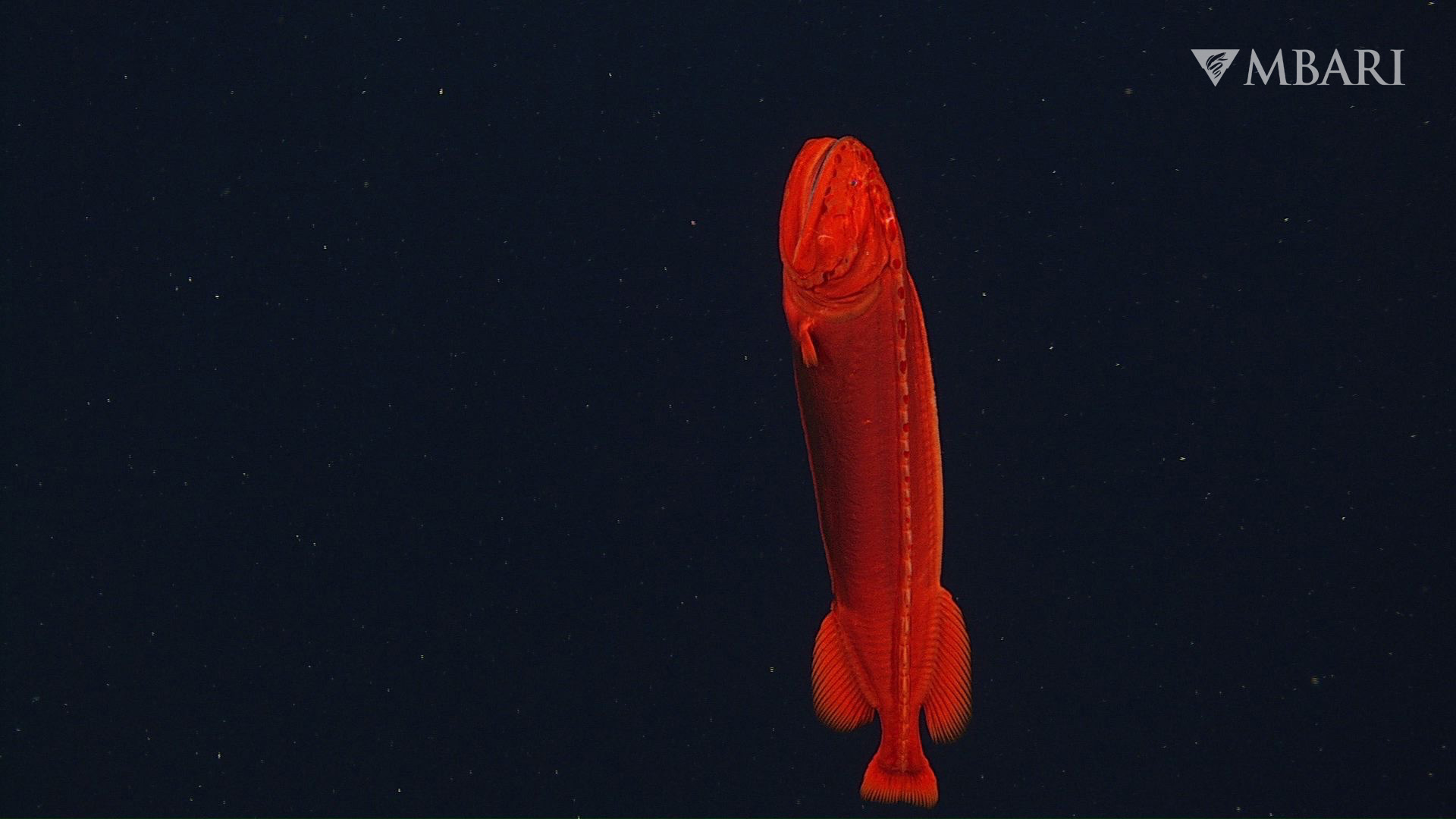
These deep-sea fish were first discovered in 1895 and puzzled researchers for many years. They were named for their stout body and large mouths, which give them a shape similar to a baleen whale, even though their small size and bright red colour are far from whale-like.
It wasn’t until more than 100 years later that researchers realised what they thought were two totally different fish were much more closely linked to the whalefish than they had ever realised.
What are whalefish?
Whalefish are a deep-sea fish from the family Cetomimidae. They were first discovered in 1895 and became the centre of a huge mystery. Their dramatic transformation from juvenile to adult involves such an extraordinary metamorphosis that researchers thought they were entirely different species for many years.
Whalefish got their name from their bulky body, which looks a little like that of a baleen whale. Their striking red bodies stand out like a sore thumb when under the lights of a deep-sea research vessel but this colour is actually an ingenious form of camouflage.
What do they look like?
As their name suggests, these strange deep-sea fish resemble a whale, although not in size (they only reach 40cm at the largest with most species growing to just half that length). Rather, their big head, large mouth and thick body is said to resemble a baleen whale.
They have teeny-tiny pinprick eyes with no lenses and their vision is so poorly developed that they can’t even form images. Instead, they feel their way around their habitat: large sensory pores that run down their head and body can detect movement in the water so they can sense other animals approaching.
“Many fishes have these sensory pores, usually arranged into the lateral line running along their sides,” says MBARI on its website. “In the whalefish, the pores are quite large and lie along ridges that give the fish a crocodile-like appearance.”
- “The fish’s brain, nervous systems and internal workings of the head are visible.” Meet the see-through deep-sea dweller
- It's 6 metres long, ugly with translucent skin and looks like a goblin with a witch’s nose and has the strangest jaw ever seen. Oh, and it lives deep in the ocean too
Confusingly, these sturdy whalefish are just the female form of the species. Their male and juvenile forms look completely different. So different, in fact, that confused scientists thought they were three different species for many years.
Unlike the chunky females, males are slim with a bulbous ‘nose’ with powerful olfactory organs and a fused upper jaw that can’t move. They don’t have a throat or a stomach but their liver is huge.
Meanwhile, larvae and juveniles – known as tapetails – have upturned mouths and long, ribbon-like tails.
Like many other creatures in the deep sea, whalefish (the females, that is) are a shocking crimson colour. This is a nifty form of camouflage: red light is absorbed at this depth so the whalefish’s scarlet body looks black in its natural habitat (when it’s not lit up by the lights from research vessels).
“The intense red color helps a whalefish disappear into the darkness to ambush unsuspecting prey or avoid a hungry predator,” writes MBARI.
- Banana-sized deep-sea oddity glows red – and resembles an alien spaceship
- "Invisible armour and giant eyes": see the deep-sea dweller with its own invisibility cloak
What was the mystery of the whalefish?
When whalefish were first recorded in 1895, a huge scientific mystery lay ahead that wouldn’t be solved for many years.
In 1956, scientists discovered a fish living in shallower waters than the whalefish. It had an impressively long tail, like a streamer, so they named it the tapetail. Weirdly, all the specimens they found were larvae or juveniles.
A decade later, in 1966, deep-sea researchers discovered another new type of fish. They called it the bignose fish because of the huge bump on its snout. Again, there was something strange about it: every single one they found was a male.
The plot continued to thicken in 1989 when a scientist examined all of the 500 whalefish specimens that had been sampled from around the world so far. All of them were female.
You might guess where this is going, but it took years for experts to piece the clues together. As it turns out, whalefish, bignose fish and tapetails are all the same species (researchers had thought they were from different families).
Experts only realised this when they examined some tapetails that were in the process of developing into adults and noticed some similarities. They had found the missing link!
Juveniles go through a transformation that changes their skeleton so dramatically that they are unrecognisable as adults.
The astonishing revelation – that all three are the same species at different life stages and sexes – was published in 2009, more than a century after whalefish were first discovered.
Where do whalefish live?
In the dark and mysterious waters of the ocean’s twilight and midnight zones. Whalefish are found between 1,500 and 3,500 metres deep in tropical and temperate waters worldwide.
Down here, it’s so deep that no sunlight can reach so their world is black as pitch – the only light comes from the occasional sparkle of bioluminescence. At this depth, red light wavelengths cannot penetrate so the whalefish’s crimson body blends in perfectly with the inky sea around it.
- What actually is the twilight zone? And why is it called that?
- “The crushing pressure can be anywhere between 100 to 400 atmospheres, which would kill a human instantaneously.”
What do they eat?
Tapetails use their upturned mouths to snack on small planktonic organisms called copepods while females (thanks to their big mouths) can gobble down larger animals.
Males don’t eat at all. How can they? They have no mouth. Instead, they live off the energy reserves in their liver – hoping they can find a female before these stores run out.
How long do they live for?
The average lifespan of a whalefish is unknown.
How do whalefish hunt?
Experts think that whalefish are ambush predators, using the sensory pores along their body and head to detect prey in the water and catching them in their enormous mouths.
Are they dangerous to humans?
No. Whalefish live thousands of metres deep in the ocean’s twilight and midnight zones so the chances of ever meeting one of these tiny fish – let alone being harmed by one – is slim.
“In the more than 27,000 hours of video MBARI’s ROVs have recorded, we have logged just 16 observations,” says MBARI.
Are whalefish under threat?
Exact population numbers are unknown but these deep-sea fish likely face threats from climate change, pollution and deep-sea fishing.
A whalefish’s special features
- Bright red body
- Tiny eyes
- Large head
- Large mouth
- Rows of sensory pores
- Crocodile-like ridges
- Whale-shaped body
- Fins located towards the far end of its body
- Tail fin


