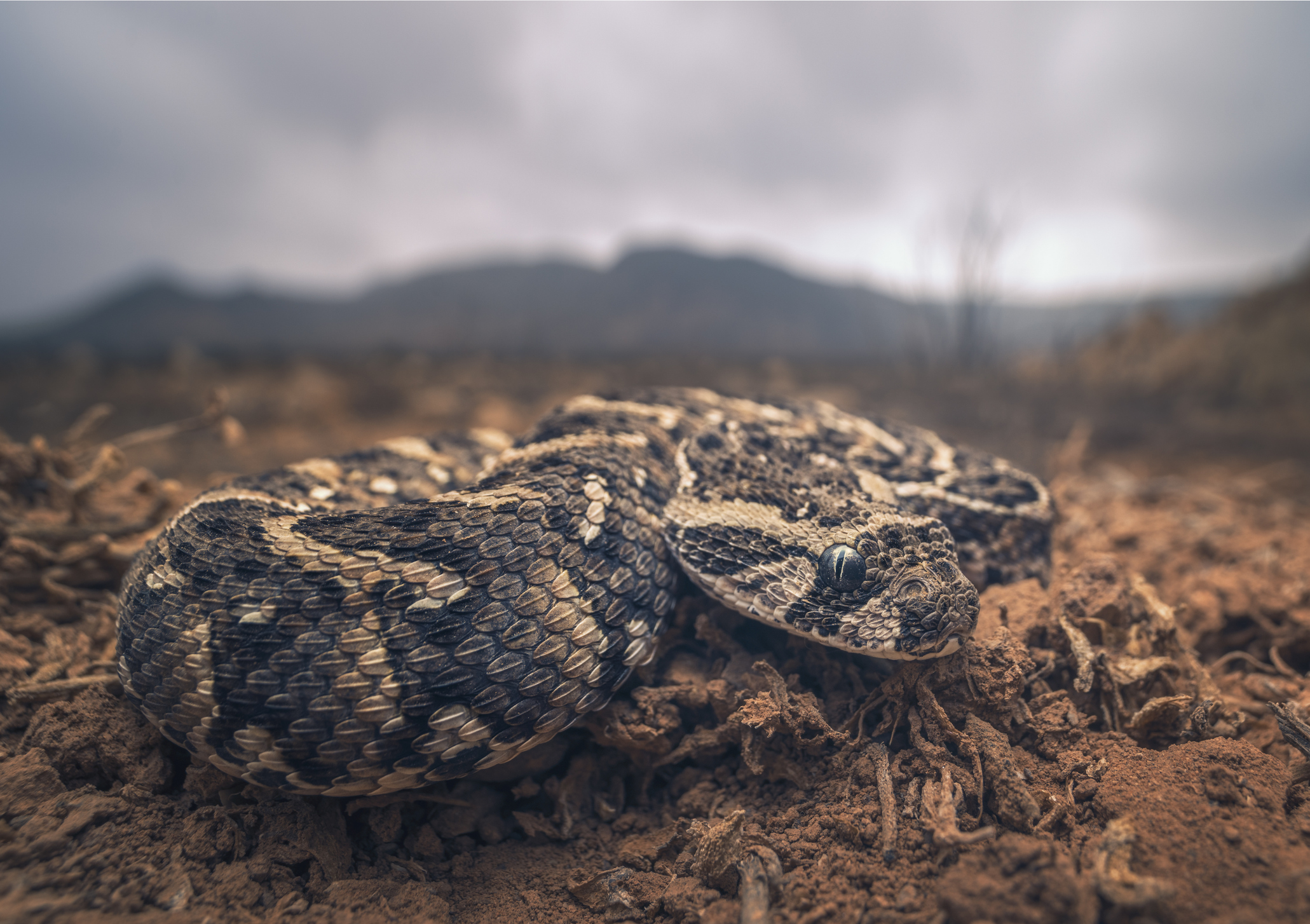
Rather than fleeing when danger approaches, this heavyweight and highly venomous viper often stays perfectly still, relying on its patterned skin to blend into its surroundings. Slow and normally sluggish until it has been disturbed, then its demeanour changes dramatically.
- Meet the animals brave enough to hunt and devour the world’s deadliest, most venomous snakes
- "One bite contains enough venom to kill at least 100 adult humans" 13 deadliest, most venomous, snakes on the planet
Puff adders inflate their bodies and unleashes a loud warning hiss and, if necessary, can strike with astonishing speed, delivering a potentially dangerous dose of venom.
Where do puff adders live?
Widespread across central, eastern and southern Africa, they can survive in an impressive variety of landscapes including sub-deserts and savannas as well as mountainous areas. Their range also extended into western and southern Arabia.
Also known as African puff adders or the common puff adder there is they may hide among grass or even partially bury themselves in sand as their brown, grey and cream markings provide excellent camouflage from being spotted by predators while resting during daylight as they are mostly nocturnal. But there is also considerable variation in their coloration with some chevrons sooty black and cream coloured, while others are dark brown and dull bluff.
Although mostly found on the ground they are also adept climbers and swimmers.
A sub species known as the Somali puff adder (Bitis arietans somalical) is only found only in Somalia, eastern Ethiopia and northern Kenya. It is distinguished by its keeled subcaudal - the enlarged scales or plates located on the underside of a snake's tail.
Why are they called puff adders?
The name comes from one of the snake's most distinctive defensive displays.
When disturbed, rather than fleeing, a puff adder inflates – or "puffs" – its body and produces a loud hiss to warn whatever has approached it to stay away.
Remarkably, the hiss is produced as the snake breathes both in and out, creating an almost continuous warning. Other true vipers use similar behaviour, but it is particularly noticeable in the puff adder. After the hiss warning, they strike fiercely - faster than a human can blink- to protect themselves.
What do puff adders eat – and how much?
Small mammals make up much of the puff adder's diet, particularly when it hunts after dark.
Like other snakes, they don't chew their food. Their large triangular head is manoeuvred over the prey and movements on alternate sides of the upper jaw gradually draw the meal inside. Their enormous fangs partially retract while they swallow.
To maintain a constant body mass, they must consume 63% of their body mass in rodents annually. But a study found when provided with unlimited food, they increased their food intake by an average factor of 12 times resulting in dramatic increases in body mass.
While eating on average once every 10 days, they can also survive for extreme periods- up to two years- without food during times of scarcity. Their total lifespan is usually between 10 to 15 years.
How do puff adders catch their prey?
Puff adders are masters of the ambush. Rather than wasting energy chasing prey, they can lie motionless waiting for an unsuspecting animal to wander within striking distance - often in a straight line like caterpillars.
When hunting, the front of the snake's body can be folded into an S-shaped position, ready to unleash an extremely rapid strike - shooting forward at a speed of 2.6 meters per second and snapping back in a fraction of a second.
Venom is injected through its long hinged fangs, around 12-18mm, which are attached to moveable bones so they can fold backwards when the jaws are closed, quickly incapacitating its victim.
Are puff adders dangerous to humans?
Yes but one reason people are bitten is not because puff adders pursue humans, it is because they can be remarkably difficult to see.
Their camouflage and tendency to remain still rather than immediately flee means people can accidentally get dangerously close or even tread on them.
A puff adder has relatively huge hinged fangs and can deliver a large quantity of venom with as much as 750mg extracted from one snake.
A bite can cause severe pain and swelling as well as damage to blood vessels and surrounding tissue. In serious cases, areas of flesh can become necrotic. But despite their prevalence and biting more than any other snake, deaths are quite rare.
- With three fangs able to deliver lethal venom - instead of the usual two - this is probably the deadliest death adder ever
- "One bite contains enough venom to kill at least 100 adult humans" 13 deadliest, most venomous, snakes on the planet
How do puff adders have babies?
Unlike many snakes, puff adders don't lay eggs. They are ovoviviparous meaning they produce young by means of eggs that hatch inside the mother's body. The neonates or juveniles are born fully independent right from birth with no parental care.
A typical brood contains around 25 to 50 babies. One extraordinary female measuring just 1.1 metres long reportedly produced 156 live young at a zoo in the former Czechoslovakia.
Timing varies depending on where the snakes live. In southern Africa mating takes place between October and December, with young generally born between March and May. In eastern Africa mating takes place in August and birth during November and December.
Juveniles are typically 5 to 8 inches long and can bite immediately although their venom yield is significantly lower than adults.
- Trap tentacles, spider-tails and faking death: Meet the world's most cunning snakes
- 10 animals that could swallow a human whole, from snakes to sharks
- From two penises to regrowing teeth and playing dead – discover 14 amazing snake facts you (probably) won't have heard before