
Slender and camouflaged, the twig snake is an African arboreal snake that hides in plain sight. Its long body, pointed head and bark-like colouring make it look less like a reptile than a wind-blown stem, and consequently they are rarely seen despite being widespread and abundant.
The name is usually applied to snakes in the genus Thelotornis, a small group of highly specialised, rear-fanged colubrids whose taxonomy is still being refined.
- It looks like a twig and a couple of dead leaves - but this is no ordinary twig. It's a master of disguise and a ruthless killer
- "One bite contains enough venom to kill at least 100 adult humans" 13 deadliest, most venomous, snakes on the planet
What is a twig snake?
Also referred to as the vine snake or bird snake, the twig snake is not a single species but a name used for snakes in the genus Thelotornis. Four main species are often recognised: the savanna twig snake (Thelotornis capensis), the forest twig snake (T. kirtlandii), the eastern twig snake (T. mossambicanus) and the Usambara vine snake (T. usambaricus). Some recent research splits the group more finely, so the exact number of species may change as herpetologists review genetic and morphological evidence.
Where does the twig snake live?
The twig snake is found across sub-Saharan Africa, though each species has its own range. The savanna twig snake occurs in southern African savanna, coastal thicket and forest fringe. The forest twig snake is associated with forests in western, central and eastern Africa, while the eastern twig snake occurs in forests farther east, including parts of Kenya, Tanzania, Mozambique and neighbouring countries. The Usambara vine snake has a much smaller range in north-eastern Tanzania, where it is linked to coastal and montane forest.
Why does it look so much like a twig?
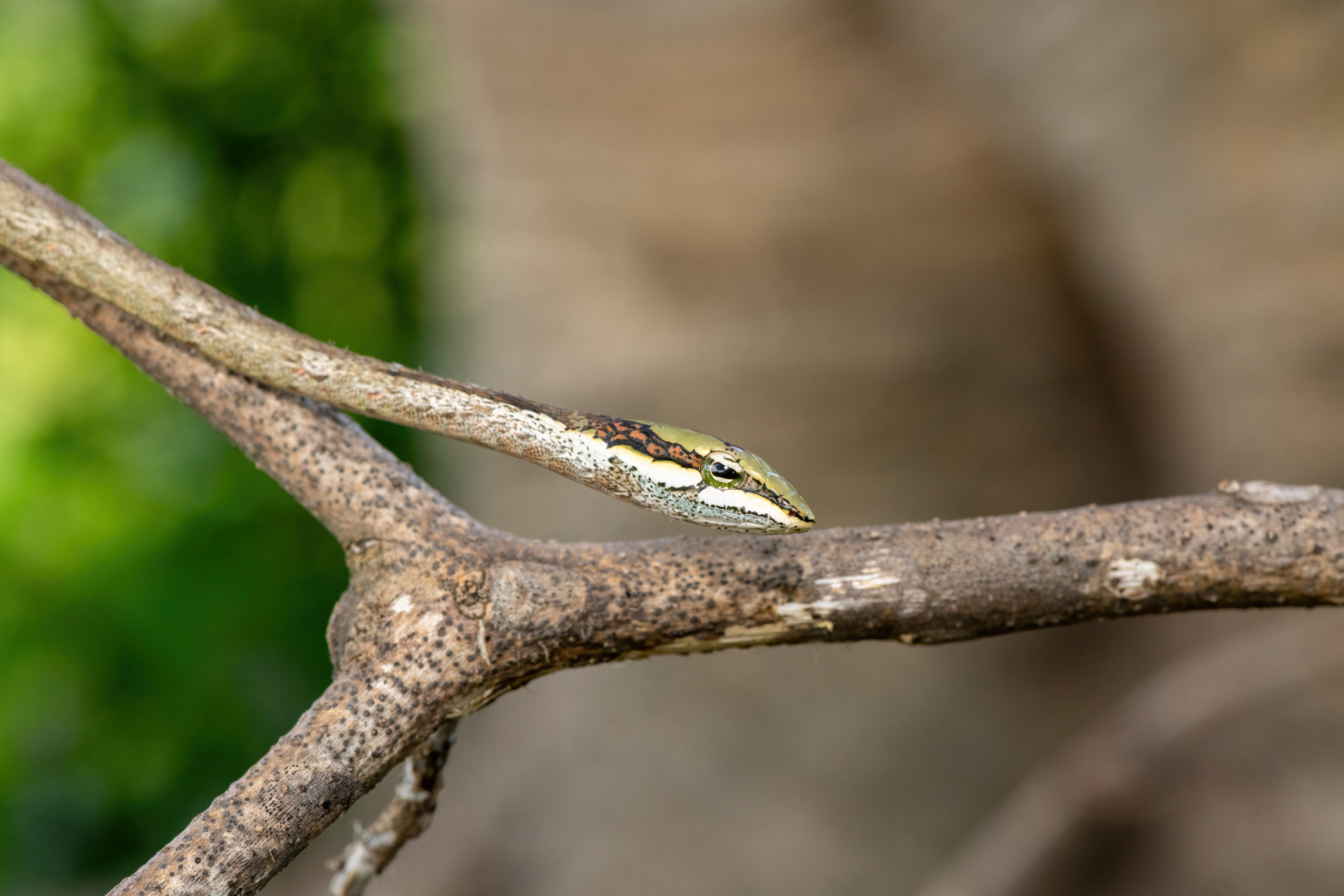
The twig snake has a very long, narrow body, a sharply pointed snout and irregular grey, brown and olive markings that break up its outline among branches and dead vegetation. Its ability to stay very still only increases its cryptic likeness to a twig. This disguise helps it avoid predators and remain undetected by prey.
How big are they?
They are usually around 75cm–1.5m, depending on species
What does the twig snake eat?
It is mainly a predator of small vertebrates, including lizards, frogs, smaller snakes and small birds – though the latter are eaten much more occasionally than the moniker ‘bird snake’ might suggest. The snake tends to lie motionless for long periods, waiting for the right moment to ambush terrestrial prey from low branches. Venom is delivered through enlarged rear fangs and subdues its victim.
Are they related to boomslangs?
Yes. The twig snake and the boomslang (Dispholidus typus) are both African, rear-fanged colubrids, and studies describe them as close relatives. They are sometimes confused because both are shy and slender tree-dwelling snakes with similar looks.
“The vine snakes [twig snakes] may be confused with young boomslang, which have similar colours in their juvenile phase,” states the African Snakebite Institute, but “the young boomslang has a more rounded head and [a] massive emerald-green eye.” Both the twig snake and the boomslang possess a slow-acting haemotoxic venom, however the boomslang’s venom is more potent.
How dangerous is the twig snake?
The twig snake should be treated as medically dangerous. It is rear-fanged, which means its venom-delivering teeth sit towards the back of the upper jaw rather than at the front, as in vipers and cobras. This can make bites less likely and sometimes less efficient, but it does not make the snake harmless. Its haemotoxic venom affects blood clotting and can cause severe bleeding. There is no antivenom available. Human fatalities have been recorded, and any suspected bite should be treated as a medical emergency.
Does it attack people?
The twig snake is not aggressive by nature and usually relies on camouflage or escape rather than confrontation. Bites are most likely when the animal is handled, restrained or mistaken for a harmless species. Because it can remain so still, people may get closer than they realise before noticing it. If disturbed, it may inflate its throat. The safest response is to leave it alone and give it space.
How does it breed?
Like many colubrid snakes, the twig snake lays eggs. A study of 144 savanna twig snake specimens found that both males and females reach sexual maturity at around three years old. Its breeding cycle is seasonal with mating taking place in spring and eggs laid in summer. Clutches contain four to seven eggs, most often six. Much less is known about breeding in the other twig snake species.
What threats does it face?
For the more widespread species, there is no single major threat across the whole range, though local habitat loss and persecution may affect populations. Forest-dependent forms are more vulnerable where woodland is cleared or degraded. The Usambara vine snake is listed as Vulnerable and is of greatest concern because of its limited distribution and dependence on Tanzanian forests threatened from agriculture, logging and firewood collection.


