
When you stop and think about it, eyes are pretty incredible. They allow us to see and interpret the world around us in real-time, making them one of our most vital senses. We rely on them to navigate, connect, and understand our environment.
- Weirdest body parts: discover some of the strangest - and we do mean strange - animal appendages out there
- 10 animal superpowers you'll wish you had
But, when you really consider it, eyes are also pretty standard — two of them, positioned one on either side of your face, giving you a clear view of what's coming towards you.
Or are they? Here are the weirdest eyes in the animal kingdom
Weirdest animal eyes
Pacific barreleye fish
The Pacific barreleye fish is the only animal known to have eyes below the skin inside its head. This odd design protects these vital organs, on which the fish’s life depends. Its skull is transparent, as is the skin on its head and most of its face. Though these features don’t actually help the barreleye fish to think, they do enable it to see things more clearly. This odd design protects these vital organs, on which the fish’s life depends.
The video and top image is from Monterey Bay Aquarium Research Institute (MBARI), which is a nonprofit oceanographic research centre dedicated to advancing marine science and engineering to understand our changing ocean. Read more about their studies into the barreleye fish
Tarsier

Who can resist this big-eyed, nocturnal, carnivorous primate? Reminiscent of a house elf in Harry Potter - or perhaps it's Gollum from The Lord of The Rings - its big eyes dominate its face and helps it see in the dark.
Iguana

The iguana's third eye is a useful way of detecting danger. It can detect blue and green light and ‘read’ the time of day, like a clock.By sensing shadows and light changes, the eye can detect danger and may also act as a navigational compass. It uses chemicals to detect light, unlike other vertebrate eyes, which use rod cells or cone cells.
Stalk-eyed flies

It's easy to see how these weird insects got their name as the most obvious thing about these flies is their eyes, and particularly those of the males.
Not just because they are a rather splendid bright red and accessorise well with the rest of their bodies, but because they are positioned, along with a pair of stubby antennae, right at the ends of extraordinary peduncles that stick out on either side of their heads.
Four-eyed fish (Anableps anableps)
The four-eyed fish has a special talent. Although it doesn't technically have four eyes like its name suggests each eye is split into two horizontally - with each split having its own pupil and retina - so it can see above and below the water line at the same time. Pretty cool...
Mantis shrimp

It might not be the biggest of all crustaceans, but the mantis shrimp can still claim to be something of a record-breaker. Its visual system is reputed to be one of the most advanced in the natural world, with a combination of attributes that enable it to see things with a clarity that is unimaginable to us.
With each of its two eyes on separate stalks, it is capable of independent vision with both. Each eye can also see three different images at once, and with 16 photoreceptors it can detect additional light sources, including UV and polarised light. It is thought to be able to see the kind of light that no other animal can.
Chameleon

Compared to other animals a chameleon's eye definitely looks weird. The reason for this is that they don't have a sclera (the white portion of the eye). Instead, chameleons have just a small opening where the pupil rests, which helps with its camouflage - as it's eyelids can also change colour like the rest of its body.
Flounder

With a wonky skull containing an eyeball capable of migrating to the opposing side of their head the flounder's eyes are definitely weird. This is because when they are born these fish are round, but as they develop they flatten out and as only one eye needs to move, both eyes end up on the same side of the face staring upwards, so they can see all around when lying on the floor.
Ostrich

For most vertebrae animals brains are bigger than eyes - but for the flightless ostrich (one of the biggest birds in the world) is fairly unique as its eyes are bigger than its brain. In fact it has the biggest eyes of any bird and one of the biggest eyes of any animals found on land.
- Why do ostriches have two kneecaps?
- Flightless birds: Meet some curious - and often strange - land-based avian wonders
Dragonflies and damselflies

These ferocious aerobatic hunters are renowned for their enormous compound eyes, which give them the optical acuity necessary to seize prey in mid-air over open water.
Their eyes are made up of thousands of ommatidia (telescope-shaped clusters of photoreceptor cells) that resemble a honeycomb. These collect light and signals that, when they are processed by the brain, can produce a clearer and less pixilated image than in other smaller-eyed insects. Some dragonflies can also see colours that we can’t, such as ultraviolet.
Reindeer
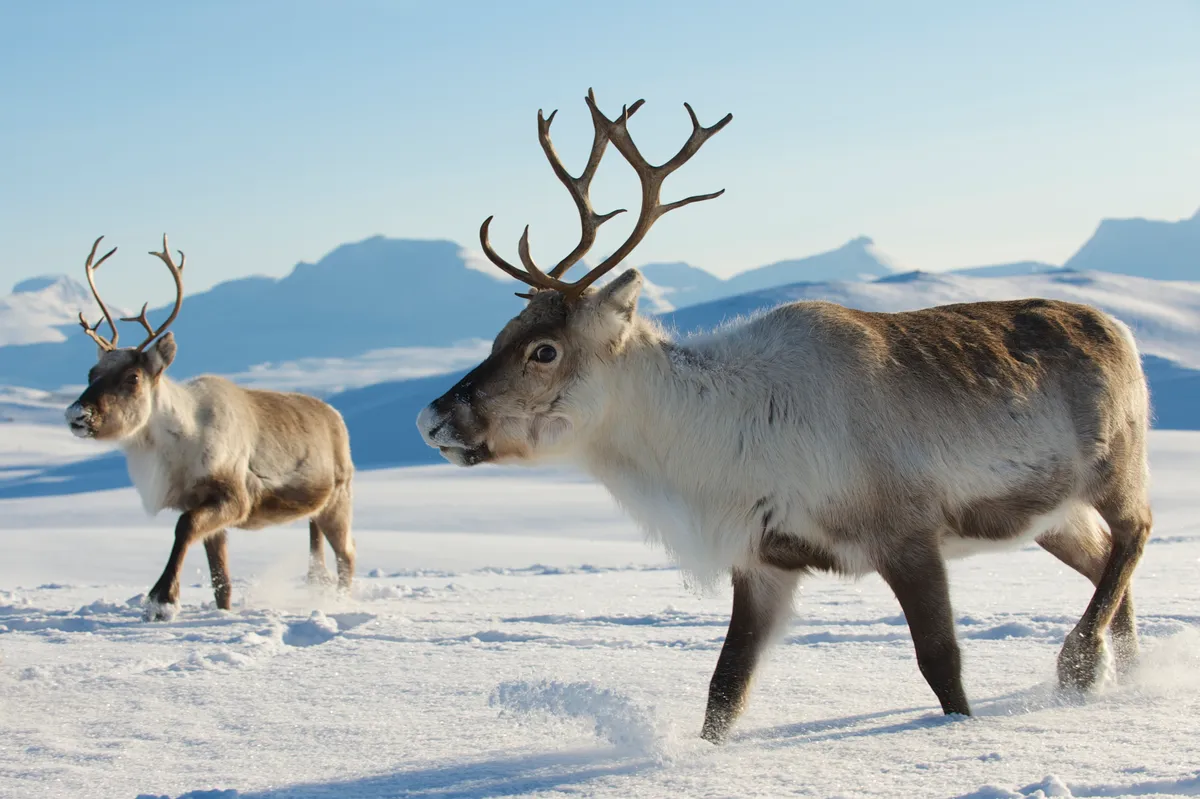
Unlike humans, Arctic reindeer can see ultraviolet (UV) light. “While we might struggle to distinguish between snow and hidden objects, reindeer excel at this because UV light, reflected vividly by snow, makes camouflaged objects stand out against the wintry backdrop," says veterinary eye expert Chris Dixon.
Discover some more incredible species
- Weirdest birds: meet 12 strange and weird wonders of the avian world
- Weirdest fungi in the world, from dead man's fingers to 'zombie fungi'
- Weirdest plants in the world: Discover some of the world's wackiest flora
- Weirdest animals: meet the weird freaks and oddballs of the natural world
Top image of Pacific barreleye fish: Daniel Smith/MBARI


