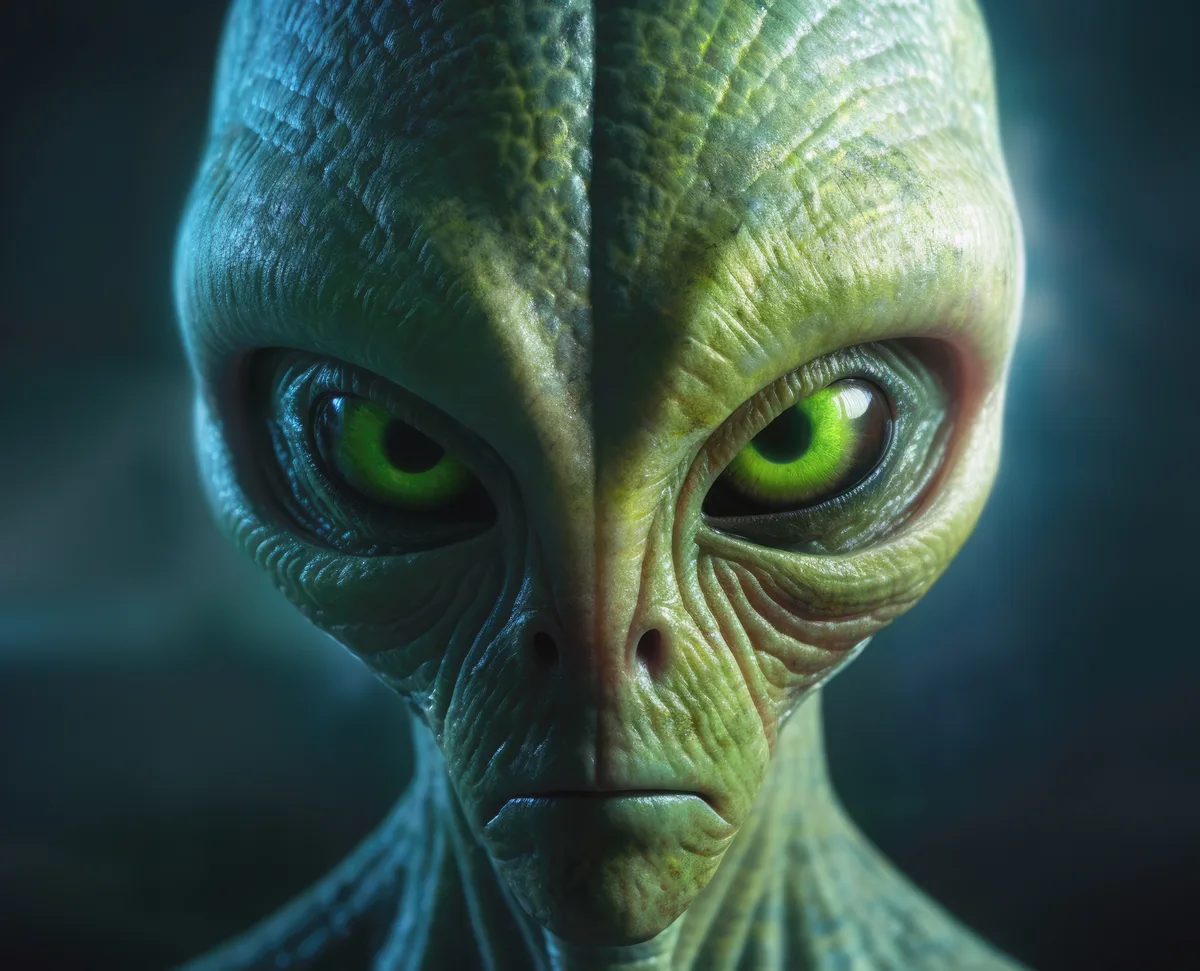
Aliens have been making headlines thanks to former US President Barack Obama’s remark in a podcast interview that they were “real but I haven’t seen them.”
On Radio 4’s flagship new programme Today, astrobiology professor Lewis Dartnell made the point that aliens – should they exist – would probably not be the “bug-eyed monsters” of Hollywood’s fevered imagination.
Still, as he also pointed out, there are three or four potentially habitable worlds, including Mars and Europa (one of Jupiter’s moons) in our solar system alone and then a mere 200 million stars in our Galaxy.
“So maybe on a sufficiently earth-like planet, evolution has had the chance to get beyond pond scum, boring bacteria-like life, to something a bit more like you and I,” Dartnell continued. “Multicellular, potentially even intelligent, perhaps technological – perhaps they are building spaceships and radio telescopes.”
But what multi-cellular and potentially intelligent alien life forms might look like is another question entirely. The chances of them being little green men with outsized eyes are, of course, remote.
Even creatures such as the xenomorph in the Alien film franchise are essentially portmanteaus of complex life found on Earth – they have heads, teeth, limbs and tails and look like a hybrid reptile-bird-insect of some description.
Netflix produced a series in 2020 called Alien Worlds – it used CGI techniques to create life-like animals from fictional planets, and though they partly avoid the cliché of the Alien films, many of the beasts still borrow heavily from life on Earth.
Carl Sagan and Edwin Salpeter indulged in more radical thinking when they came up with the idea, in a paper published in 1976, for what they called “floaters” in giant gas planets akin to Jupiter. They imagined them as “thin, gas-filled balloons” that could be anything from 1 metre to 1km in diameter and would float in dense atmospheres, obtaining food through either something similar to photosynthesis or the oxidation of methane.
A more recent paper, titled The Astrobiology of Alien Worlds: Known and Unknown Forms of Life written by Louis N Irwin and Dirk Schulze-Makuch, put forward the idea of “amorphous organisms” that could attach to seabeds or float in layers of water. Another idea is for “vertically floating, cigar-shaped organisms long enough to tap heat energy from lower layers of gas-giant atmospheres (or upper layers of deep aquatic bodies)”.
Planets much bigger than Earth, this paper also points out, would have a far greater gravitational force that would have significant consequences for large, complex life forms on land.
The evolutionary pressure would be for beings with low-lying morphologies – more snake than giraffe, in other words. That wouldn’t necessarily be true for those organisms that directly rely on sunlight in the way Earth plants do – they would still want to grow towards the light.
Darwin’s aliens, published in 2017, meanwhile predicted that any aliens out there would have undergone “natural selection” just as everything in our world has. It imagines the “octomite”, a squat blob-like beast that appears to live mostly below ground but possesses stubby appendages (possibly for feeding, though it’s not clear) and what look like feeding or excretion or egestion orifices.
But the real truth is that alien life on other planets could be even stranger than floating balloons or amorphous organisms floating in layers in water. Here on Earth, we have carbon-based life forms, but would they necessarily be elsewhere in the Universe?
Many scientists hypothesise that only silicon could replicate carbon’s versatility to create complex compounds such as polymers (DNA and proteins are bipolymers), but then only in very specific environmental conditions. Silicon can form organic compounds (they have been detected in space) but on Earth, it reacts with both water and oxygen and “is immobilised as silicates”. There is a possibility of organic silicon compounds existing in sulphuric acid, but that’s about it.
Silicon life forms could be very different to life as we know it – they could be crystalline in structure and very slow-growing (and slow-moving). They might flourish better at very high temperatures, so exist in molten environments. We might not even recognise such organisms as being alive.
Or think about it like this – as Irwin and Schulze-Makuch point out, on Earth we are progressing towards a point where the mass production of intelligent machines is becoming more possible every day. What if other civilisations on other planets have already gone way beyond this so that the manufacture of these machines is entirely robotically controlled. “At that point, the distinction between organic and mechanical life will be blurred at best,” they say.
The SETI Institute (SETI stands for “search for extraterrestrial intelligence”) has been combing the universe (as far as it can) for signs of life since 1984, but has so far drawn a blank.
The famous Fermi Paradox asks, if there are so many worlds out there and alien civilisations an absolute certainty, then – as the physicist Enrico Fermi famously said – “Where is everybody?”
“And what do they look like?” he might have added.
Top image © Getty