
Fossilised red blood cells found in dinosaur bone in "landmark discovery"
Finding signs of biomolecules within fossils is extremely rare; finding unequivocal, chemically proven evidence of fossilised red blood cells in dinosaur bones is unheard of, until now.
The recent discovery, made by an international team of scientists, not only promises to improve our knowledge of dinosaur physiology, but also reshape our understanding of how long biomolecules can survive in the fossil record.
Our understanding of prehistory hinges on fossils. These rare, often fragmentary remains of ancient organisms are our only windows into the world as it existed millions of years ago. While fossils can reveal what long-extinct organisms looked like, they can also give us insights into how they lived, thanks to the preservation of biomolecules.
From protein, carbohydrates and pigments such as melanin, to ancient DNA, all sorts of biomolecules have been recovered from fossils. These biomolecules add to our understanding of the physiology and ecology of ancient organisms, as well as the processes that take place after their death - i.e. those that transform them into fossils.
Not every fossil preserves biomolecules; finding them is extremely rare and gets increasingly less likely with age. There’s also a lot of controversy surrounding ancient biomolecules as they’re easily altered (and often destroyed) during the fossilisation process, which makes finding unequivocal evidence of their presence inside fossils incredibly difficult.
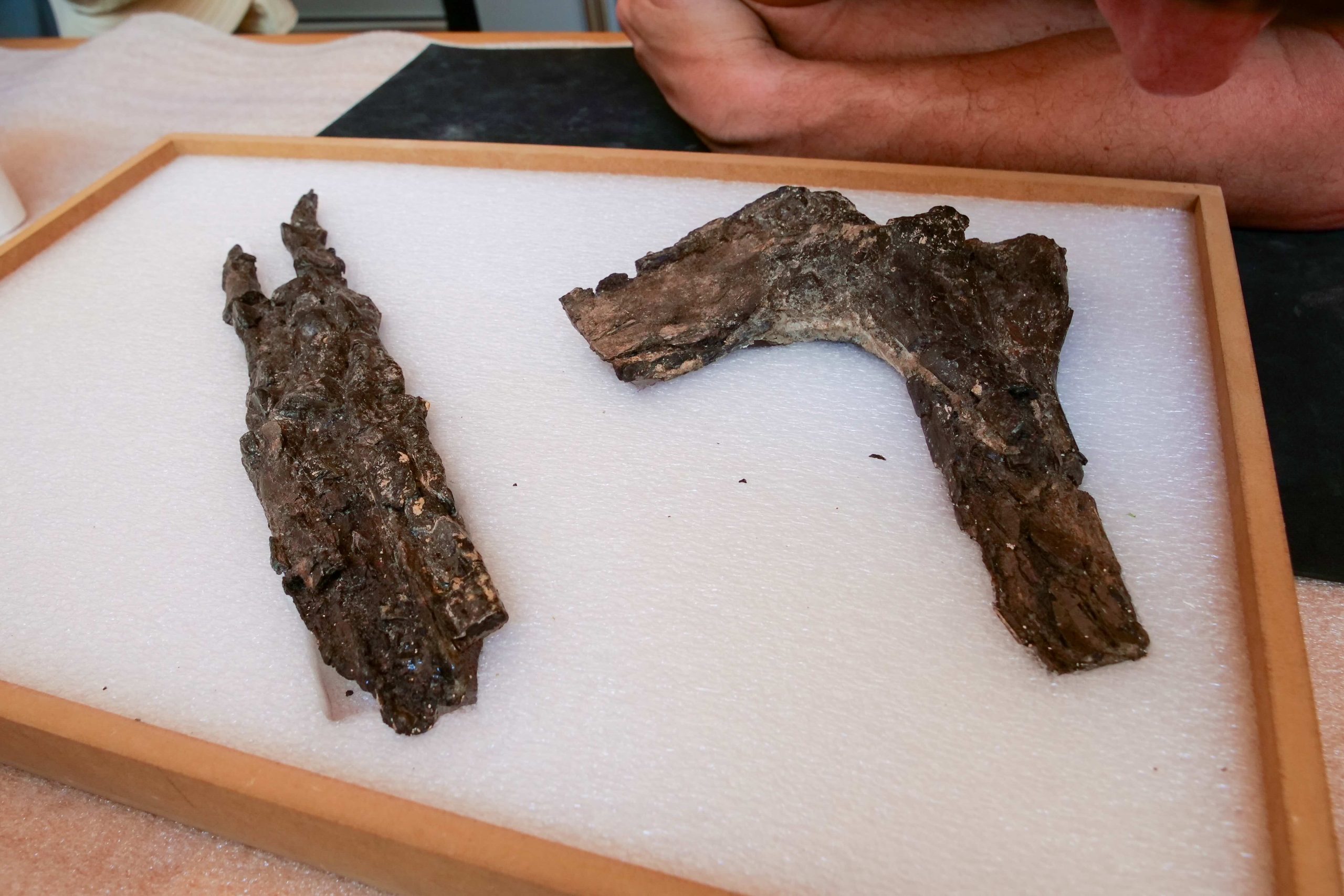
As part of a groundbreaking study, an international team of scientists led by Curtin University, Western Australia, has examined the limb bones of a 115-million-old theropod dinosaur from northwestern Brazil known as Aratasaurus museunacionali and found evidence of mineralised red blood cells and intact heme B biomolecules.
Heme is a ring-shaped, iron-containing molecule that forms a major component of haemoglobin, the protein found in red blood cells and responsible for transporting oxygen around the body. There are four major heme groups within haemoglobin, and heme B is the most common.
While studies have reported possible red blood cell structures in fossils before, this study, published in The Proceedings of the National Academy of Sciences, is the first to chemically prove the presence of haemoglobin-derived molecules (i.e. heme B) inside such cells.
“To detect intact heme derived molecules in 115-million-year-old red blood cells is astonishing: this really is a landmark discovery,” said the study’s lead author Kliti Grice. “It not only extends the known fossil record of blood, but also offers a direct molecular window into the physiology of long-extinct animals so we may better understand them and the world they lived in.”
- 10 Ice Age animals: extraordinary prehistoric beasts that thrived when the world was frozen
- The petrifying prehistoric beasts that would have terrified early man
- Imagine if dinosaurs hadn't gone extinct. Here's what scientists think may have happened next
- 8 extinct animals that could be brought back to life – from mammoths to dodos
After finding what they thought looked like fossilised red blood cells within the vascular canals of the fossilised bones, Grice and colleagues used a technique called high-performance liquid chromatography-mass spectrometry to analyse their chemical contents.
This involved passing an extract of bone through a special column containing material that separated its different chemical components. These components then entered a mass spectrometer, which measured their mass-to-charge ratios. This produced a distinctive chemical fingerprint that helped the scientists identify the molecules present.
In order to confirm the heme B came from the bones of Aratasaurus museunacionali and not elsewhere, Grice and colleagues subjected the surrounding rock to the same analyses. They found no heme B and instead detected signatures of chlorophyll and bacteriochlorophyll, suggesting the heme B did in fact originate from the bones.
The team believe the exceptional preservation exhibited by these bones was as a result of the dinosaur being rapidly buried in a low-oxygen, microbially rich environment shortly after its death. They also think the red blood cells were mineralised by a chemical compound known as hausmannite, which helped stabilise the cellular structures and associated biomolecules, transforming them into natural time capsules.
The team believe the exceptional preservation exhibited by these bones was as a result of the dinosaur being rapidly buried in a low-oxygen, microbially rich environment shortly after its death.
“These findings challenge longstanding assumptions that certain biomolecules such as haemoglobin cannot survive deep time,” said Grice. “It opens exciting new avenues for molecular-level palaeontology, allowing us to investigate the evolution of blood, metabolism, and even activity levels in ancient animals.”
This remarkable discovery will no doubt conjure images of Jurassic Park, where mad scientists extract dinosaur DNA from blood-sucking mosquitoes and use it to bring them back to life. But this study isn’t that. Although researchers may have found evidence of red blood cells, they’re fossilised and don’t contain any traces of DNA.
The oldest direct evidence of DNA in the fossil record dates back just 1.1 million years, preserved in the back teeth of a mammoth unearthed in Siberia, Russia. In comparison, dinosaurs faced extinction 66 million years ago, which is long past the point that scientists believed intact genetic material can survive.
While finding dinosaur DNA remains firmly in the realm of science fiction, this study does open up an equally fascinating avenue of research: using ancient biomolecules such as heme B to learn more about the biology, physiology, and perhaps even lifestyles of long-extinct animals.
You can read more about the latest research here.
More amazing wildlife stories from around the world
- Ichthyosaur pregnant with almost a dozen babies discovered in China – and they were nearly ready to be born
- Dinosaur hunters make “chilling” discovery deep in Canadian badlands
- Expedition finds rare and exquisite trove of ancient animals deep in Grand Canyon
- 100-million-year-old fossil found INSIDE belly of gigantic dinosaur in Australian desert
Top image: red blood cells found in dinosaur bone. Credit: Curtin University


