
In 2018, scientists noticed bright orange plumes of water billowing across a river in Alaska’s Brooks Range. According to their most recent findings, those plumes were even more acidic and metallic than water leached from metal mines, despite their pristine surroundings.
- "Truly astounding": rivers in Alaska are turning orange. Some are so bright they're visible from space
- "Parts of it have so little oxygen, they are considered ‘ecologically dead.’" 10 most polluted, toxic rivers on the planet
The new study – conducted by researchers from University of California Davis (UC Davis), USA, and published in the journal AGU Advances – examined six impacted watersheds in the Brooks Range mountains in north-west Alaska.
In previous research, the rusty-coloured water was attributed to thawing permafrost – soil (or underwater sediments) which continuously remains below 0 degrees Celsius for two years or more.
Around 11 per cent of the global land surface is underlain by permafrost, covering a total area of around 18 million km2. Most of this permafrost lies in the Northern Hemisphere, including large areas of Alaska, Canada, Greenland and Siberia.
When permafrost thaws and water trickles into the ground, it encounters minerals long-trapped in previously frozen soil – and then releases iron, sulphuric acid and other metals into nearby streams, turning them orange.
This is an increasingly common occurrence as the climate warms, especially in the Arctic, which is warming four times faster than the global average. Previous studies have documented more than 200 rivers and streams affected by this phenomenon.
“This was a process that was not forecast, predicted or included in any assessment of how the Arctic will change under a warmer climate, but we’re seeing it in rivers across the Arctic,” said Brett Poulin, a UC Davis professor in the Environmental Toxicology department and senior author of the study.
“Since our 2024 paper, ‘rusting rivers’ have been documented in Boreal and Arctic Canada, and other parts of the world that have permafrost.”
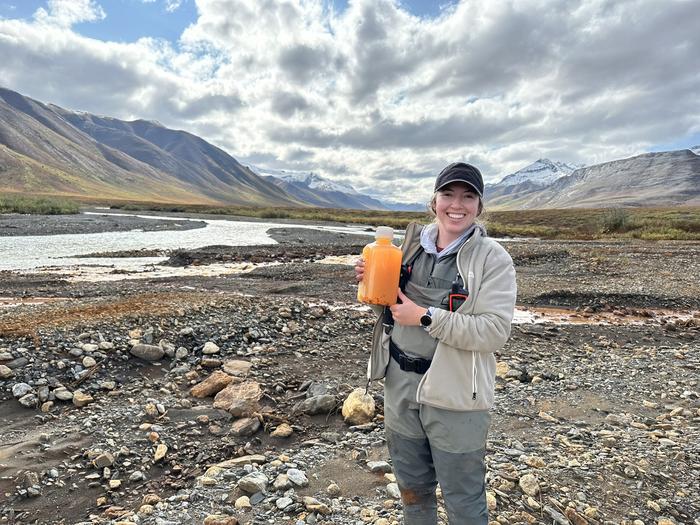
Studying the rivers
In the summers between 2022 and 2024, the scientists collected water samples from six affected watersheds within national parks and preserves in north-west Alaska’s Brooks Range.
They found that the metals released by the permafrost can travel far – and more than that, they can become more toxic as they go. Metal concentrations were about 70 times higher as far as 96km downstream from where they entered the river.
“This is very acidic, metallic water. The good news is the river’s mainstem did not become more acidic. It’s buffering the pH, indicating there is some resiliency in this system,” said Poulin. “But there are metals that increased downstream, and those can be transported very long distances.”
- A great predator is slipping through a hidden passage into the rivers and lakes of Alaska
- Siberia’s ‘Gateway to Hell’ is getting bigger. And it’s spewing out prehistoric animals
To determine when this event started in the region, the scientists used long-term water quality records. They were able to trace the onset to 2019-2020 – which coincided with Alaska’s hottest summer to date, followed by a snowy winter.
The analysis demonstrated abrupt, large spikes in sulphate and zinc concentrations that year, followed by a steady decline and recovery phase.
“When you have more snow, it insulates the soil, preventing refreezing,” said Taylor Evinger, a Ph.D. candidate in Poulin’s lab at UC Davis and first author of the study.
“We think water went deeper into the soil because of soil thaw, interacted with these minerals, and all of these watersheds were triggered around the same time."
The effects
Currently, there are no known adverse impacts to people or wildlife from acid rock drainage in these remote streams. But the scientists are examining the risks more closely, noting that thawing permafrost and subsidence also carry implications for local infrastructure.
“Concerns and hopes are the big takeaways. While we are not seeing massive fish die-offs, and we’re not aware of drinking water quality issues currently harming villages, the numbers of observations are still concerning,” said Evinger.
“Many watersheds – hundreds of them – have acid rock drainage inputs. These rivers are pretty much untouched, and yet this is happening here. It’s a new reality of climate change.”
Read the full findings here.
Top image: Orange, metallic water enters the Igning River in Gates of the Arctic National Park and Preserve in Alaska. Credit: Taylor Evinger/UC Davis


