
Between 2021 and 2023, East Antarctica gained a whopping 695 billion tonnes of ice – and scientists from the Institute of Oceanology of the Chinese Academy of Sciences (IOCAS) have now determined the cause.
In a new study published in the journal Nature, researchers say that this unusual gain of ice is temporary – but not insignificant. It’s the largest Antarctic mass gain observed by the Gravity Recovery and Climate Experiment (GRACE) satellite missions since they first launched in 2002.
- It’s about the size of Spain, stretches 800km – and protects the planet from a whopping 5 metres of rising sea levels
- Has Antarctica ever been ice-free? Why the coldest place on Earth hasn't always been blanketed by snow
The Antarctic ice sheet covers 98 per cent of Antarctica and plays an important role in regulating global sea levels. In the past two decades, Antarctica has lost ice at an average rate of approximately 140.5 billion tonnes per year.
West Antarctica is melting much faster than East Antarctica, but East, which has been referred to as a 'sleeping giant' of sea level rise, has the potential to impact Earth in a far greater way. It contains enough water to raise sea levels 52m, compared to 3-4m in the West Antarctic sheet. Even small changes could have relatively significant consequences.
To explain why the pattern shifted between July 2021 and April 2023, the researchers analysed gravity satellite measurements, snow accumulation records preserved in ice cores, and simulations of atmospheric circulation. This helped the team determine where the extra moisture came from – and how it got to East Antarctica.
Chain of events
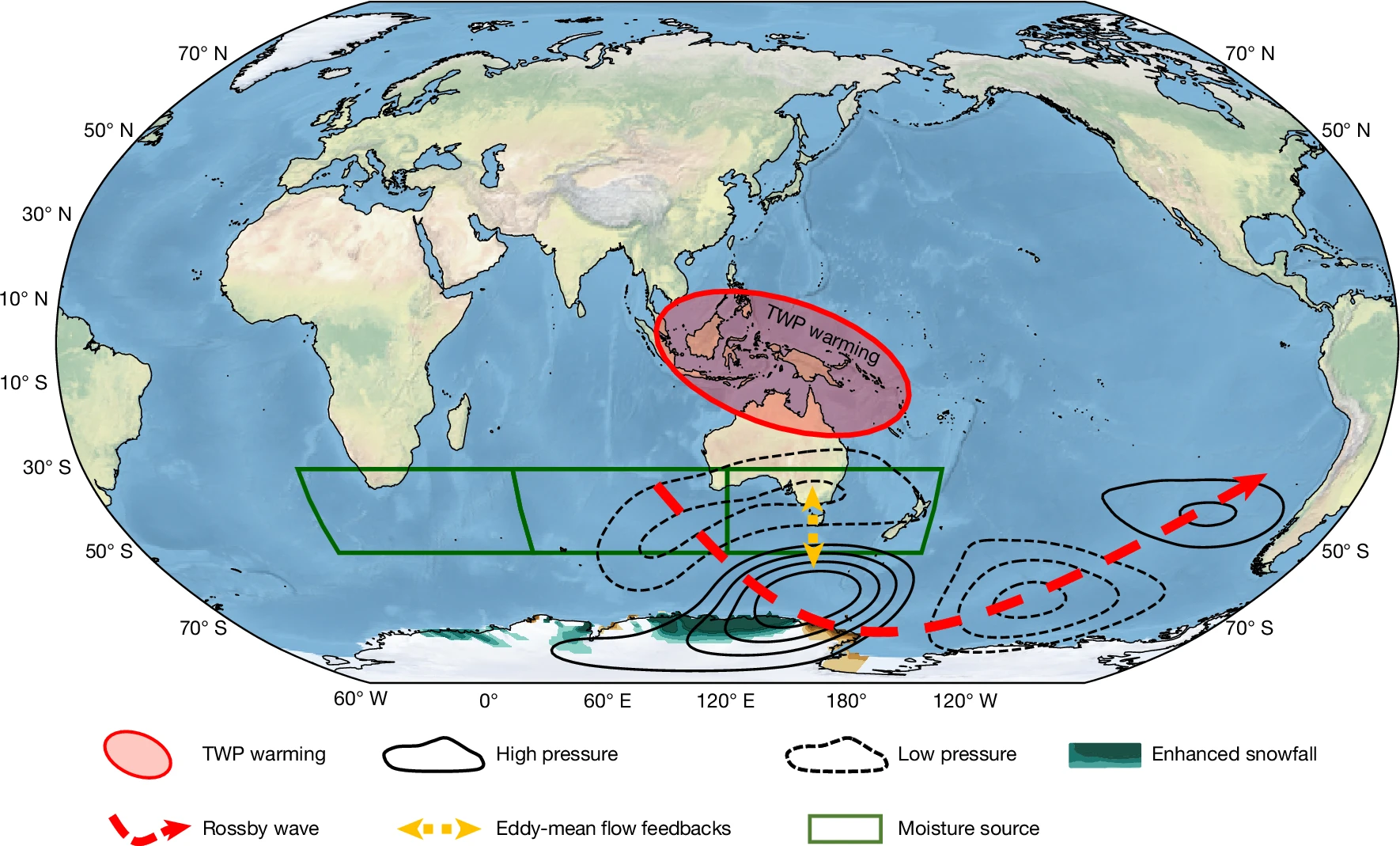
It all started in a region called the tropical warm pool, where the tropical western Pacific meets the eastern Indian Ocean – some of our planet’s warmest ocean waters lie here.
Sustained warming in the region between 2021 and 2023 triggered something scientists call a Rossby wave train – a wide-ranging pattern of atmospheric waves capable of influencing weather thousands of kilometres away.
The Rossby wave train transported these warm ocean waters to East Antarctica, influencing atmospheric conditions – including temperature, precipitation, humidity and wind velocity – around the continent.
This resulted in unusually low pressure south of Australia and unusually high pressure along the East Antarctica coast. The new pressure pattern changed how the moisture moved through the atmosphere – in particular, it strengthened the transport of water vapour from the Indian Ocean towards East Antarctica through atmospheric rivers (narrow corridors of concentrated moisture in the atmosphere).
When atmospheric rivers reach cold regions such as Antarctica, that moisture turns into a lot of snow. And that’s exactly what happened – the Queen Mary Land and Wilkes Land regions received sustained heavy snowfall, adding substantial mass to the ice sheet.
The researchers also took other factors into account and checked how much of the snowfall increase could be attributed to human-caused climate change, also known as anthropogenic forcing. As it turns out, anthropogenic forcing equated to an estimated 9 per cent of the ice gain.
- It’s more than twice the size of Texas and moves 800m a year – and it’s almost 2,000m deep
- It’s 100 times the size of Yellowstone, almost entirely covered by ice and is home to the ‘Iceberg Graveyard’
Not an anomaly
After additional observations and simulations, the researchers determined that this period of sustained warming in the tropical warm pool wasn’t an anomaly, and that comparable periods occur approximately once every decade. And they’re consistently associated with the connection between the tropical warm pool and East Antarctica.
“We found a previously under-recognised ‘tropical warm pool-East Antarctic Ice Sheet’ teleconnection pathway,” said Yunhe Wang from IOCAS, first author of the study.
“Our research provides a theoretical basis for understanding Antarctic Ice Sheet mass changes and conducting future research on the East Antarctic climate.”
Read the full findings here.
Top image: Not actual event. Credit: Zoonar RF/Getty Images


