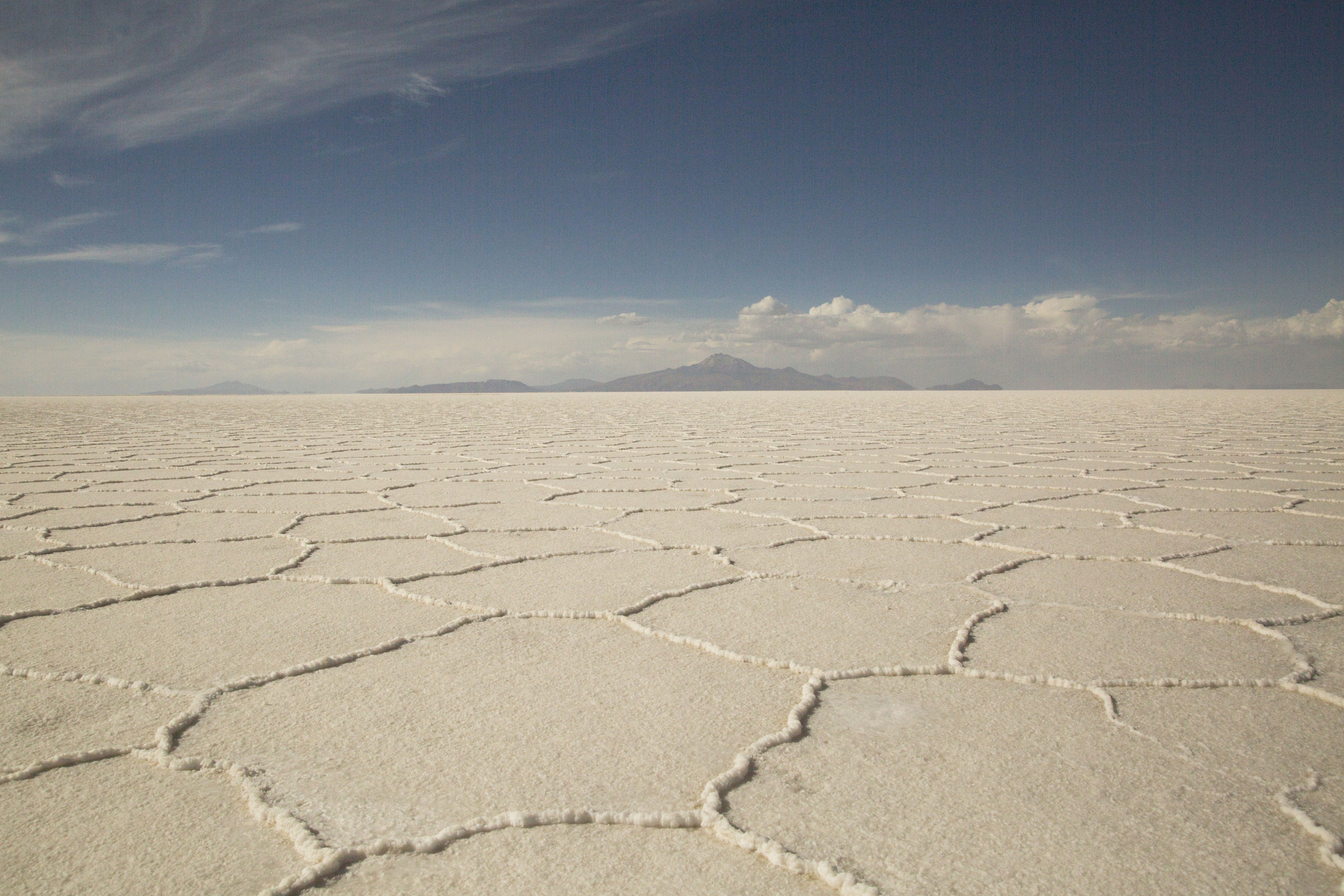
On the high Altiplano plateau in the remote southwest corner of Bolivia, there is an enormous desert of white salt.
According to legend, it was created when the tears of a heartbroken god mixed with her breastmilk. It is now one of the most lifeless places on Earth and those who drive out into this 10,500km sq wilderness can be overwhelmed by the solitude and silence.
If you visit after rainfall and a thin layer of water covers the landscape, the entire region becomes a vast mirror. It's no wonder Star Wars filmmakers were inspired to use it as the backdrop for the planet Crait in The Last Jedi (2017).
- Mysterious animal discovered in Utah's Great Salt Lake. It may exist nowhere else on Earth
- “It’s so dry that NASA has used parts of it to test Mars rovers.” 6 extreme places on Earth where you can still find life
Salar de Uyuni means the salt of Uyuni, a village on the south-eastern edge of the salt flats that is the gateway to most visitors' explorations of this extraordinary landscape. It is also a place to catch breath, literally.
The altitude here, on the edge of the Andean mountain range, is a heady 3,656m. With few other building materials available, many of the houses are made of bricks cut from the salt and this has tempted many tourists to lick the outer walls to see if it's true. It is. There are even luxury hotels made of salt here.
In the dry season, between December and April, the salt stretches further than the eye can see. The curious hexagonal honeycomb pattern in the salt crust, which is found in all the world's salt flats, was recently discovered to be caused by “the convection or circulation of salty water in the soil beneath the salt crust” according to researchers at Nottingham Trent University and TU Graz in Austria.
“The salt deserts in which these patterns occur are by no means bone dry and the highly salty groundwater often reaches up to lie directly below the salt crust. In these deserts you’d quickly reach that water digging by hand, although it would be far too salty to drink.”
When it rains (May to November), surface water covers the salt and creates a breathtaking mirror 130km across – when there is no wind. As there is no discernable horizon or trees and hills to create scale, visitors often take advantage of the flat landscape and mirror effect to create 'forced perspective' photoshoots. For instance, a tiny model dinosaur can be photographed to appear to tower over humans, and even “chase” them.
Indigenous Quechua and Aymara people often work as tour guides and have an alternative name for the salt flats: Salar de Tunupa. Tunupa, Kuska and Kusina are nearby mountains but also viewed as gods. Tunupa married Kusku but he betrayed her with Kusina while Tunupa was pregnant and it's Tunupa's tears and breastmilk that created the salt flats.
The scientific view is that about 40,000 years ago the Salar was a series of giant prehistoric lakes, some freshwater, some salty. As the climate changed, the lakes progressively dried up until by about 10,000 years all that was left was a layer of salt 8m deep but also extremely flat.
Elevation across the whole Salar varies by no more than one metre, which means, according to the European Space Agency “the area [is] ideal for calibrating satellite radar altimeters – a kind of radar instrument that measures surface topography.”
But the Salar isn't entirely a flat lifeless desert of salt. Far out in the middle of the flats there is a rocky hill covered in giant cacti. Called Isla Incahuasi (home of the Incas), it covers about 25 hectars and rises to 50m above the salt flats and is the tip of an ancient volcano.
- It's the lowest place on Earth, the size of Seoul, 10 times saltier than the ocean – AND it's dying. One day soon it might not be here...
- "Known as the Gateway to Hell, where lurid-coloured acid lakes create an eerie, alien world." 10 barren dead zones where nothing survives...
As well as the huge cacti, there are strange fossils of coral-like structures. A number of high-altitude bird species can be found here, including hummingbirds. Some species are drawn to the bonanza of food left behind by tourists. There is also a colony of rabbit-like rodents called vizcachas.
It is estimated that there are 10 billion tonnes of salt within the Salar and salt harvesting is a major business for local people with up to 25,000 tonnes extracted every year.
The Salar and surrounding areas also hold over 70 per cent of the world's lithium reserves. The world's lightest metal is a crucial element in smartphones and laptops but debate rages over whether lithium mining might damage and even destroy this unique environment. Many local people live in poverty and believe mining might bring jobs and opportunities but there are fears control could fall into the hands of foreign mining companies and major mining infrastructure may not be sensitive to local cultural and environmental concerns.
- “I once worked at an elevation of more than 5,000m in Bolivia and it was very difficult to breathe, eat and sleep.”
- The world’s largest desert is enormous and there’s hardly any rain – but it’s not hot. Here’s why
- The ‘world’s smallest desert’ covers just 1 square mile, is in Canada and was carved out by ancient glaciers – but it’s not actually a desert