
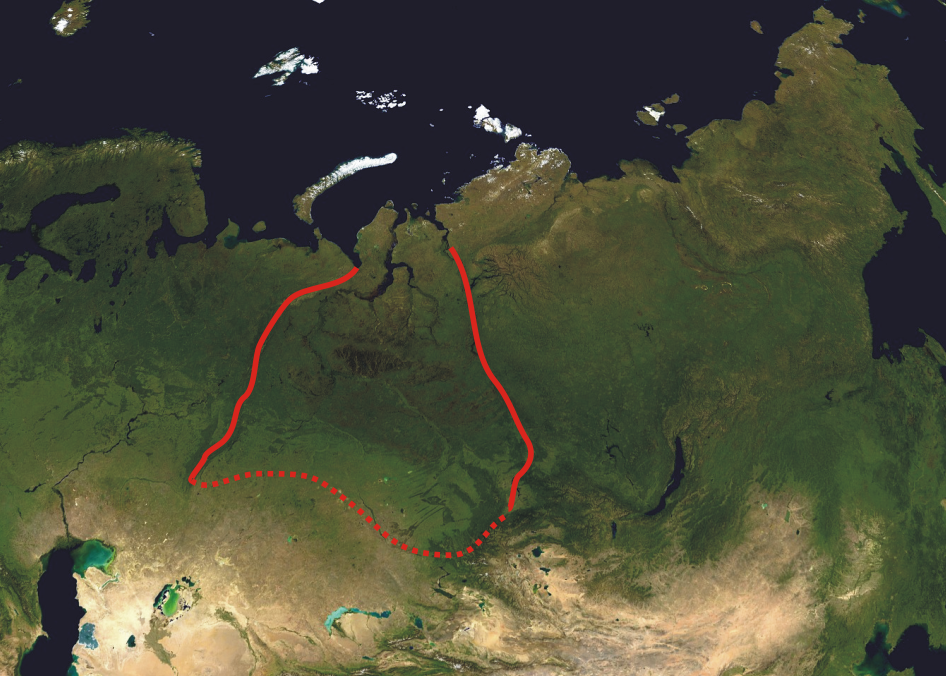
The West Siberian Lowland (WSL) stretches from the northern Arctic tundra to the edges of the Kazakhstan steppe.
It spans an area of around 3,000,000 square kilometres (nearly 1,200,000 square miles) across central Russia, with the Ural Mountains in the west and the Yenisey River valley in the east. It’s thought that the WSL represents 16 per cent of the territory of Russia.
- Siberia’s ‘Gateway to Hell’ is getting bigger. And it’s spewing out prehistoric animals
- Just how long do glaciers take to give up their dead? Inside the chilling journey...
While it is blanketed by snow in the winter period, with permafrost underneath, the WSL is also the world’s largest high-latitude wetland. And apart from some low hills and ridges, the plain is mainly flat and featureless. But this landscape hides an unusual secret: it contains the world’s largest peatland.
What’s the largest peatland in the world?
The West Siberian Lowland (WSL) contains what is generally considered to be the largest peatland in the world – although estimates vary. Journal article calculations of the peatland’s total area range from 592,440 square kilometres to 900,000 square kilometres, with the Guinness World Records stating that the peatland covers 787,000 square kilometres.
In contrast, the US’s second-largest state –Texas – is 695,662 square kilometres.
The WSL likely contains 70 petagrams of carbon (the equivalent of 70 billion metric tonnes) and has been a long-term carbon dioxide sink and global methane source since the early Holocene period (our current geological epoch, which began around 11,700 years ago).
However, the permafrost across the region is thawing – which means this vast gas sink could end up releasing its stores into the atmosphere. This creates a positive feedback loop, as more greenhouse gases in the atmosphere further increase global temperatures, thawing more permafrost.
Heatwaves and wildfires in the region are also making the area more susceptible to releasing its stores.
- What exactly is peat – and why is it so important?
- The Great Barrier Reef, Machu Picchu – and a Scottish bog. Unearth the latest UNESCO World Heritage Site
West Siberian Lowland wildlife
The West Siberian Lowland is rich in wildlife due to its varied ecosystems, including wetland and taiga (a boreal forest region in the Northern Hemisphere). Predators such as the brown bear, grey wolf, Eurasian lynx and wolverine are found across its vast lands, as well as smaller mammals such as the steppe polecat, Siberian weasel and Siberian flying squirrel.
Many insects thrive in its watery environment, which provides plenty of feeding options for birds such as yellow-breasted buntings, Siberian cranes and white-headed ducks. Migrating birds, such as greater-spotted eagles, also use the lowlands during the breeding season.
In the wider West Siberia region, you’ll find amphibians such as the Siberian salamander, the moor frog and the Siberian wood frog. However, the amphibian fauna in this region is relatively poor due to harsh climatic conditions.
Top image: aerial view across an area of the West Siberian Lowlands. Credit: Leonid Ikan/Getty Images


