
They once roamed large parts of Europe, Asia and northern Africa, but aurochs became extinct in the 17th century when the last confirmed individual died in Poland. But in Scandinavia, they perished much earlier – and a new study suggests it wasn’t a single factor that led to their demise.
- Prehistoric aurochs are back from extinction and spreading across Europe. And they could be heading to the UK sometime soon…
- It weighed the same as a BMW, was taller than Brad Pitt and had enormous horns. The terrifying, prehistoric aurochs that survived until the 17th century
The research was conducted by an international team of scientists led by Lund University in Sweden. The findings are published in the journal The Holocene.
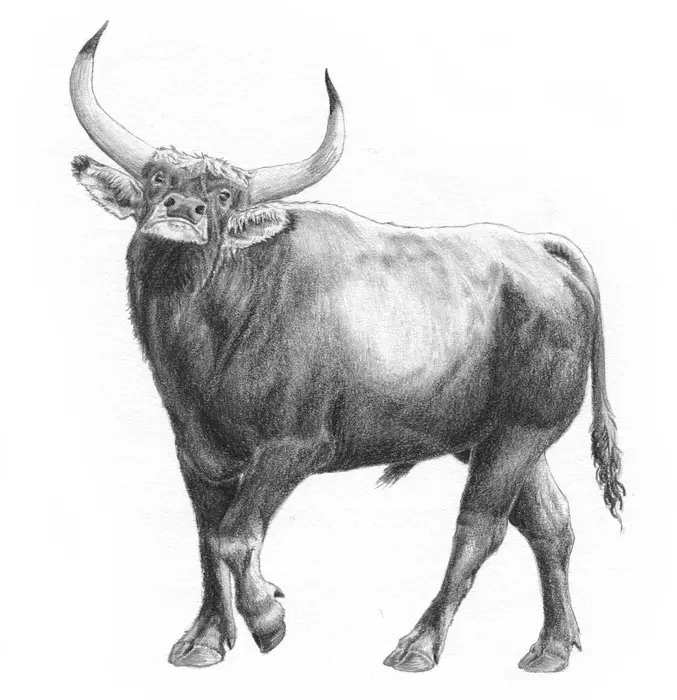
Aurochs (Bos primigenius) were a type of megafauna in the Pleistocene (around 2.5 million to 11,700 years ago). This prehistoric animal stood taller than most humans, tipped the scales at more than a tonne and was much wilder than its modern descendant.
The global extinction of the aurochs was largely driven by human activity, but the reasons for its much earlier disappearance from Scandinavia have remained unclear.
To find out what factors might have influenced this extinction, the researchers studied ancient aurochs’ bones from bogs and settlements in southern Sweden and Denmark, tracking how many specimens and bones showed up in each period. Then they compared the ages of bones across archaeological sites, and all of this data was matched against paleoenvironmental and archaeological records.
The migration
At the end of the last Ice Age – around 11,700 years ago – the aurochs began moving northward from their habitats in the peninsular regions of Europe. Using a land corridor formed by low global sea levels and postglacial rebound, the species reached Scandinavia.
But that migration didn’t come without a cost. The aurochs likely suffered a sharp population drop (also called a population bottleneck) which left them with lower genetic diversity.
“I found it incredibly interesting to see how the genetic diversity of the aurochs decreased as you moved north from mainland Europe up through Jutland and then dropped further across Zealand and Scania,” says Mikkel-Holger S. Sinding, associate professor at University of Copenhagen and a senior author of the study. “It’s a textbook example of a bottleneck in evolutionary genetics.”
It was previously believed that the Scandinavian aurochs population became isolated around 10,000 years ago, when a river and lake system developed across present-day Denmark.
But, according to genetic evidence, the Scandinavian aurochs were in contact with the main European population for another 2,000 years. That’s when the land bridge connecting Scandinavia to the European mainland was flooded, completely isolating the Scandinavian population.
- It was a 2-metre-tall, 500kg prehistoric monster pig with bone-crushing jaws – one of the most ferocious predators ever to have lived
- "Standing at a whopping 3.7m and weighing 4 tonnes they were truly colossal." 10 extraordinary Ice Age, prehistoric, beasts that thrived in a frozen world
Multiple factors
The researchers also identified a period of seemingly intense human hunting that coincided with the flooding. Despite an apparent decline in the species’ population, aurochs’ bones continued to be present within Scandinavian archaeological sites. This is attributed to Mesolithic groups deliberately transporting prey carcasses from hunting territories.
This led to a complete disappearance of aurochs from the island of Zealand in Denmark, with the most recent remains dating to around 8,500 years ago. In southern Sweden, the species persisted – albeit in low numbers – until at least 6,500 years ago, likely driven to extinction by open landscapes giving way to dense forests.
This complex set of factors that ended with the extinction of Scandinavian aurochs holds clues that could be useful to wildlife management today.
“Our results add nuance to our understanding of human impact on human populations. They confirm that species rarely disappear because of a single factor. Conservation plans must therefore be comprehensive and consider multiple stressors at the same time,” explains Erika Rosengren, a doctoral student at Lund University and lead author of the study.
“Our results support the need to establish ecological corridors for threatened wildlife, rather than isolated nature reserves.”
Read the full findings here.
Top image: Aurochs skull from Scania from the Biological Museum at Lund University. Credit: Lucas Gölén


