
The evolution of the horse is often presented as a simple, straight-line journey. In this familiar tale, Eohippus stands at the base of the family tree, followed by progressively larger species until the story reaches today’s horses (Equus) - the largest horses ever to exist. But the real story is far more complicated.
What was Eohippus?
Eohippus is an extinct ungulate mammal that is widely considered the first ‘true’ horse and the ancestor of all living (and extinct) horses. It lived in North America during the Early Eocene (56-48 million years ago), just 10 million years after the extinction of the non-avian dinosaurs.
Named Eohippus, or ‘dawn horse’ after the fact it’s the earliest member of its family (Equidae), this pint-sized pony is only known from one species, Eohippus angustidens. This hasn’t always been the case, though. In fact, Eohippus has one of the most confusing taxonomic histories of any extinct mammal.
How was Eohippus discovered?
In 1938, Sir Richard Owen - a palaeontologist best known for coining the term Dinosauria, or‘terrible lizards’ - stumbled across a small, fossilised jaw in the Thames River of southeast England. He noted the teeth resembled those of hyraxes, leading him to name the fossil Hyracotherium, or ‘hyrax-like beast’
.A few decades later, in 1876, another esteemed palaeontologist known as Othniel C. Marsh described a new genus, Eohippus, based on a skeleton discovered in New Mexico, USA. In 1932, another palaeontologist - Sir Clive Forster-Cooper - waded into the mix and noted remarkable similarities between Hyracotherium and Eohippus, eventually coming to the conclusion that they represented the same animal.
- It looked like a cat and acted like a cat – but this cat was different. It was the first-ever cat on the planet – the ancestor of all cats today…
- It didn't much look like a dog – or act like one as it climbed trees like a cat – yet it was the first-ever dog on the planet and the ancestor of all dogs today…
According to the International Code of Zoological Nomenclature (ICZN), the earliest established scientific name takes priority, so Eohippus became Hyracotherium.
The story doesn’t end there, though. A later study of Hyracotherium’s jaw revealed that it wasn’t actually a horse, rather a member of a closely related group called the palaeotheres - horse-like animals with shorter, stouter bodies and more compact skulls.
This meant that the skeleton originally described as Eohippus represented a species from a distinct family, which led to its name being restored and recognised as the first ‘true’ horse.Many other species that were named during this period have since been recognised as Eohippus and synonymised, including eight different species of Hyracotherium.
What did Eohippus look like?
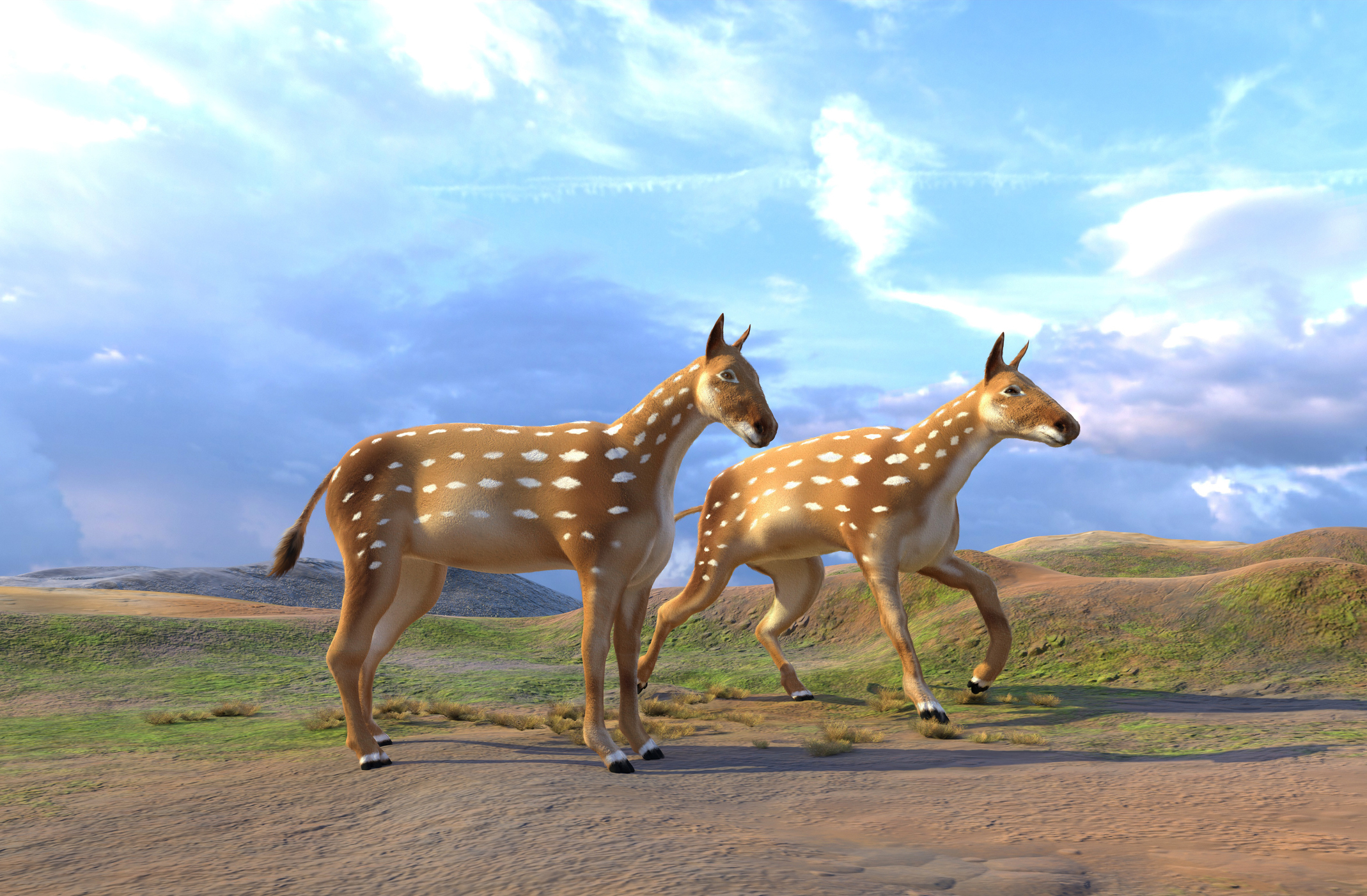
If you came across an Eohippus in the wild today, you’d be forgiven for thinking that it was a modern horse that had shrunk after spending too much time in the tumble dryer. Standing just 30cm tall and measuring 60cm, it was about the same size as a baby lamb and only a little bit larger than a yappy Chihuahua.
But if you looked closer, particularly at its feet, you’d start to notice some key differences.
Instead of only having one functional toe per foot, like modern horses, Eohippus had four toes on its front feet and three toes on its hind feet. Each of these toes ended in a hoof - miniature versions of the giant hooves sported by today’s horses.
Eohippus’ incisors, molars, and premolars were distinctly horse-like. In fact, it’s these characteristic features that helped palaeontologists identify Eohippus as an early member of Equidae. However, unlike modern horses, Eohippus possessed large canine teeth that some think may have played an important role in defense and intraspecies fights over territory and mates.
Where did Eohippus live?
While fossils once thought to belong to Eohippus have been found in Europe, these have since been identified as belonging to palaeotheres, such as Hyracotherium. Eohippus and later equids lived in North America, particularly around the western US and Mexico.
In contrast to modern horses that are found almost exclusively on open steppes, semi-arid deserts, and grasslands, Eohippus preferred dense, subtropical forests where it could browse on soft, low-hanging plants.
Its toes were an adaptation to these kinds of environments, providing stability, balance and even weight distribution while it moved across soft, wet, and uneven forest floors.
As a small, agile mammal, Eohippus could dart through dense undergrowth with ease, thanks to its padded, hoof-tipped toes and unfused lower legs bones, which gave it excellent manoeuvrability. In modern horses, these lower leg bones are fused, increasing speed at the expense of agility.
What did Eohippus eat?
Based on its teeth and the shape of its hindgut, palaeontologists think Eohippus was a forest-dwelling browser that predominantly ate soft plants, such as leaves, fruits, berries, and shoots and buds.
While its teeth looked similar to those of today’s horses, they were low-crowned, meaning they were better suited for crushing soft foods rather than grinding down harsh grasses.Eohippus also had a small hindgut built for a low-fibre diet, unlike the complex digestive systems of modern horses.
What did Eohippus originate from?
Eohippus may be considered the first ‘true’ horse and the founding member of Equidae, but it didn’t appear out of nowhere - it can trace its roots back to several horse-like ancestorsthat, while not true horses, could easily be confused as such.
Horses, along with their close cousins the palaeotheres, make up a group known as Equoidea. This group appeared in Europe or Asia during the Late Palaeocene, just a few million years before Eohippus arrived in North America. However, the exact origins ofEquoidea remain a mystery.
Both horses and palaeotheres belong to a larger family of mammals known as perissodactyls, or ‘odd-toed ungulates’
Today, this family is represented by just three subfamilies - Equidae (horses), Rhinocerotidae (rhinoceroses), and Tapiridae (tapirs) - but during the Eocene they were incredibly diverse and comprised many other now-extinct subfamilies, such as brontotheres (‘thunder beasts) and chalicotheres (‘gravel beasts’).
Like later horses, the perissodactyls had small and humble beginnings. They are thought to have evolved from a tiny, horse-like mammal called Radinskya, which lived in East Asia during the Late Palaeocene. Soon after, the group underwent an adaptive radiation, rapidly diversifying into a wide range of species.
Why did Eohippus become extinct?
Eohippus didn’t go extinct in the traditional sense of it dying out completely; it’s from Eohippus that many larger, more ‘advanced’ horses evolved.
However, small Eohippus did eventually disappear 48 million years ago, around the same time that North America’s climate grew drier and dense forests began to open up into mixed plains and brush.
To survive these changing landscapes, lineages that emerged from Eohippus developed longer legs and more efficient grinding teeth, in order to deal with the increasing abundance of abrasive grasses.
What came after Eohippus?
Shortly before Eohippus disappeared, a similarly sized but longer legged horse known as Orohippus appeared. Although its name means ‘mountain horse', this early horse didn’t live in the mountains, nor was it particularly well adapted for running. Instead, palaeontologists think its longer legs were characteristics of a good jumper.
Mesohippus, or ‘middle horse’, was the next major protagonist in the story of horse evolution, appearing in the Late Eocene (37 million years ago) as grasslands continued toexpand across North America. Mesohippus was roughly twice the size of Eohippus (60cm tall), but with longer lower limbs and an extended middle toe, it was a much better runner.
These traits helped Mesohippus become one of the most widespread mammals in North America.
In the Middle Miocene (approximately 15 million years ago), an ancestor of Mesohippus, Merychippus, thrived. Merychippus stood 1m tall and looked a lot like today’s donkeys. Its lower limbs and middle toe were even longer than those of Mesohippus and were well on their way to resembling the lower limbs of modern horses. It’s believed Merychippus diversified into at least 19 additional species!
Pliohippus arrived on the scene at a similar time to Merychippus, but it looked even more horse-like, running on a single, extended middle toe tipped with a large hoof. The teeth of Pliohippus were also wider and higher crowned than its predecessors - a sign that horses were slowly but surely adapting to the hard grasses of the steppes and open plains.
Dinohippus and Plesippus followed shortly after Pliohippus and are widely considered to be the direct ancestors of Equus, which includes all living horses - from wild and domestichorses, to donkeys, zebras, and asses. Plesippus was one of the pioneering species that left North America via the Bering land bridge, sparking the diversification of horses in Eurasia.
Is ‘straight-line evolution’ a myth?
The evolution of the horse is often put forward as an example of ‘straight-line evolution’ where species emerge in a classic linear sequence, progressing neatly from Eohippus to Merychippus and, finally, to Equus.
This is an old, 19th-century idea that has no basis in modern palaeontology. Since the first early horses were discovered, palaeontologists have found many species that buck this simple trend. Some lineages actually became smaller over time rather than larger, and many different types of horses lived alongside one another.
One reason this misconception has endured is because Equus is the only surviving horse lineage. This makes it seem as though evolution followed a straight path from Eohippus to modern horses, but that’s only because Equus is the last surviving branch of a family tree that once had many, many more branches. Rather than a ladder, horse evolution is better pictured as a bush, with many branches existing side by side before all but one died out.
This less direct, branching idea of evolution applies to most groups of animals, including us. Like horse evolution, human evolution is a branching bush, not a ladder. We didn’t evolve from chimpanzees - despite what the famous March of Progress illustration would have you believe. Instead, we share a common ancestor, with each lineage following its own distinct evolutionary path.


