
Instead of flippers, a blowhole, and a body the size of a school bus, this whale ancestor walked on four legs, was covered in fur, and was no larger than a fox
There are few evolutionary stories more mind-blowing than that of whales. These water-bound behemoths are amongst the largest animals that have ever lived, yet if you trace their roots back far enough you’ll come across animals that were a fraction of their size, walked on four legs, and - crucially - spent a lot of their time on land.
What was Indohyus?
Indohyus is an extinct, semi-aquatic mammal that lived in Asia during the Middle Eocene, from 49 to 45 million years ago.
It’s known from fossils unearthed across Asia, but it derives its name Indohyus, or ‘Indian Pig’, from the fact it was originally found in the northern Indian province of Jammu and Kashmir.
Indohyus belongs to a bizarre group of mammals known as the raoellids, which, like Indohyus, were semiaquatic and lived primarily around northern India and Pakistan during the Eocene.
The raoellids are long-extinct, but they emerged from a group that’s still widespread across Earth today: the artiodactyls, or ‘even toed ungulates’. This group includes many different families of mammals, from pigs and hippos to antelopes, deer, giraffes, cattle, and even whales.
What did Indohyus look like?
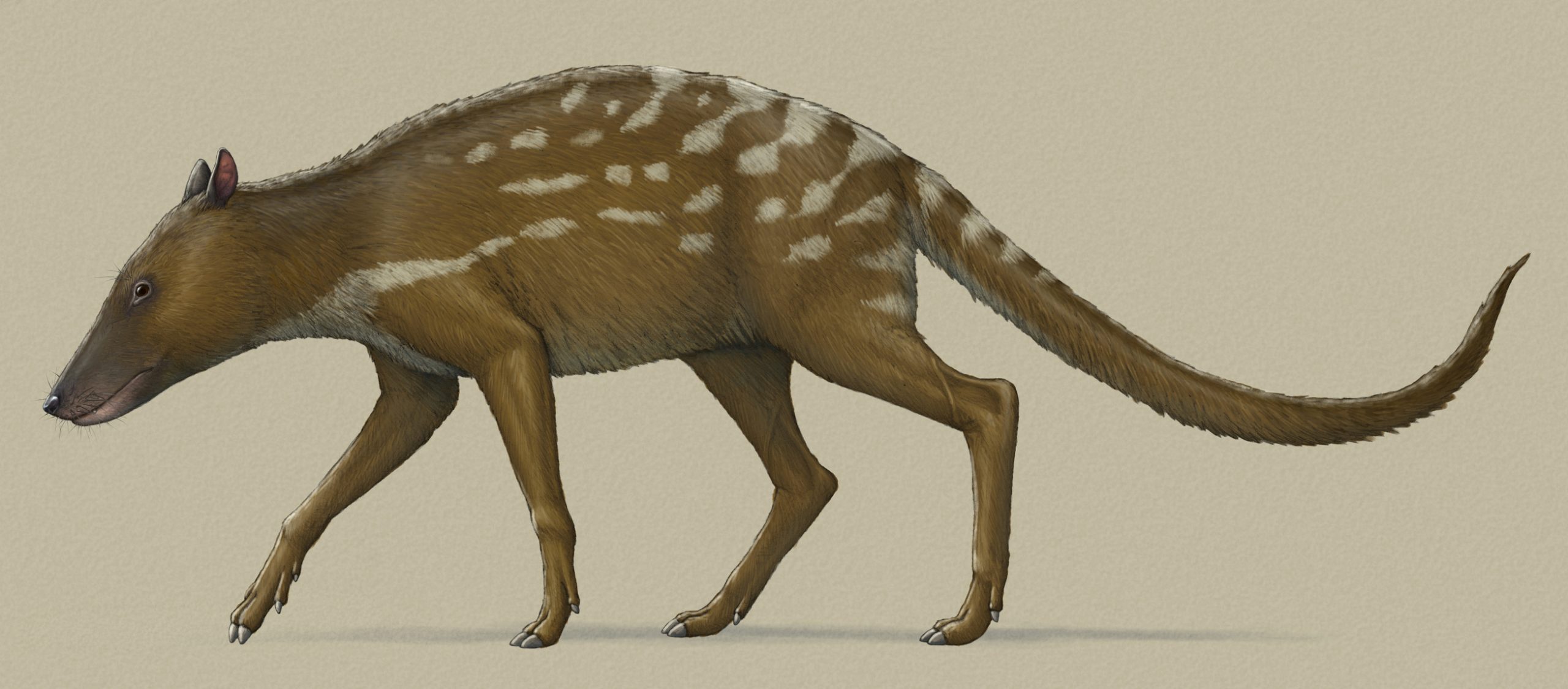
If you stumbled across an Indohyus in the wild you’d be forgiven for thinking you’d come face to face with a fox.
As well as being roughly the same size as a fox, Indohyus’ build was quite similar; with an elongated snout, slim body, skinny legs, and a long tail, it could have easily passed for an early canine. It was also covered in a layer of short fur - though what kind of colours it sported remain a mystery.
However, unlike other mammals, Indohyus had unusually thickened bones, more like those of hippos and whales than traditionally terrestrial mammals. This, along with several other adaptations, led researchers to suggest Indohyus was semiaquatic.
In fact, based on isotopic studies of its bones, researchers think it may have spent more of its time underwater than on land.
Where did Indohyus live?
During the Eocene, the Indian subcontinent was an island just beginning its collision with Asia.
The collision of these two massive landmasses squished layers of oceanic crust that, over the course of several million years, folded to form the Himalayas - the highest mountain range today. This uprising of oceanic crust is why fossils of animals that used to live on the ocean floor can be found near the summit of Mount Everest!
Indohyus and other raoellids thrived on this island subcontinent. They primarily lived along the coast, which were covered in mangrove forests and other flooded, tropical habitats.
Despite spending a lot of its time in water, researchers think Indohyus was a poor swimmer - its limbs were thin and its heavy bones would have weighed it down. Instead, it’s more likely Indohyus bobbed around like hippos do, using its dense bones to sink to the bottom of a river or lake where it would then start walking.
There are several different theories as to why Indohyus evolved to be semiaquatic, chief amongst them being to avoid predators. Like mousedeer do when threatened by birds of prey, researchers think Indohyus may have dove into water and hid beneath the surface for several minutes before reemerging.
Indohyus may have also been partial to aquatic plants and/or invertebrates, adapting to an underwater lifestyle in order to satisfy its cravings.
How was Indohyus discovered?
The first remains of Indohyus were discovered in 1970 by Indian geologist Ranga Rao in northern India. Rao described his findings in 1971, naming the species Indohyus indirae after Indira Gandhi, India’s first and so far only female prime minister.
While it was quickly recognised as a raoellid, exactly where Indohyus and its cousins fell on the wider family tree of mammals puzzled researchers. Historically, raoellids were considered basal artiodactyls, or even the long-lost ancestors of pigs.
This all changed in 2007 when a student of Dutch-American palaeontologist Hans Thewissen accidentally broke the skull of an Indohyus. This accident ultimately provided the key to unlocking the mystery surrounding Indohyus’ identity, revealing anatomical features only seen in modern whales.
Thewissen noticed a thickened inner bone, as well as other features that were distinctly whale-like, such as thicker limb bones, the arrangement of its incisors, and the high crowns of its back molars.
After making these observations, Thewissen published a study that - for the first time - demonstrated Indohyus and other raoellids are the closest relatives of whales, lying just outside the group known as Cetacea (which encompasses all extinct and extant whales).
What did Indohyus eat?
Based on the shape of its teeth and its long snout, researchers think Indohyus was most likely a herbivore that rummaged through the undergrowth for soft leaves, shoots, and buds.
However, whether it ate aquatic plants, terrestrial plants, or a combination of both is the subject of debate. The wear patterns on its teeth are different from those observed on other, more terrestrial artiodactyls, which suggests it may have had a preference for aquatic plants. That said, it may have also returned to land to eat terrestrial plants, like hippos do.
An alternative theory suggests Indohyus was omnivorous and fed primarily on aquatic invertebrates living in the muddy bottoms of rivers. This is based on wear patterns on its molars that bear remarkable similarities to those of early toothed whales. Some researchers also point towards its pointed incisors as adaptations for grasping small, slippery critters.
What did Indohyus originate from?
Indohyus and other raeollids make up a subfamily of Artiodactyla, a diverse order of mammals better known as the ‘even toed ungulates’.
This group appeared 55 million years ago in the Early Eocene and is characterised by the fact that they bear weight equally on two of their five toes. In contrast, perissodactyls (or ‘odd toed ungulates) - a group that includes horses, rhinos, and tapirs - bear weight on an odd number of their five toes.
The artiodactyls can be split into four main subgroups: camels, pigs, ruminants (e.g. cattle, deer, sheep, and antelopes), and hippos/whales. Together, hippos and whales comprise a group hilariously known as Whippomorpha.
Indohyus sits at the base of this group. It’s closer to whales than it is to hippos in terms of its ancestry, though it’s not technically a whale (as it’s not part of Cetacea).
Instead, Indohyus is best imagined as the closest non-whale relative of whales - like a second-cousin that doesn’t carry the family name, but has the characteristic big ears or square chin.
Why did Indohyus become extinct?
Indohyus faced extinction roughly 45 million years ago, during a time when global temperatures reached a high point known as the Eocene Climatic Optimum. The climate was so warm at this time that there were no permanent ice caps and lush, tropical forests grew all the way up into the high polar latitudes.
As the climate warmed, Indohyus was forced to adapt. Instead of being killed off by a single catastrophic event like theasteroid impact that wiped out the non-avian dinosaurs, it slowly disappeared as descendant populations gradually shifted their ecological niches, changing their diets and body plans to become fully aquatic.
What came after Indohyus?
After Indohyus came a similar-looking animal known as Pakicetus. This four-legged creature was larger than Indohyus, more comparable in size to a wolf, and had a suite of adaptations that made it even more suited to an aquatic lifestyle, such as a thickened temporal bone that boosted its hearing underwater.
Pakicetus is the earliest recognised cetacean and therefore the ancestor of all extinct and extant whales, from 30m-long giants like the blue whale to the critically endangered vaquita porpoise, the smallest cetacean at maximum lengths of just 1.5m.
Pakicetus was then followed by Ambulocetus, Kutchicetus, Rodhocetus, and Basilosaurus. These animals record the stepwise acquisition of adaptations for a fully aquatic lifestyle, such as flippers, pad-shaped tail fins, and, eventually, giant body sizes.
From these early whales, two distinct groups emerged: toothed whales (Odontoceti) and baleen whales (Mysticeti). The former includes dolphins and orcas, belugas and narwhals, sperm whales, and the lesser known beaked whales, while the latter includes many of the largest animals alive today.
The baleen whales are characterised by the huge, bristly plates that they use to filter plankton, krill, and small fish from the water column.
These plates are made of keratin - the same thing that makes up our hair and fingernails - and they hang from the upper jaws of baleen whales in place of teeth. This way of feeding is incredibly efficient and allows baleen whales to consume enormous amounts of food, which enables them to grow to humongous sizes.
The blue whale - the largest baleen whale and the largest animal to have ever lived - is the culmination of millions of years of evolution and serves as a prime example of how the solution to ecological success underwater is often size.
Its distant ancestor, Indohyus, may look unassuming, but this was the pioneer that set whales on their aquatic path. Without Indohyus, there’d be no Free Willy, no Moby Dick, and David Attenborough’s Blue Planet wouldn’t be nearly as good.


