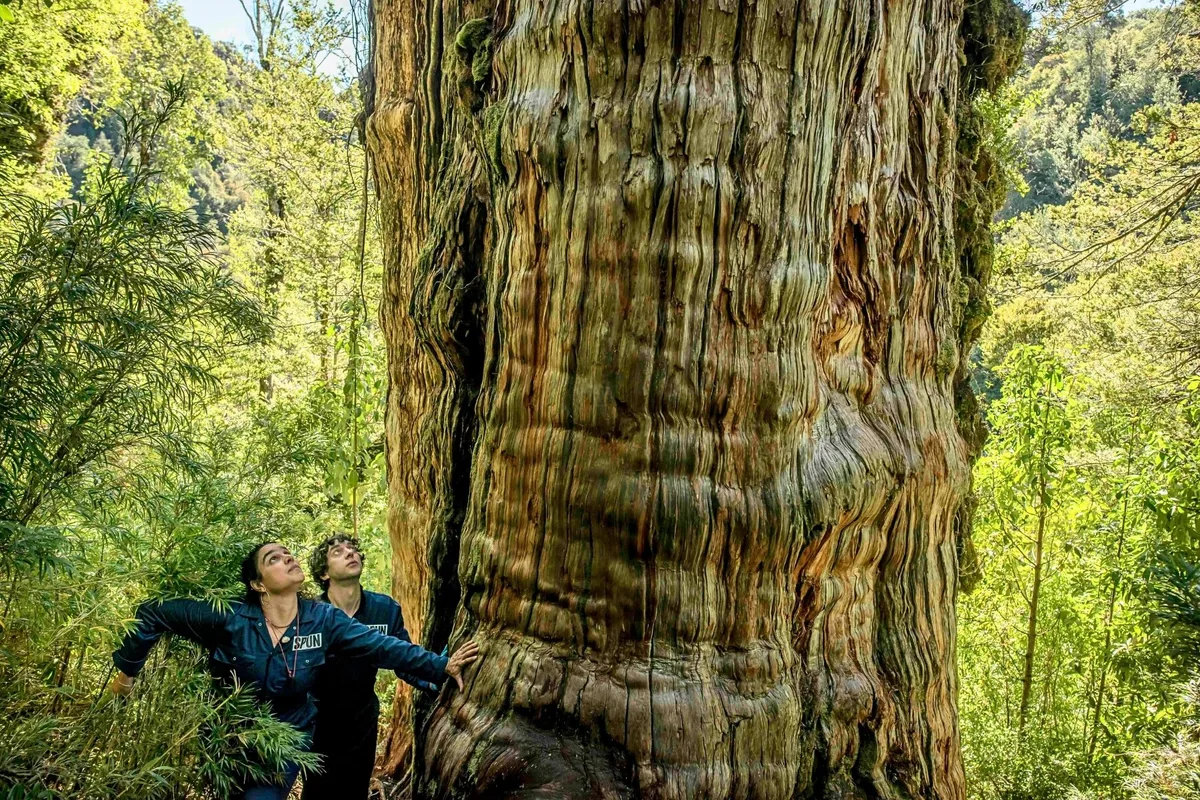
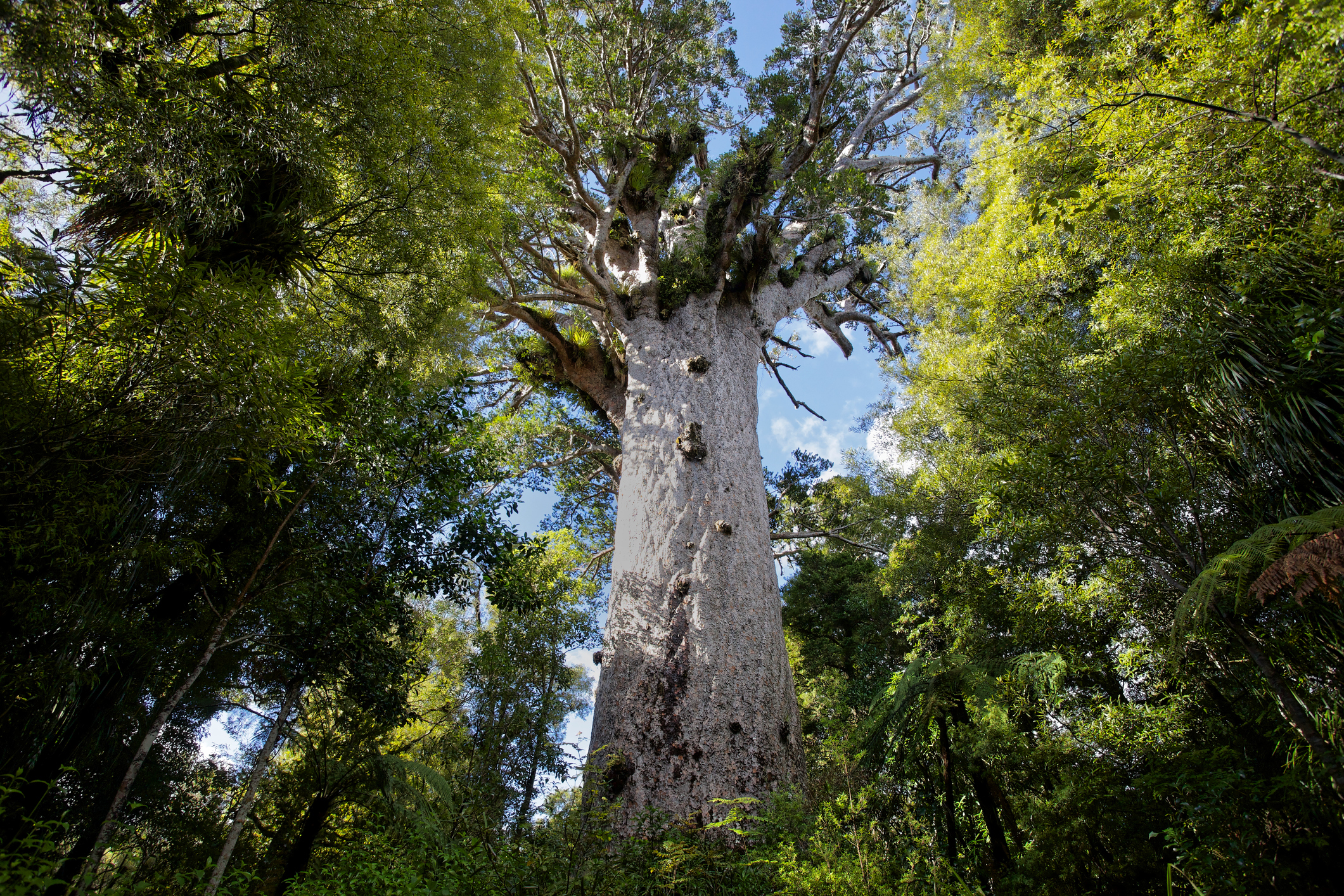
Step beneath the canopy of this lush forest in Northland and immense, almost branchless trunks rise like pillars from a tangle of ferns and other subtropical vegetation. The largest kauri (Agathis australis) can exceed 50m in height, reach 16m around their trunks and live for as long as 2,000 years.
But even among these giants, one tree stands apart.
Tāne Mahuta – the ‘Lord of the Forest’ – is New Zealand’s largest known living kauri. It stands around 51m high, has a trunk almost 14m in girth and is estimated to be 1,500 years old. Its immense column-like trunk alone rises almost 18m.
Abbie Reynolds, Interim CEO of WWF-New Zealand, describes Waipoua as “an absolutely iconic forest for Aotearoa New Zealand”.
“It’s home to Tāne Mahuta, god of the forest and the largest known living kauri tree. There’s something so extraordinary about standing beside a tree of such immense size and age.
- 10 epic photos of the most monumental trees on Earth
- Scientists went into an ancient cave in New Zealand and found a 'lost world' hiding within
“The forest feels truly ancient and untouched. For New Zealanders, it’s such a special place, and one that gives us a real sense of connection with the natural world and with the deep history of Aotearoa. Places like Waipoua remind us of the incredible nature we have here in New Zealand, and the need to look after our wild places and species so future generations can experience them too.”
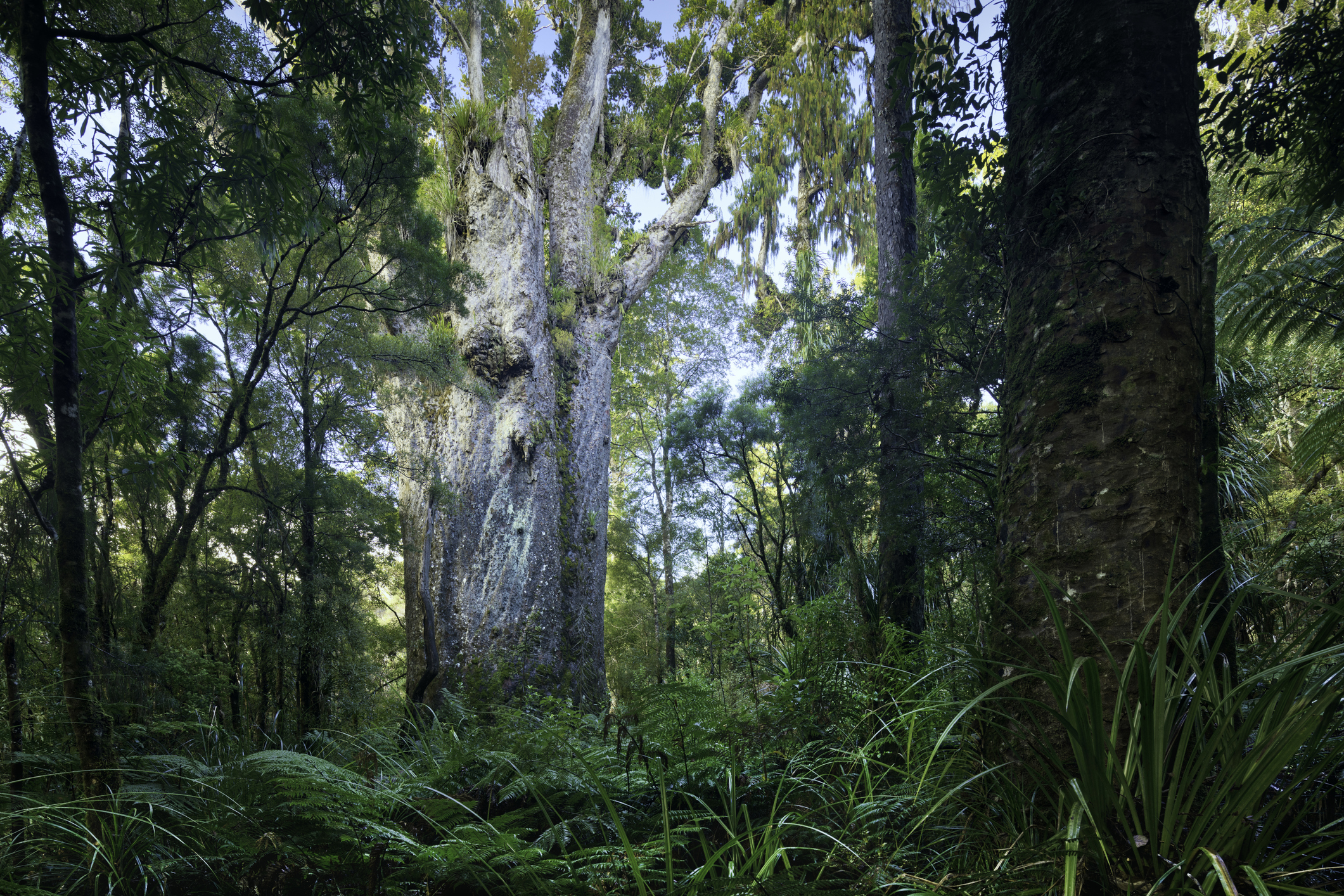
And Tāne Mahuta may not even be Waipoua’s oldest inhabitant. Te Matua Ngahere – the ‘Father of the Forest’ – is estimated to exceed 2,000 years old and boasts an extraordinary 16.41m trunk girth.
Kauri are conifers but don't expect them to look much like Christmas trees. Instead of needles, they have thick, leathery, olive-green leaves. As the trees mature, their lower branches are shed, leaving the enormous straight, clean trunks for which ancient kauri are famous.
They even create strange structures around their own feet. Kauri continually shed flakes of bark. Around some old trees, centuries of this material have decomposed into great reddish-brown mounds of humus called pukahu, which have been recorded at several metres high.
- A tree that can walk? The 'walking tree' that's said to be able to move itself to a sunnier spot
- It weighs up to a whopping 30kg, has a diameter of 50cm and is the biggest seed on the planet
The trees carry both male and female cones. Pollen is carried by the wind, while female cones take around a year after pollination to produce ripe seed, which is also dispersed on the breeze. Kauri belong to the Araucariaceae, an ancient family of conifers with an evolutionary history stretching back hundreds of millions of years.
The world beneath them is pretty peculiar too. Waipoua is home to the kauri snail, a giant land species with a shell up to around 7.5cm across. Unlike the snails familiar in gardens, it is a predator, hunting earthworms, slugs and other soft-bodied creatures on the forest floor.
The forest is also home to some of New Zealand’s threatened birds, including North Island brown kiwi and North Island kōkako. Other inhabitants include kererū, the native New Zealand pigeon, the distinctive iridescent tūī, fantails and shining cuckoos.
- “Viewers have been absolutely hooked.” Over 100,000 tune in to watch rare New Zealand parrot raising her chicks
- Expedition team has "unforgettable encounter" with one of New Zealand's most incredible creatures
Waipoua and the adjoining Mataraua and Waimā forests now make up the largest remaining tract of ancient kauri forest in the world. But they are survivors of a landscape that once looked very different.
Kauri timber was highly prized. Its huge trunks could produce exceptionally long, straight boards and its durable wood was particularly sought after for boat building.
Most of Northland’s ancient forest was ultimately lost to logging, fire and clearance for farmland. Even in the 1940s, kauri from Waipoua was felled to provide timber for wartime boat building. The 9,105-hectare Waipoua Sanctuary was finally declared in 1952.
Kauri were valuable for more than their timber. The trees produce a resin known as kauri gum, which became an important ingredient in products including varnish. Gum collectors also deliberately ‘bled’ living trees by cutting into their trunks to encourage the resin to flow, leaving scars that can still be seen on some trees.
For Māori, however, these trees have a much deeper significance. Te Roroa are tangata whenua – people of the land – at Waipoua, and Tāne Mahuta is a taonga, or treasure. According to Māori tradition, Tāne was the son of Ranginui, the sky father, and Papatūānuku, the earth mother. He separated his parents, bringing light into the world, before clothing the earth in forest. All creatures of the forest are regarded as Tāne’s children.
- "It explodes with a loud bang, flinging toxic seeds at speeds of up to 150MPH." 8 weirdest, wackiest trees on the planet, including one that walks...
- What's the oldest tree on the planet? Clue – it's older than Stonehenge…
Having survived centuries of exploitation, kauri now face a very different enemy.
Kauri dieback is caused by the microscopic soil-borne pathogen Phytophthora agathidicida. Its spores infect the roots and damage the tissues responsible for carrying water and nutrients through the tree. Leaves can yellow, branches die and the canopy thins as the tree is effectively starved. There is currently no known cure.
Most alarming of all, the pathogen has been detected within just 60m of Tāne Mahuta.
Humans can inadvertently help it travel, carrying contaminated soil on footwear and equipment. Across Northland, there is a strong correlation between kauri dieback and access trails, suggesting people are a significant vector in its spread.
Visitors to Tāne Mahuta now approach along a raised boardwalk, bridge and viewing platform designed to reduce impacts on the forest floor and sensitive roots. And the work is continuing: in 2026, DOC and Te Roroa are upgrading the wider Kauri Walks network with new infrastructure intended to improve access while protecting the trees from dieback.
- It’s older than the Roman Empire, taller than the Statue of Liberty and as heavy as 7 blue whales
- Scientists took soil samples from a forest and tested them for microplastics. What they found was disturbing
Yet protecting the giants that remain is only half the story. Along the edges of Waipoua, conservationists are attempting something more hopeful: making the forest bigger.
The aim isn't simply to plant individual kauri, but to restore the wider ecosystem at landscape scale, replanting native vegetation and controlling introduced pests so wildlife has more space in which to recover.
Given the chance, some of the kauri seedlings taking root today could potentially survive for more than a thousand years - the next chapter in this extraordinary story of New Zealand’s forest of giants.
top image: Scenic landscape of the Waipoua forest in New Zealand. Credit: Lina Shatalova/ Getty Images
More wildlife stories from around the world:
- The strange island where trees bleed, deadly cucumber trees grow and nature has evolved in ways found nowhere else on Earth
- "It's famous for the mighty river that snakes through its forests, but high above the canopy, another vast river is moving…" – Discover the Amazon's 'Flying River'
- This deadly tree is one of the most toxic on the planet, with just 50g of foliage able to kill a human within hours