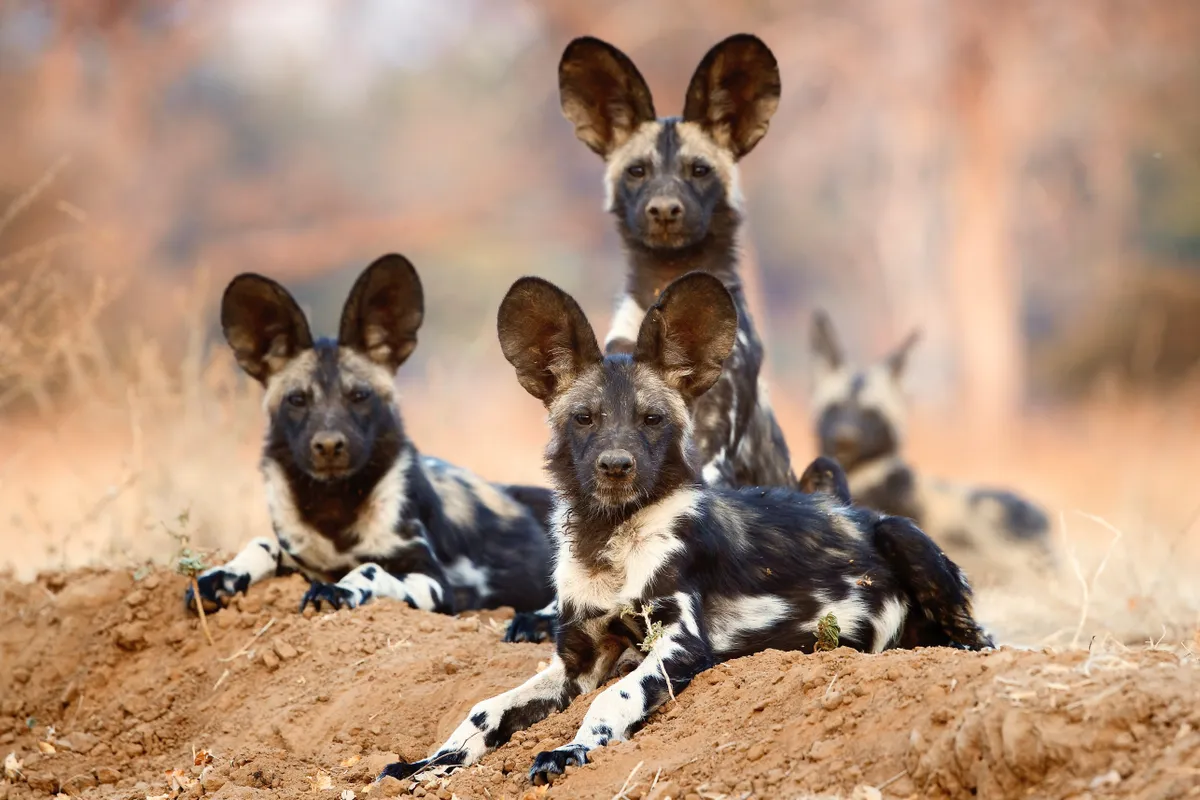
The bush dog (Speothos venaticus) is an elusive species. These small and stocky canines have an extensive range in Central and South America yet are so rarely seen in the wild that most of what we know about them is gleaned from studying captive individuals. Its closest relative is thought to be the maned wolf or the African wild dog.
What do bush dogs look like?
Bush dogs have a build similar to a terrier, with short legs and a bushy tail. Their soft, longish hair is reddish brown, and is often darker towards the hindquarters, with a lighter patch on the throat. Younger bush dogs are covered in dark fur. They have partially webbed feet and sharp claws, useful for digging and swimming. There are three recognised subspecies of bush dog: South American, Panamaniam and southern.
- 10 most beautiful wild dogs on the planet, from the supermodel-legged wolf to tiny, blonde desert fox
- 5 weirdest dogs on the planet, including one that can climb a tree like a primate and another that looks like a cuddly bear
How big are bush dogs?
Bush dogs typically grow to around 30cm tall at the shoulder, measuring up to 75cm long, plus a 15-cm tail. They weigh about 5-7kg, making them one of the smallest wild hunting dogs in the world.
Are bush dogs social animals?
A lack of data makes it difficult to draw conclusions about bush dog behaviour in the wild but in captivity they live in tight-knit family groups of up to 12 individuals, including young from multiple litters. Bush dogs are highly social but solitary individuals are also common in the wild.
How large is a bush dog’s territory?
There is a very large variation in the reported territories of groups of bush dogs, ranging from a little as 16 km sq up to 150 km sq. Researchers think that this variation is down to quality of habitat and the availability of prey. But their territory is not as strictly defined as in other carnivorous species – instead bush dogs appear to be semi-nomadic.
Bush dogs use strongly smelling urine to scent mark their territory – it’s this that gives them their one of their Portuguese and Spanish names, cachorro-vinagre and perro vinagre, meaning vinegar dog. They are also known as wáter dogs and shrub dogs.
How do bush dogs reproduce?
Based on observing animals in captivity, we know that bush dogs reach sexual maturity at around one year old (sooner for females) and continue to reproduce until around six years old. They breed all year round, producing litters of up to six young after a gestation of 65-70 days.
Pups are born blind and helpless and are weaned at between two and five months old; while the alpha female is nursing, her mate hunts for food. Bush dogs are likely monogamous, with only the dominant pair in the group breeding while the others help raise the young.
- Can dogs crossbreed with wolves?
- Wolf vs dog: what's the difference between man's best friend and its wild cousin?
- It barks like a dog, looks like a cross between a squirrel and a hamster and is the size of a bowling pin – meet an adorable, but little-known, American creature
Where do female bush dogs raise their young?
Bush dogs live in underground burrows, including those dug by armadillos. Bush dogs are themselves proficient diggers thanks to their partially webbed feet and sharp claws; they will work as a team to dig and clear material from the entrance to a hole. Females are also known to raise their young in hollow tree trunks.
Where do bush dogs live?

Bush dogs can be found in the east of Central America and in South America as far south as Paraguay. Researchers think that there may also be isolated populations in Ecuador, Colombia and Costa Rica, a hint to the likely previous range of the species. The only countries where bush dogs are regarded as common are Guyana and Peru.
What is the preferred habitat of bush dogs?
Bush dogs are considered ‘habitat generalists’, meaning they are able to thrive in a range of habitats. They have been observed in lowland forests, on cerrado –tropical savanna – and the shrubland known in the region as caatinga and chaco. Bush dogs are also found in wet areas such as seasonally flooded forest, pampas and mangroves. Wherever they live, it tends to be close to water.
What do bush dogs eat?
Diet also seems to vary depending where the bush dogs live and on the seasonality of available prey, with the species known to eat nine-banded armadillos, agoutis, capybaras and other large rodents, small mammals, reptiles, invertebrates and birds. They are also known to take down larger prey, including rheas. While they are considered carnivorous, bush dogs are also known to consume fruit, both in the wild and in captivity.
How do bush dogs hunt?
Bush dogs hunt in packs, driving prey into water sources or to other members of the pack. They use vocalisations that sound like bird calls to coordinate while they hunt.
Their partially webbed feet are well adapted for swimming and also stop them from sinking into muddy riverbanks. Bush dogs are mostly diurnal, but have also been observed being active at night. Solitary individuals hunt alone.
- The 10 deadliest dogs on Earth: Discover the world's most ferocious and savage wild canine hunters
- This prehistoric monster is the largest dog that ever lived and was able to crush bone with its deadly teeth – but was wiped out by cats
How is the bush dog adapted for its diet?
Bush dogs have sharp incisors, strong molars and powerful jaws.
What threats do bush dogs face?
It is difficult to estimate the numbers of bush dogs in the wild because the species is very elusive. But the IUCN categorises it as Near Threatened thanks to a decline in recent years as a result of habitat loss and fragmentation and disease spread by domestic dogs. Domestic dogs are also a problem for the species in that they predate the bush dogs’ prey; this prey is also limited by illegal hunting.
How do scientists study bush dogs in the wild?
Bush dogs are rarely observed using traditional camera traps thanks to their rarity and elusive nature, so scientists use other techniques to study them, including trained detection dogs who identify the presence of bush dogs based on the scent of their scat. Researchers then use DNA analysis on the scat to confirm where bush dogs are living, sometimes even allowing them to identify individuals.
How long do bush dogs live in the wild?
Their average lifespan is 10 years in captivity - unknown in the wild
- 10 fearsome prehistoric dogs that roamed the Earth millions of years ago: Are these the deadliest canine hunters of all time?
- "Each family display loyalty, courage and generosity" – These wild dogs might be branded villains, but what I found in the savannah completely changed my mind
- It has supermodel legs, walks like a camel, hunts like a cat and loves fruit. Meet one of the weirdest dogs on the planet