
To call the rufous hornero (Furnarius rufus) unprepossessing would be generous. Compared to the ostentatious plumage of other South American birds, its reddish-brown feathers are vanishingly modest.
The species might escape notice entirely were it not for its architectural mastery. Hornero means baker in Spanish, in reference to the oven-shaped nests constructed by breeding pairs to protect their eggs. The industry and determination with which hornero pairs erect these structures has earned them the admiration of ornithologists and everyday people alike in their native Argentina, Brazil, Bolivia, Uruguay, and Paraguay. Indeed, the hornero is the national bird and national animal of Argentina — a tribute to its work ethic.
- The weirdest bird nests on the planet – including a 2-tonne giant and one bound together with spider webs
- Supersized animal homes: From ant megacities and termite towers to giant bird nests we take a tour of nature’s mega mansions
Hornero pairs, which remain together for years at a time, build a new nest of mud and plant matter each breeding season. They daub the materials onto tree branches, ledges and even sometimes the ground, resulting in adobe domes weighing more than 4 kilograms. Each structure comprises some 3,000 beakfuls. Some pairs are more efficient than others. While motivated duos may complete their nests in less than a week, others take a more desultory approach and put the finishing touches on their domiciles over a period of months.
Despite the care with which they are constructed, nests are rarely used more than once. And the birds are surprisingly fickle — up to 50% of nests are abandoned, hatchlings and all, in some populations. Subsequent nests may be constructed in the same location, resulting in clusters of tiny huts, some of which may be taken over by other hornero pairs or by any of nearly 30 other species of bird, including swallows, wrens and tyrant flycatchers. A subspecies of the brown-chested martin (Progne tapera fusca) uses vacant hornero nests almost exclusively.
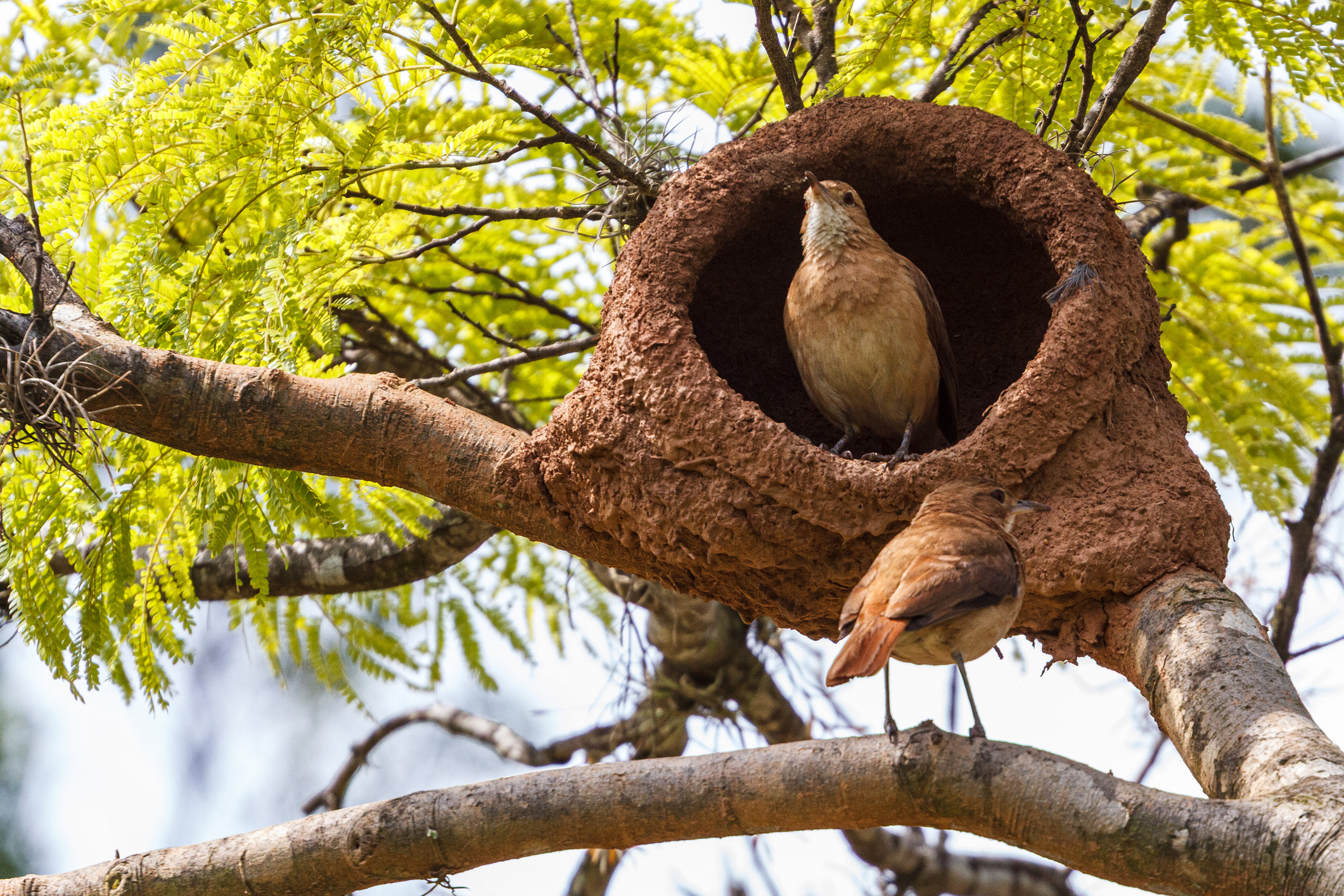
Each hornero couple consistently orients the angled entrance to its nest to either the left or the right — almost never deviating from the established direction. This has led scientists to speculate that this tendency is inborn, in the manner of right or left-handedness in humans. One study found that nests with the entrance angled to the right were 12% more common. It is unclear whether this pattern serves any adaptive purpose or is simply a random variation. In regions closer to the equator, the nests tend to face south, probably in an effort to mitigate heat from the sun.
- "While she goes off to fetch water, it reveals a dark side to the relationship with its nest mate"
- Forget gender wars! These bizarre birds have had equality sorted for some 44 million years - watch them in action
- What's the UK's most promiscuous bird?
Because the nests are closed, horneros have developed an ability unique among birds — they can detect eggs from brood parasites such as cowbirds in the dark. Scientists have inferred that, unlike other birds, which rely on differences in color and pattern, horneros use the size of the eggs to determine which are theirs and which are changelings. The latter are summarily ejected from the nest. In areas where cowbirds are more common, the parasites lay smaller eggs, possibly as an adaptation to reduce the likelihood of defenestration.
Brutal as they may be to their unwanted adoptees, horneros are remarkably faithful to each other. In other birds, cheating — or extra-pair mating, in technical terms — is relatively common. But only about 3% of nestlings were found to be fathered by another male according to one Brazilian study. While we have yet to translate hornero conversations about infidelity when it does occur, the Brazilian legend that adulterous birds are walled into their nests by the wronged partner appears to be untrue.
top image: Rufous Hornero with Mud Nest. Credit: Doug Cheeseman/ Getty Images
Discover more bird stories from around the world:
- "Long, curved talons can crush the skull and break the spine of large prey – and carcasses too heavy to carry are dismembered where they fall"
- ”It grabbed one from a stall, then wandered down the street – tentacles dangling from its beak”
- "They have normal-sized bird lungs, yet can remain submerged for 20 minutes or more and dive hundreds of metres deep, all on a single breath of air"


