
The crowned eagle is considered Africa’s most powerful raptor. Built for ambushing prey among the trees, it kills monkeys and antelopes almost four times its own weight, crushing their skulls in its enormous talons. Its prowess may even have made it a hunter of our distant ancestors. Yet its strength offers little protection against the disappearance of its woodland habitat and this awe-inspiring bird is declining across its range.
Why is it called a crowned eagle?
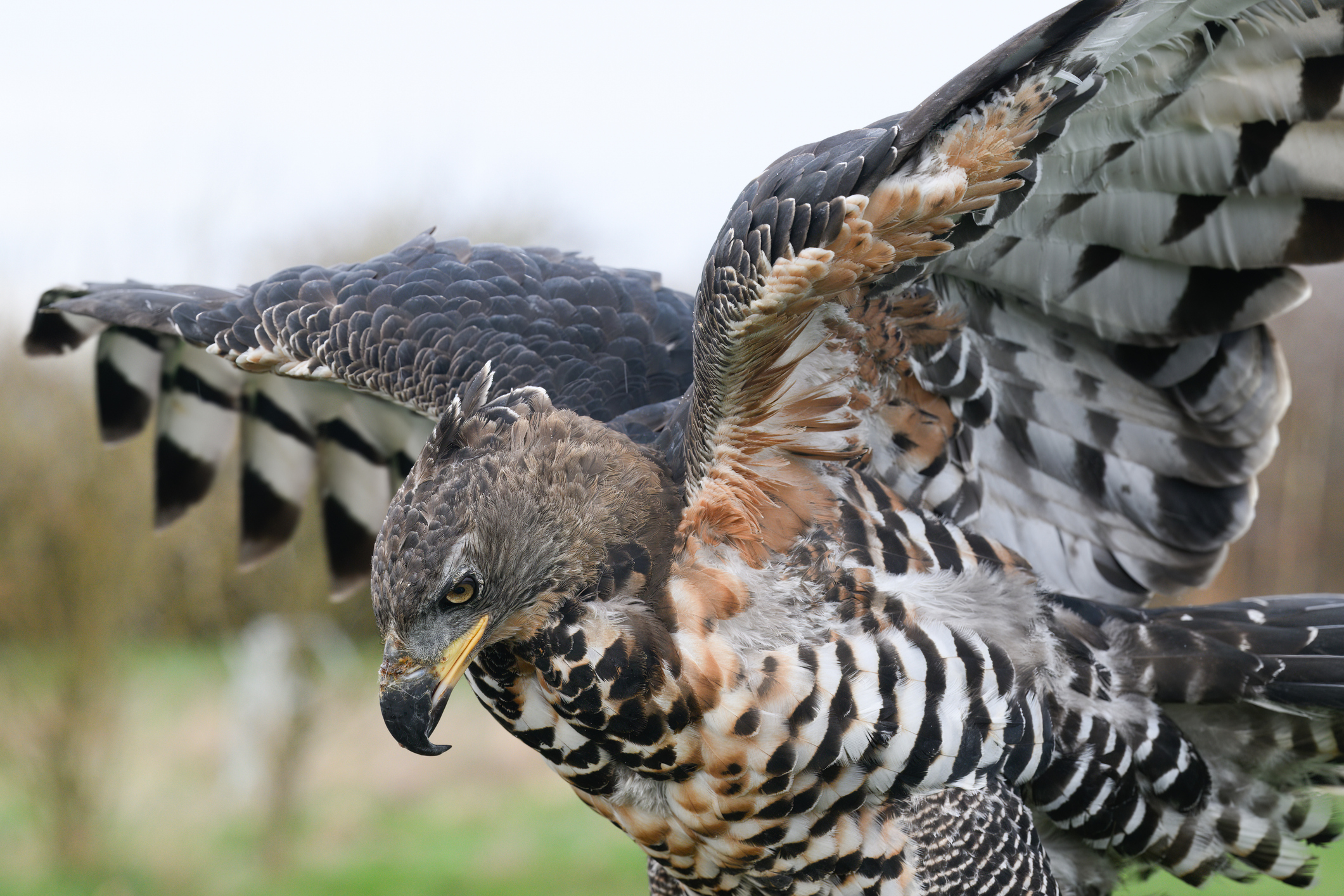
The name refers to the double crest of dark feathers on its head, which it can raise. It is also called the African crowned eagle or crowned hawk-eagle, and is the only living member of its genus, Stephanoaetus. A second species, the Malagasy crowned eagle, went extinct after humans settled on Madagascar.
- 10 jaw-dropping eagle moments captured in photos and film that reveal the brutal hunting behaviour of this powerful bird of prey
- "Its talons are as long as a grizzly bear's claws and its legs are as thick as a child's wrist." 10 most formidable, powerful eagles on the planet
- Meet the world's deadliest-ever eagles, including a 18kg mighty raptor that terrified New Zealanders until its extinction in the 15th century
How big are crowned eagles?
Crowned eagles are between 80–99cm long, have a wingspan between 1.5–1.8m and weighs 2.7–4.7kg
Where does it live?
It is found throughout sub-Saharan Africa, from Senegal across the rainforests of West and Central Africa to Ethiopia, and south as far as eastern South Africa. It inhabits a variety of habitats, including forest, woodland, savanna and shrubland. It does not migrate and holds the same territory year-round.
What does it eat?
Overwhelmingly mammals, though the menu varies with geography. In Taï National Park, Ivory Coast, about half of the prey items are primates, including sooty mangabeys. In north-eastern South Africa, by contrast, small antelopes make up 61 per cent of their prey and monkeys 25 per cent. Rodents, reptiles and birds are also taken.
How does it hunt?
Usually from a concealed perch. It is a diurnal ambush predator with short, broad wings and a long tail that allow it to manoeuvre through the trees.
In a 2001 study published in the scientific journal Folia Primatologica, zoologist Susanne Shultz observed that the crowned eagle may hunt monkeys by perching motionless high in the forest canopy, sometimes for more than half an hour, waiting for a group to approach before swooping down on an individual exposed as it leaps between trees.
Long, curved talons can crush the skull and break the spine of large prey, and carcasses too heavy to carry are dismembered where they fall. Pairs sometimes hunt cooperatively: a male might call overhead to distract a troop of monkeys, while the female swoops in to attack.
Did it prey on our ancestors?
Possibly. The skull of the Taung Child, a three-and-a-half-year-old early human – Australopithecus africanus – found in South Africa in 1924, has puncture marks around the eye sockets that closely resemble the damage inflicted on monkey skulls from crowned eagle nests in Taï National Park. Researchers have argued that a large eagle much like the crowned eagle could have killed the child.
- It has piercing blue-grey eyes, a 2m wingspan, a spectacular shaggy crest – and is powerful enough to take monkeys in its deadly talons
- Its legs are as thick as wrists and it's able to rip monkeys from branches with its deadly talons: Meet the world's most powerful bird
Does it live in cities?
Remarkably, yes. A 2015 study of Durban’s 350km² urban core, in South Africa, found up to 22 breeding pairs, with the crowned eagle nesting in eucalyptus trees and hunting rock hyraxes, hadeda ibises and vervet monkeys. Breeding pairs there even raise a chick every year rather than every other year, possibly due to greater prey availability. Durban benefits from a network of protected green spaces and researchers credit the “urban mosaic landscape” for the raptor’s success.
How does the crowned eagle communicate?
The crowned eagle is surprisingly vocal for an ambush predator, producing loud, piercing whistles that carry across the forest. During spectacular aerial courtship displays, the male repeatedly calls kewee-kewee-kewee, while the female produces a deeper, more mellow sound. Adults and chicks also call to each other when food is brought back to the nest.
How does the crowned eagle breed?
The crowned eagle generally forms a long-term pair bond, with elaborate courtship displays involving soaring climbs, steep, looping dives and loud calls. The pair builds an enormous stick nest high in a tree, returning to it over successive breeding attempts. Over time, this structure can grow to 2.4m across and 3m deep.
One or two eggs are laid and the female incubates them for around 50 days. If two chicks hatch, the stronger, usually older chick typically kills its sibling, leaving just one to survive.
The young eagle takes around three to four months to make its first flight, but remains dependent on its parents for another 9–12 months while learning to hunt. During this period, the adults continue supplying food, sometimes every three to five days.
- "This slashing can cause fatal wounds in humans…" 10 deadliest birds on the planet, including one with a highly lethal 12cm claw…
- Scientists discover bald eagle nest on banks of Michigan river – and are stunned at what they find inside it
- Forest eagle finds goose eggs in nest. What happens next is staggering
Is the crowned eagle endangered?
Globally classified as Near Threatened, the population of the crowned eagle is declining. Threats include forest clearance and fragmentation, competition with humans for prey species, collisions with infrastructure, electrocution on utility networks, and persecution due to concerns about livestock or pet predation. In South Africa, where an estimated 900–1,000 mature individuals remain, the species is classified as Vulnerable. Its exceptionally slow breeding cycle makes it particularly susceptible to population losses.
Discover more interesting bird stories from around the world:
- ”It grabbed one from a stall, then wandered down the street – tentacles dangling from its beak”
- "They have normal-sized bird lungs, yet can remain submerged for 20 minutes or more and dive hundreds of metres deep, all on a single breath of air"
- “They’re just waddling around in their poop.” Penguin poop is melting snow in Antarctica. Here’s how
Top image: Close up of the crowned eagle, also known as the African crowned eagle or the crowned hawk-eagle. Credit: Paul Grace Photography Somersham/ Getty Images.

