
The Philippine eagle is one of the world’s largest and rarest birds of prey.
Found only in the Philippines, this forest raptor has piercing blue-grey eyes, a wingspan that can exceed 2m and a spectacular shaggy crest that lends it a certain star quality.
Powerful enough to take monkeys – hence its historic name, the monkey-eating eagle – it is also perilously vulnerable, with its future tied to the survival of the country’s remaining old-growth forests.
Where does the Philippine eagle live?
The Philippine eagle is endemic to the Philippines, a group of islands in South East Asia. Its remaining range is restricted to four islands: Luzon, Samar, Leyte and Mindanao, though Mindanao is considered its main stronghold. It lives in tropical forest, especially mature lowland and montane forest, where tall trees provide nesting sites and the canopy supports the mammals, birds and reptiles on which it depends.
- Wildlife travel: What animals can I see in The Philippines?
- What’s the biggest, heaviest eagle in the world? Meet the contenders – including a giant with a monster 3-metre wingspan
A single breeding pair needs an enormous territory. Depending on the amount of prey available, this can range from about 4,000ha to 11,000ha of forest, which partly explains why the species is so vulnerable when woodland is cleared or broken into smaller fragments.
How big is the Philippine eagle?
The Philippine eagle can reach about 1m tall, weigh up to 8kg and have a wingspan of up to 220cm, making it one of the largest living eagles. Its broad wings are actually relatively short for its size, an adaptation that helps it move through dense forest rather than soar over open country.
Does the Philippine eagle really eat monkeys?
Yes, the Philippine eagle was once widely known as the monkey-eating eagle and it is certainly capable of hunting macaques (namely the Philippine long-tailed macaque). However, its diet varies between islands and forests, depending on which animals are available. It also feeds on Philippine flying lemurs, also called colugos, as well as civets, squirrels, bats, birds, snakes and monitor lizards. On the island of Mindanao, flying lemurs are the primary prey species.
- Monkey business: if macaques want your food, they're not going to ask for it!
- Mysterious new monkey species with orange lips discovered in the Congo rainforest
- “I spent five days in hospital after a bite from a monkey you could buy for a child”
How does it hunt?
The Philippine eagle hunts within the forest, either flying from tree to tree or watching from a perch before launching a sudden attack through the canopy. There are reports of pairs hunting monkeys cooperatively, with one bird distracting the troop while the other attacks from another direction. Its large eyes are said to be able to see eight times more clearly than human eyes and help it detect movement in the trees, while its strong talons deliver the force needed to seize prey.
How does it breed?
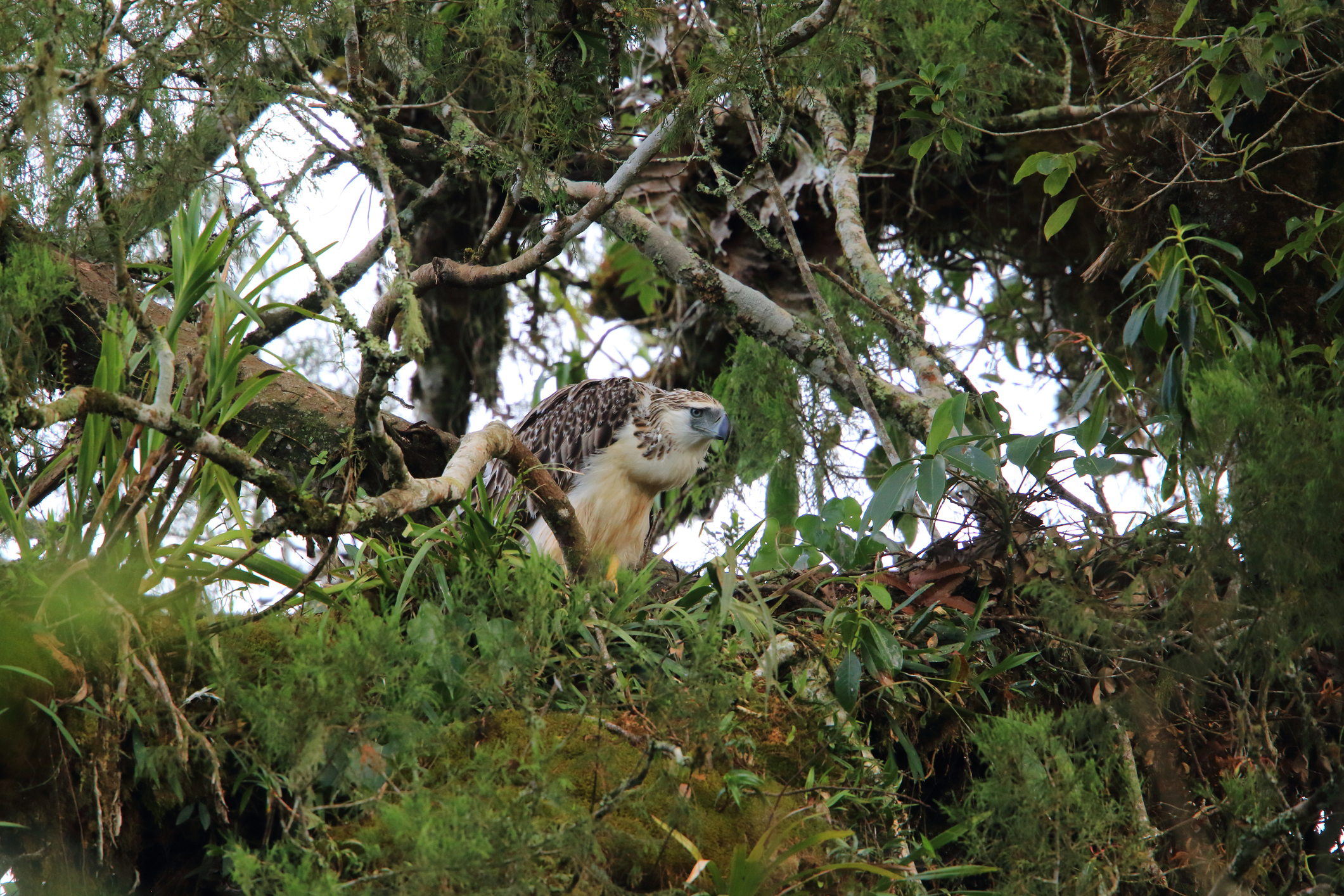
The Philippine eagle is thought to form long-term pairs and has an exceptionally slow breeding cycle for a bird of prey. The nest is typically built high in a large forest tree, often a dipterocarp. The female usually lays a single egg every two years, which is incubated for around 60 days.
Once the egg has hatched, the parents bring prey to the rapidly growing nestling over a period of around four to five months, at which point the fledgling – now as large as its parents – ventures from the nest. Still, the youngster will remain in the vicinity for well over a year and may not breed until it is five to seven years old.
- 10 jaw-dropping eagle moments captured in photos and film that reveal the brutal hunting behaviour of this powerful bird of prey
- With deadly talons the size of a human hand and a prehistoric-looking beak, this is one of nature's most terrifying giants, able to reach speeds of 100mph
- Meet the world's deadliest-ever eagles, including a 18kg mighty raptor that terrified New Zealanders until its extinction in the 15th century
Why is the Philippine eagle so rare?
The Philippine eagle is listed as Critically Endangered and it is estimated that there are fewer than 500 pairs in the wild. The IUCN states that the population size of the species is “highly uncertain” but that it “is precautionarily suspected of having declined by at least 50 per cent over the past three generations”.
The main threat is the loss and degradation of forest, caused by logging, agriculture and, to a lesser extent, mining. As forest disappears, the eagle loses nesting sites, hunting territory and prey.
Shooting is another serious problem. When forest is lost, an eagle may move closer to farms and settlements, increasing the risk of conflict with people. Its slow breeding makes recovery especially difficult: a pair that produces only one chick every two years cannot quickly replace birds.
What is being done to protect it?
The Philippine eagle is protected by law and since 1970 it has been illegal to kill, hunt, wound or take the eagle, or to destroy, disturb or remove its nests or eggs.
Practical conservation work led by the Philippine Eagle Foundation includes monitoring nests; training and supporting local forest guards; rescuing and rehabilitating injured birds; fitting released eagles with trackers; restoring habitat; and running conservation breeding and education programmes.
The aim is not only to save individual birds, important though each one is. As an ‘umbrella species’, protecting a breeding pair can mean protecting thousands of hectares of forest and the wider web of life that the Philippine eagle needs to survive.


