Perhaps best known as cousins of calamari (or squid), cuttlefish belong to the group of marine animals known as cephalopods, which also include the octopus and nautilus among their tribe.
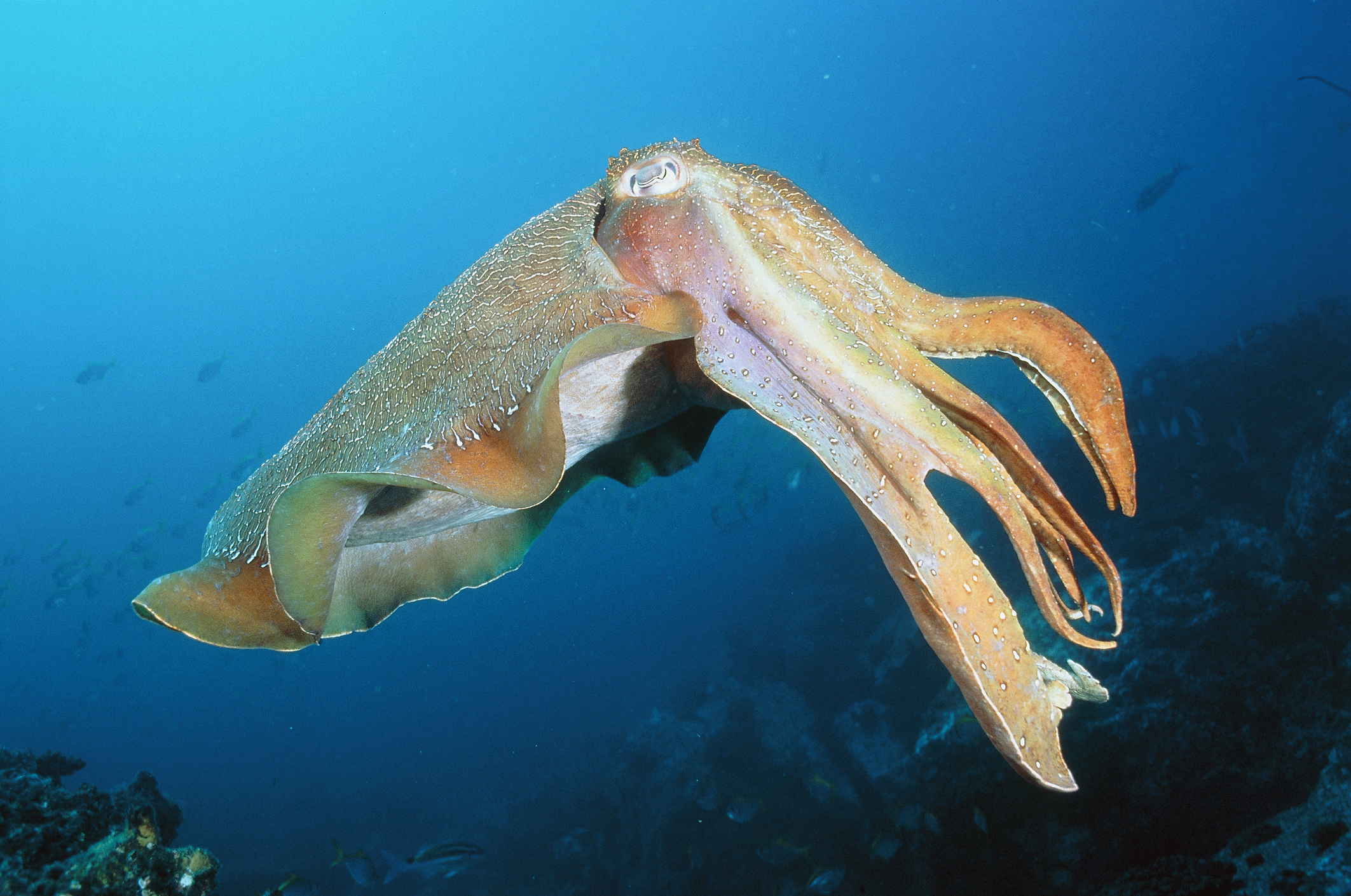
Extraterrestrial-looking, cuttlefish have 10 appendages – eight large arms and two tentacles – and large eyes with distinctive W-shaped pupils. Their body, or mantle, houses their internal organs, including a unique shell (known as the cuttlebone) that helps control buoyancy.
Surrounding the mantle is a fringe-like skirt, which works as a flexible, undulating fin, for slow, graceful movement in the direction of choice.
Should an injection of pace be required, the cuttlefish quickly switches to jet propulsion, by forcefully squirting water from its body cavity out through a siphon below its head. This rapidly propels it backwards, and can be deployed when pursuing prey or avoiding predators.
Another trick is to generate an inky smokescreen to obscure the creature’s position. On top of this, it can instantly change colour and patterning via millions of minuscule organs in its skin, which can help with blending in – or standing out during its colourful courtship.
Among the approximately 120 known species, dimensions vary from the dwarf cuttlefish, no longer than an index finger, to the metre-long Australian giant cuttlefish. Native to the rocky reefs, seagrass beds and sandy seafloors of southern Australia, the ‘giant’ is the only known cuttlefish to conduct mass mating aggregations.
Though these titans are seemingly widespread across Antipodean waters, the only place they come together in any number is in the Spencer Gulf, near the small town of Whyalla.
- Scientists put tiny cameras on a load of Aussie sea lions – and what they found was mesmerising
- " By altering their colouring and patterns they actually pretend to be different marine animals." 9 amazing, gobsmacking animals that can change colour...
In the austral winter, more than 100,000 of them may temporarily abandon their solitary lifestyle to assemble for the annual gathering of the cuttlefish clan.
As numbers build, the males, which are larger, look for females. Wooing her with all the colours of the rainbow, the male can also form his markings into intricate patterns of lines and dots for a flashing, pulsating light show. And when the female’s attention is assured, he further communicates his ardour with gentle tentacular touches.
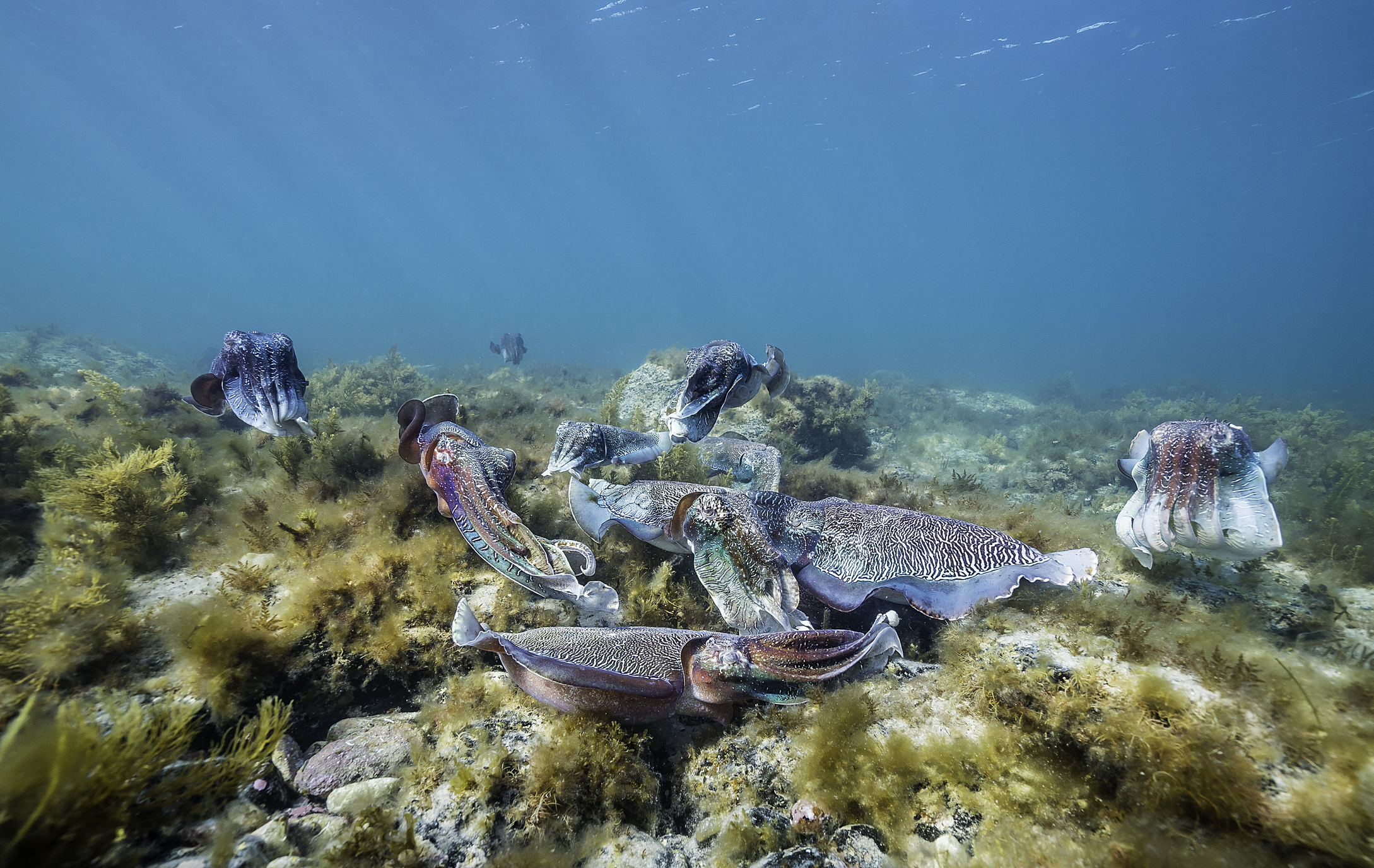
However, with males outnumbering females on the spawning grounds by 11 to one, the course of true love rarely runs smooth, and a colour war begins.
The males produce scintillating and shimmering displays resembling everything from waves of passing clouds to zebra stripes, and even turn their entire bodies a monochromatic black or white.
If there isn’t a winner at this point, the next strategy entails males flaring their arms and inflating their bodies in an attempt to cow the opposition.
If this too fails, things can quickly escalate into a wrestling match, as strong, suckered tentacles and sharp beaks come to the fore. Given these high-stakes battles, it’s perhaps not surprising that many males appear to show at least a few battle scars, with some even missing a tentacle or two.
While the large males invariably edge these duels, the smaller individuals can still contribute towards the gene pool, but must do so with stealth and deception.
Whenever a larger male becomes preoccupied with grappling others, or simply showing off, miniature males (called ‘sneakers’) will often furtively sidle past to copulate with the lady in waiting.
Even craftier males use their colours, patterns and behaviour to masquerade as an unreceptive female. Brazenly strolling past the dominant incumbent, these cunning cephalopods then boldly proceed to service the female right under the nose of her betrothed.
This daring strategy works surprisingly well, and biologists believe that ‘sneaker’ males may well be responsible for more than a third of successful matings.
- "It had two gigantic 20cm fangs that it used to tear apart its prey." 10 horrifying, terrifying prehistoric sea monsters that once ruled our oceans
- Scientists hid cameras in an abandoned house in Argentina – and found carnivores sharing a room inside it
- Conservationists carry the eggs of the world’s rarest duck for 44km on foot. Here’s why