
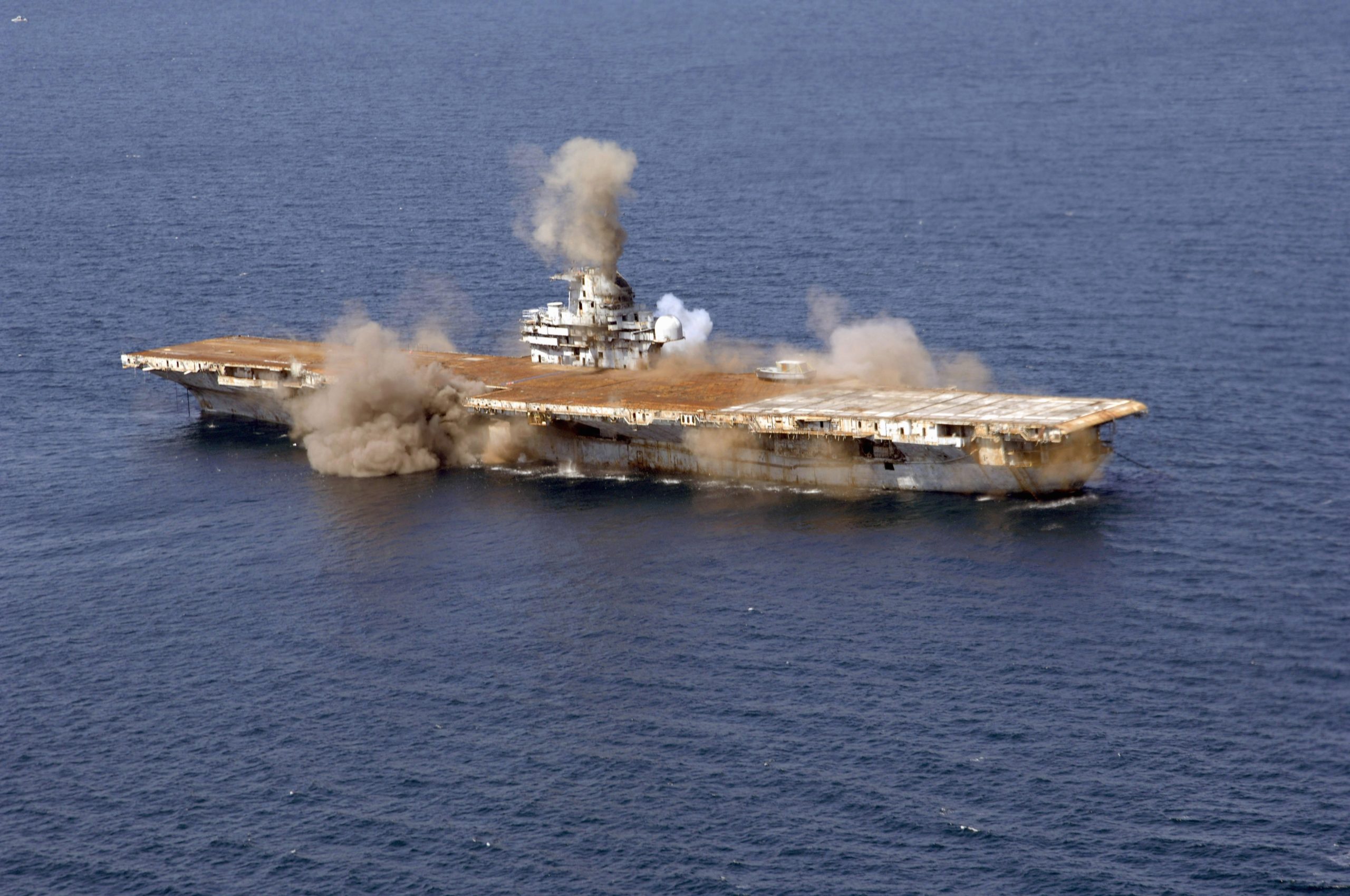
More than twenty years ago, tens of thousands of tonnes of steel plummeted to the ocean floor when the USS Oriskany found her resting place off the coast of Pensacola, Florida.
- In 1941, a massive WWII ship sank off the coast of Albania. Divers just went down there – and found a rare mammal living among the wreck
- It’s the size of Key West in Florida, 300 years old, buried 1,000m beneath Arctic ice – and is home to thousands of giant animals
Once a US Navy aircraft carrier capable of holding up to 80 planes and nicknamed the Mighty O, she was scuttled (sunk on purpose) in May 2006 to create an artificial reef.
In honour of the world’s biggest coral reef system (the Great Barrier Reef), she gained a new nickname: the Great Carrier Reef.
During her 25-year career, the USS Oriskany, saw lots of active service. She earned two battle stars for her deployment in the Korean War and five more in the Vietnam War. She was decommissioned in September 1976.
- Sunken warships fill this eerie lagoon – and they're scattered with gas masks, skulls and bullet casings
- This haunting shipwreck in North Carolina has its own 'shark ballroom'
The retired warship still sees plenty of action – albeit of a different kind. Over the years, marine life has sprung up around the ship, which sits upright in the seabed.
Scuba divers who visit can expect to see a whole host of fish – with some lucky divers even having the chance to spot the largest fish on the planet.
“The wreck is a habitat for all kinds of marine life from small tropical fish such as blennies, damselfish and angelfish to large game fish such as snapper, grouper and massive amberjack,” writes Florida Dive Pros on its website. “Pelagic fish species can sometimes be spotted racing by and even whale sharks and manta rays have been spotted cruising around the tower of the carrier.”
- Divers stumble upon pod of sleeping giants in Caribbean Sea
- It can be as long as a cricket pitch, weighs a mighty 30 tonnes (that's three-times the weight of a T-rex) and can live for a century
The carrier sits between around 24 and 65 metres deep. Recreational divers can visit her shallower sections, such as the smokestack, but only certified technical divers can see deeper areas such as the flight deck and hangar. This can be a challenging dive with strong currents.
As you might expect, time has taken its toll on this magnificent structure. “In 2008, Hurricane Gustav gave her a slight starboard list – about 5 degrees – and helped her sink into the sand approximately 8'” but she was otherwise only slightly damaged, according to MBT Divers.
- When this WWII seaplane was discovered by a fisherman in 1994, dazzling animals were found hiding in the wreck
- This giant ship sank off the Egyptian coast in 1941. Now an animal that looks like a crocodile hides in its shadows
But the arrival of Tropical Storm Ida the following year told a different story. After the storm hit in November 2009, divers were shocked by what had happened. “The portion of the Island which covered the funnels leading to the smokestack has collapsed, and the funnels have collapsed onto the flight deck on the port side of the Island,” says MBT Divers. This tore a 10 by 52-foot hole in the ship and both divers and marine life now enjoy this tunnel as a swim through.
The Great Carrier Reef measures around 277 metres, making her the world’s largest artificial reef.
However, this might soon change as there are plans to scuttle the SS United States off the coast of Destin-Fort Walton Beach. At around 302 metres, she’s almost as long as the Shard is tall. The difference in size between the two is more than the length of a cricket pitch.
top image: View from underwater of an aircraft carrier turned artificial reef. Credit: Gary McDaniel, CC BY 4.0 https://creativecommons.org/licenses/by/4.0, via Wikimedia Commons
More wildlife stories from around the world:
- "In the shadow of the Himalayas swims a fish that seems to have developed a taste for human flesh…" 10 most aggressive freshwater fish
- It has a gaping, cavernous mouth crammed with sharp teeth – and one of the wildest mating strategies in the animal kingdom
- It has superpowers, the fastest punch in the animal kingdom and and is very reluctant to leave its fortress burrow beneath the ocean floor
- 10 incredible, dramatic shipwrecks around the world that are just teeming with marine life


