
There’s an enormous, 15 square kilometre, 300-year-old sponge garden hidden in the depths of the Central Arctic Ocean – and scientists had never seen it until 2022.
Some of the sponges found on Langseth Ridge are smaller than a penny, at just 1cm in diameter, while others can grow to around half a metre – roughly the size of a small exercise ball.
Throughout the year, the North Pole is almost always covered with around two or three metres of sea ice. This thick layer can block the sunlight to deeper waters, which prevents algae from photosynthesising and makes it more difficult for life to prevail.
So, in 2022, scientists were amazed to find a nearby garden of deep-sea sponges thriving on the peaks of extinct underwater volcanoes, which are known as seamounts. The finding was published in a 2022 Nature Communications paper.
“This is a unique ecosystem,” said Antje Boetius, chief scientist of the expedition, head of the Research Group for Deep Sea Ecology and Technology at the Max Planck Institute for Marine Microbiology in a statement about the discovery. “We have never seen anything like it before in the high Central Arctic.”
The sponge garden was full of life, which was puzzling in waters that should have so few nutrients.
“In the study area, primary productivity in the overlying water provides less than one percent of the sponges’ carbon demand,” adds Boetius. “This sponge garden may be a transient ecosystem, but it is rich in species, including soft corals.”
The sponges must have a source of food for the garden to grow to such an epic size but the scientists didn’t know what they were eating.
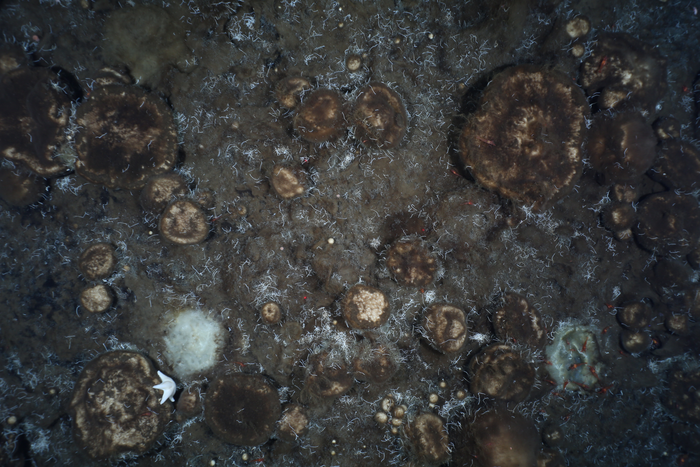
To find out, they took samples of the organisms within this ancient ecosystem.
This revealed that the sponges – which were around 300 years old on average – were feeding on old organic matter from an extinct deep-sea community living on the seamounts. These animals, which lived two or three thousand years before the sponges, survived on nutrients that were seeping out of the seafloor as a result of volcanic activity.
They have special microorganisms in their bodies that help them break down this matter and turn it into energy. “This allows them to feed on the remnants of former, now extinct inhabitants of the seamounts, such as the tubes of worms composed of protein and chitin and other trapped detritus,” says Teresa Morganti, a sponge expert who was at the Max Planck Institute for Marine Microbiology at the time of the discovery.
With Arctic sea ice melting, the scientists stress how important it is to learn about unique ecosystems like the Langseth Ridge sponge garden before it’s too late.
“With sea-ice cover rapidly declining and the ocean environment changing, a better knowledge of hotspot ecosystems is essential for protecting and managing the unique diversity of these Arctic seas under pressure”, says Boetius.
More stories from around the world:
- Where is the coldest place on Earth – the Arctic or Antarctica?
- Tuna carcass placed at bottom of ocean. All was quiet, before this happened
- It's colossal – 3 times the height of Angel Falls – carries 5 million cubic metres of water every second and it's buried 3000 metres under the ocean
- Far below the Arctic Ocean's frozen surface, this ghostly, eel-like fish swarms around boiling vents
Top image: NOAA


