
The mosquito species Anopheles coluzzii, endemic to sub-Saharan Africa, is notorious for carrying malaria. Scientists from the Johns Hopkins University School of Medicine in Baltimore, USA, have now described in great detail its biting process and published their findings in the journal Science Advances.
Malaria is the deadliest disease carried by mosquitos, causing hundreds of thousands of deaths worldwide every year. The latest World Health Organisation (WHO) report cites 14 million deaths worldwide since 2000, and 610,000 in 2024 alone.
The disease is transmitted through the bites of infected female mosquitoes from the genus Anopheles. The bite is the critical moment when the pathogens responsible for the disease are passed on from the insect’s saliva into your bloodstream, making studying it particularly important for developing prevention strategies.
But studying a mosquito’s biting behaviour both above and under the skin is challenging, with the primary difficulty in synchronising them into coherent and detailed results. In this study, the scientists combined computer vision with advanced waveform analysis to accurately capture the biting process of Anopheles coluzzii.
“In simple terms, you can say that, on the surface, we put a high-speed camera, and beneath the surface, we recorded the mosquito’s behaviour by capturing electronic signals,” Danny Poinapen, a research fellow at the Johns Hopkins University School of Medicine and co-author of the study, told BBC Wildlife.
Joanna Konopka, an associate researcher at the Johns Hopkins University School of Medicine and lead author of the study, was the only human volunteer during the tests. Because every person is slightly different in the way they might smell and taste to a mosquito, the researchers needed to conduct the study on a single subject to avoid confounding factors. Konopka ended up having to get bitten over 1,000 times to optimise the study, despite the paper containing recordings of only about 550 of them, due to many of the bites being incomplete.
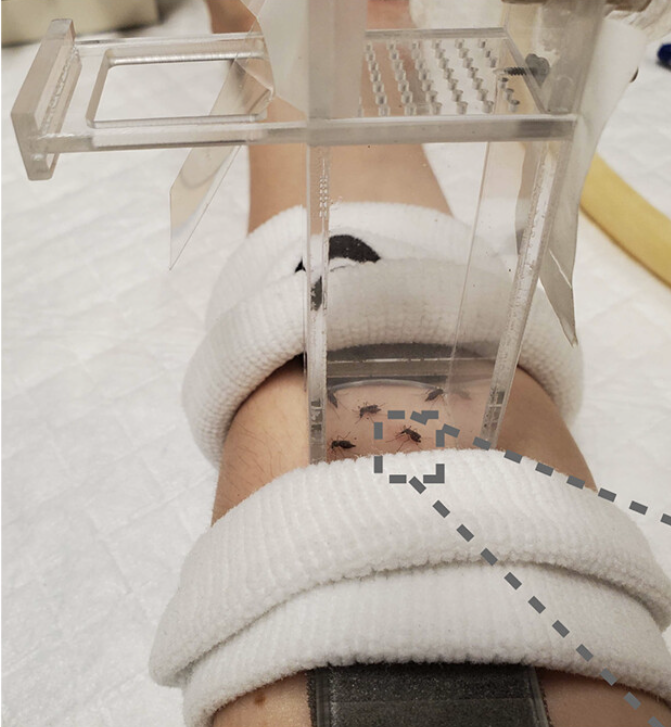
As she explained, the test was set up as such: the human volunteer holds an electrode with a very tiny voltage that is unperceivable to a human. The mosquito has a conductive wire attached to its back, which is connected to an apparatus. When the insect lands on skin and breaks its surface, it connects the entire circuit, giving the researchers a ‘look under the skin’.
The bite
The main player in the biting process is the mosquito’s mouthpart, which is comprised of six different needle-like stylets able to hold your skin, pierce the tissues, deliver saliva and siphon your blood in record time. Poinapen likens it to a “Swiss Army knife optimised for skin microsurgery.”
The insect completes the bite in five ‘stages’: piercing, vessel searching, blood ingestion, retraction and withdrawal. When the mosquito first lands on a host, it needs to find a bite site. It does so by repeatedly lifting and sliding the tip of that mouthpart on the skin surface, choosing the best spot to munch.
Once that’s done, it penetrates the skin in search of a blood vessel. It’s then time for the ‘blood meal’, which is the longest step in the process.
“It’s a very fast behaviour – some of this stuff happens in the blink of an eye,” says Konopka.
During the blood ingestion, the mosquito remains almost motionless on the surface of the skin, but underneath, the researchers recorded vigorous electrical activity associated with the blood pumping.
“She’s just sitting there, the only hint of activity the increasing size of her abdomen as she’s engorging with blood,” describes Konopka.
Despite the moniker of a ‘blood meal’, the mosquito is not actually eating the blood for nutrition. Female mosquitos bite because they need to extract protein from animal blood to produce their own eggs. The transmitting of disease is an unfortunate byproduct of this, as they are often carrying pathogens.
Practical use
The researchers hope that the findings from this study can be used for development of new strategies to reduce and prevent Anopheles mosquito bites, in addition to ones already out there. The Centers for Disease Control and Prevention (CDC) advice lists using chemical barriers, wearing protective clothing, and controlling breeding habitats as the main strategies.
Mosquitos use a range of different sensory cues to find a host, including our smell, heat and humidity. A lot of insect repellents work by targeting and disrupting those sensory systems, for example masking our scent, making it smell ‘bad’ to the mosquito or overloading its senses and leaving it too disoriented to land on skin.
“All these strategies work, but the problem is that to really control something like a mosquito, you need a multi-pronged approach,” says Konopka.
By targeting a specific part of what the mosquito is doing on the skin, the researchers are working towards reverse-engineering it to stop it. Konopka’s main focus is on how the mosquito uses chemosensory cues once it lands on skin, which is “the last chance to intervene before the bite happens.”
“To stop the bite, we need to understand how it happens so that we can see which step of it we could reasonably target to disable or prevent mosquitos from physically biting us,” explains Konopka.
This study targeted two specific pathways the mosquitoes rely on to smell and taste human skin – and one of them brought especially interesting results. The gene IR76b, a co-receptor mostly used by the mosquito for close-range taste and smell, turned out to be especially vital for the blood vessel searching stage of the bite.
“When we disable that gene, the mosquitos have a very hard time actually initiating the bite. Even if they’re successful, they then have a hard time completing it,” says Konopka.
Although more research is needed, the scientists note that this gives them a potential target to use to prevent mosquito biting in the future.
Read the full findings here.
Top image: close up a mosquito sucking human blood. Credit: smuay/Getty Images
