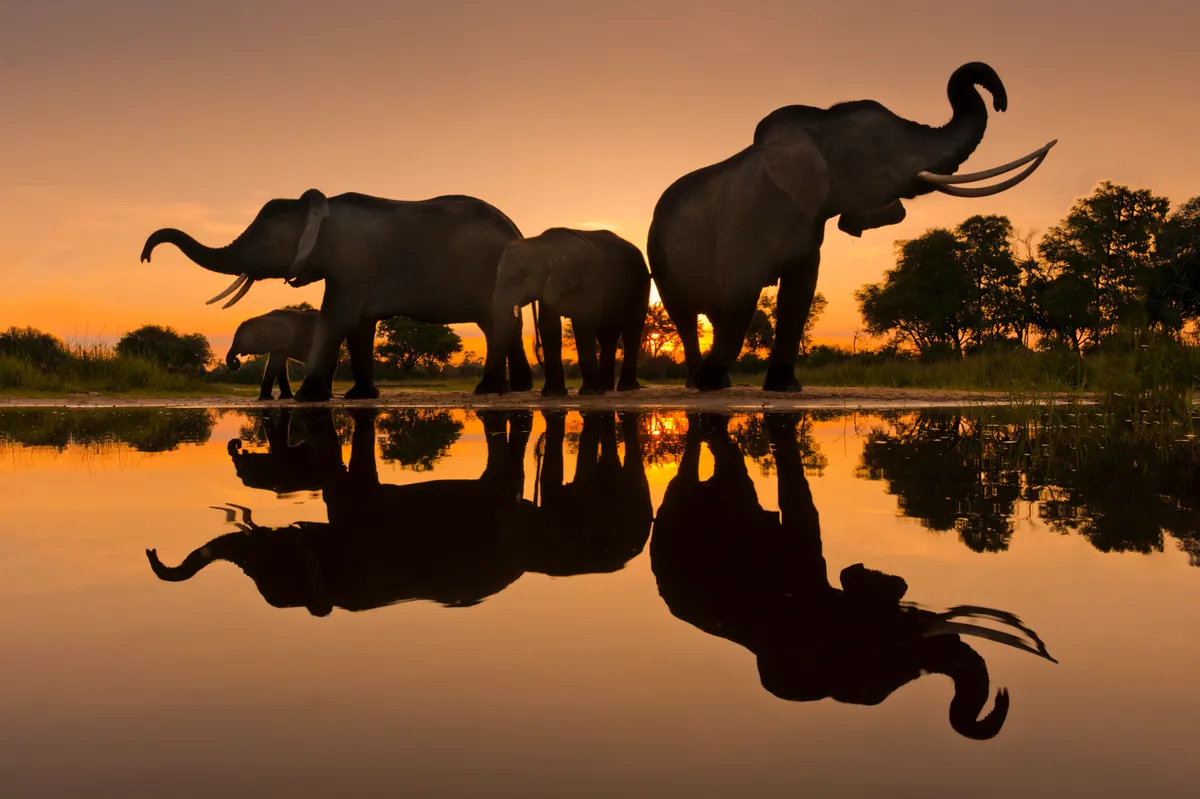
The second largest land mammal on the planet is also the largest land mammal on the Asian continent.
The genus Elephas originated in Sub-Saharan Africa during the Pliocene and spread throughout Africa before emigrating to southern Asia.
- Baby elephant suck their trunks, like human babies suck their thumbs. Here's why they do it...
- "A bull elephant appeared from the bush. Ambling over to the carcass, the immense creature used his tactile trunk to gently caress the bones of his fallen comrade"
The Asian elephant (Elephas maximus), is smaller than its African relatives, with males growing up to 3.5m at the shoulder and weighing in at up to 5.5 tonnes (African elephants grow up to 4m and weigh up to 7 tonnes).
They also have smaller, more rounded ears, a twin-domed head and just one ‘finger’ at the tip of the trunk (African elephants have two).
Asian elephants use their trunks as an exploration superpower – smelling, breathing, trumpeting, drinking and grabbing things. These versatile trunks are equally capable of brute force (pushing over a tree to reach leaves on the upper branches) or performing a delicate task such as manipulating a morsel of food using the ‘finger’ at the tip.
- Just how and why did the elephant get its remarkable trunk?
- This baby elephant taking its first trembling steps is the cutest thing you’ll see today
They also touch trunks to reassure each other, the equivalent of a hug, say experts. This extraordinary ‘nose’ has more than 40,000 muscles (the human body has just 600+).
There’s a difference in the tusks, too. Female Asian elephants don’t have them, instead growing rudimentary tusks, called ‘tushes’. Some male Asian elephants never grow tusks.
Asian elephants vary in size and there are three recognised subspecies – Indian, Sumatran and Sri Lankan (the largest).
There is also the Borneo pygmy elephant, endemic to the island, that stands at 2.5–3m tall at the shoulder.
Asian elephants inhabit dry to wet forest and grassland habitats in 13 range countries spanning South and Southeast Asia.
While they prefer to forage plants – grasses, bamboo shoots, leaves, roots and bark – Asian elephants have adapted to survive on a variety of resources available in their habitat. Indeed, their fondness for cultivated crops such as bananas, rice and sugarcane has led to conflict with humans. More than two-thirds of an elephant’s day can be spent feeding on around 150kg of plant material.
Asian elephants differ quite noticeably in their social structure, emerging research has revealed. While African elephants have a strict hierarchy by age and are led by the oldest and wisest female, the matriarch, their Asian cousins have more changeable social networks.
This flexible species, which lives up to 80 years, forms significantly smaller, less hierarchical and more loosely collected groups that can separate and reunite over time. This ‘fission-fusion’ arrangement seems to allow elephants to adapt quickly to changing conditions.
Long revered as both deities and cultural symbols, Asian elephants have been intertwined with human history across the continent for centuries. But today they face threats.
- Elephant graveyards: is there any truth in the legend elephants go to a special place to die?
- The car was stuck in the mud. Then an elephant charged. I still can’t believe what happened next
The expansion of agricultural and city infrastructure has fragmented wild Asian elephant habitats, squeezing the animals into isolated pockets of land. This has also fuelled conflict with humans as elephants seek space and raid crops grown close to their forest home.
As well as the deforestation of their habitat, poaching is a threat – not necessarily for tusks, but for other elephant products such as skin and tail hair.
There may be fewer than 50,000 in the wild, compared to around half a million of their African relatives. Now classified as Endangered on the IUCN Red List, all three subspecies hang on in only about five per cent of their historical range, which once stretched from China to as far west as the Euphrates River.