We humans like to think of ourselves as highly intelligent beings, and we do sit at the top of the evolutionary tree in tool-making and problem-solving. But our primate relatives can also demonstrate some pretty impressive brain skills. Here are eight of our most intelligent cousins.
- 10 smartest animals on the planet: Discover the world's cleverest creatures, including some unexpected species redefining intelligence
- "22% of US men believe they could beat a chimpanzee in a fight" – Here’s how humans actually stack up against the world’s 10 strongest primates
Smartest primates on the planet
Orangutan
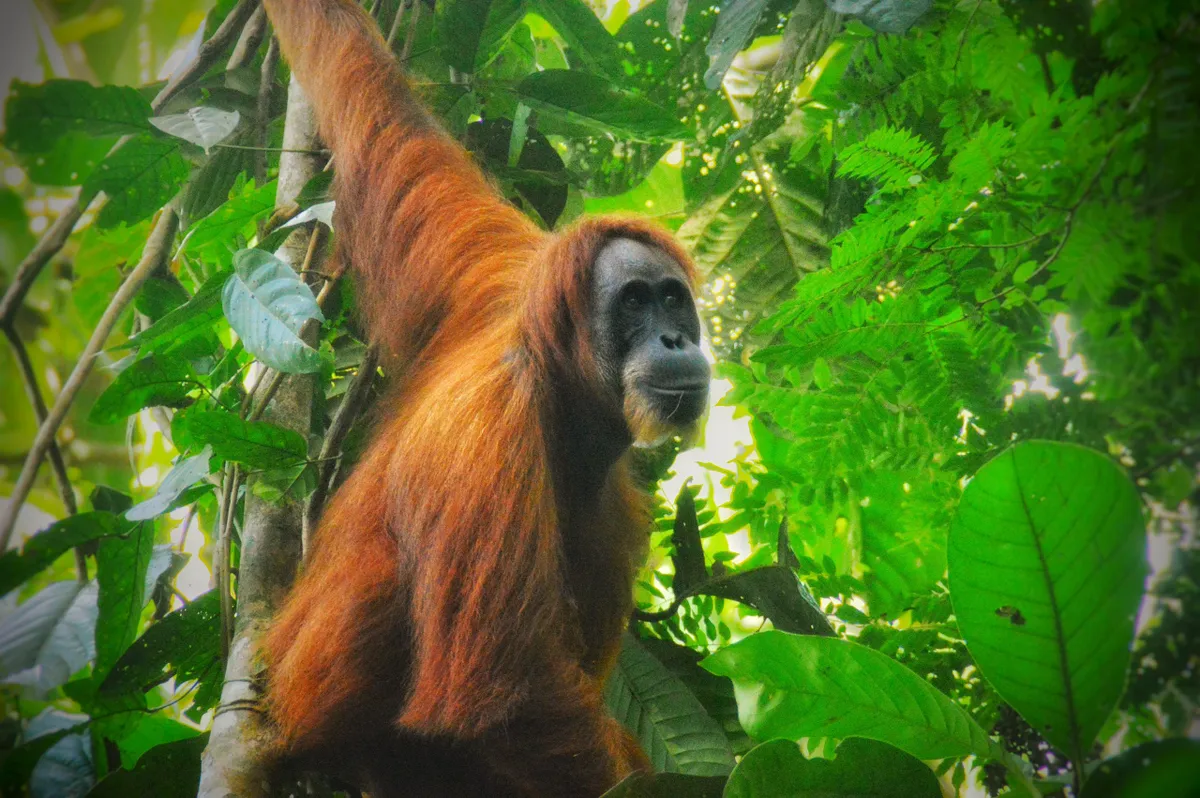
There are many ways to measure intelligence – tool use, communications, innovation, empathy and emotion, memory and recognition – and orangutans score well on pretty much all of them.
They make use of items in their environment to make life easier and more comfortable. Branches and foliage are arranged into sleeping nests, they select specific plants to cure ailments, and they use sticks to poke edible insects out of their holes and seeds out of fruit. They will even prod sticks at fish to make them leap into the air where they can be caught.
But they have one characteristic sign of a thinking being that they share with humans, that no other species has demonstrated. They will communicate about an event to other orangutans after what has occurred has been and gone.
Where other species will alarm call as soon as they spy an approaching predator, for instance, orangs will often stay silent until the danger has passed and then ‘tell’ their cohorts with what are called kiss-squeak sounds. These involve sucking in air between pursed lips, a sort of reverse whistle. This demonstrates a calculated, intentional reaction to an event, rather than an instinctive, automatic one.
A clever way to make sure you’re safe before helping others, rather like they tell you to do with lifejackets on an airplane!
Chimpanzees

Chimpanzees are often cited as the most intelligent primates. The main reason for this is their adept and varied use of tools in their daily lives. They make cups out of leaves to drink water from less accessible places, or they use moss to soak it up and then suck the plant to gain moisture. They employ thick sticks to dig into termite nests and then switch to thin sticks to probe into the resulting holes and extract the insects to eat.
- Chimp video shows one of the most complex tool-use behaviours by wild animals ever documented
- They use tools, fight to the death and live in social groups – and are the closest living relative to humans
They also use sticks to inspect anything that might turn out to be dangerous – unfamiliar objects, reptiles or insects, for instance – turning them over and assessing them before deciding on their approach. They are aware of hygiene and use leaves to keep themselves clean after eating or going to the toilet.
- "They have been seen to use use sticks as weapons against humans, and clean their ears with grass" – 11 animals that use tools in surprising and clever ways
- Would chimpanzees make good politicians?
To communicate chimps use lots of vocal sounds as well as facial expressions and hand gestures to convey what they want or how they are feeling. In captivity they can be taught rudimentary sign language and they have demonstrated an understanding of human words and phrases in scientific experiments.
- Can humans and chimpanzees interbreed?
- Can chimpanzees and other great apes breed with monkeys?
- A chimp was adopted and taught sign language by humans in the 1960s – but it turns out that chimps already have their own 'language'
Bonobos

Close relatives of chimpanzees and humans, bonobos exhibit the sort of intelligence that comes from understanding social situations and the need to work cooperatively. Appreciating the feelings and abilities of others and using this information to make decisions on how far to interact with them is a different type of intelligence to coping with physical challenges.
- Bonobo guide: where they live, how they’re related to chimps, and why they have such a fascinating society
- Your 60 second guide to bonobo behaviour
So these apes don’t have the same skills with tools as chimps and orangs but they do know how to ‘read the room’ and adapt their behaviour accordingly. Experiments have proved that bonobos analyse their companion’s body language and work out if they need help with a task, in which case they will step in.
- Monkey vs ape: what’s the difference between these two intelligent primates?
- When scientists set a test for apes they were astounded with what happened next...
However, if they work out that the companion knows what has to be done and is just not acting on that knowledge, they stay apart and don’t offer help. This ability to distinguish whether a fellow creature is knowledgeable or ignorant requires a higher level of brain power that has previously only been associated with humans.
Spider Monkeys

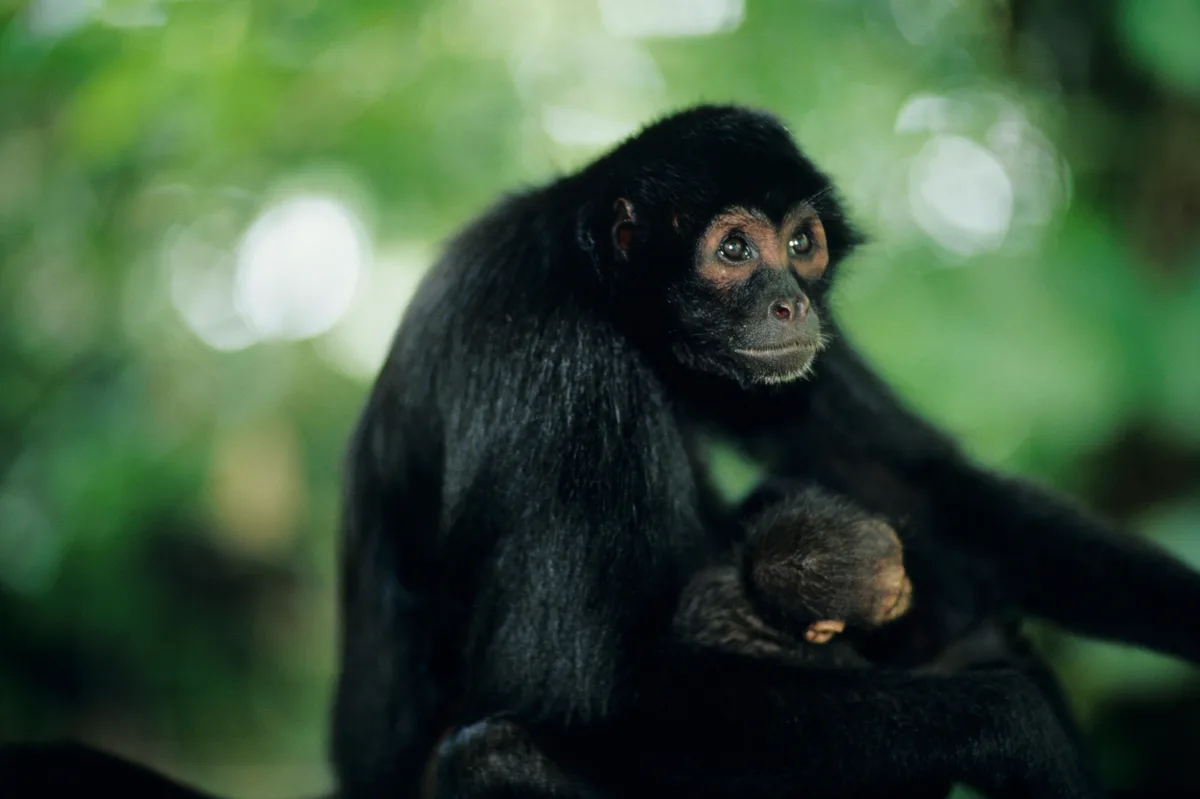
These agile primates are capable of efficient group organisation that benefits the entire colony in their daily task of finding good food supplies. They will divide themselves into small subgroups of three or four animals each, and in that way form foraging parties to explore their surroundings for well-laden fruit trees. The subgroups then interact to share the knowledge they have gained with the rest of the troop.
- Do spider monkeys have thumbs?
- What are the smallest monkeys and primates in the world? Meet the tiny creatures of the monkey world
Scientists have discovered that each spider monkey subgroup tends to contain individuals that are very familiar with certain well-trodden areas as well as others that know more obscure places in their home forest. By switching groups frequently, members pool information and maximise the chances of all of the monkeys getting a decent meal. This system means that collectively the entire group knows their forest far better than one individual monkey ever could. It’s the sort of close cooperation that until recently has only been attributed to humans.
Gorillas

These apes have the heaviest brains of all primates, apart from humans. However, human brains are more than twice as heavy, so relative to their body size a gorilla’s brain is not so impressive.
Like orangutans, gorillas make sleeping nests in the trees and employ tree branches as supports while fishing. They also use tools they have earmarked for a specific purpose, but sparingly as their forest homes are usually flush with food plants so they don’t have to work too hard to nourish themselves.
For example, they have been observed using a stick to measure the depth of a pool of water when crossing a swampy area, which shows some capacity for working out the world around them and creating strategies, and they have improvised clubs out of fallen branches to use as weapons in territorial disputes.
In captivity, one gorilla proved able to learn simple sign language but, basically, they are not animals that need to use brain power to get on in the world. So although they obviously have reasonable intelligence and are feeling, emotional animals, they don’t often openly demonstrate a higher intellect.
Capuchin Monkeys

Considered to be the smartest of the Old World monkeys, capuchins have a large brain relative to their body size, unlike gorillas. They are frequently observed to use tools to help access their food. Stones and flat boulders are used to crack nuts, which enables them to eat much larger fruits with tougher shells than they would otherwise. If they live near water capuchins will employ the same stone-on-stone technique for cracking the shells of crabs and molluscs.
Capuchins also have mental maps of their foraging area, retaining knowledge of the best places to find fruit or frogs, another food source they enjoy. They will pick palm nuts and make a small hole to drink the juice. The fruit they leave to dry in the sun until the skins are brittle. They then return to collect them up, take them to a boulder spot, crack them open and extract the kernels.
Another sign of intelligent awareness is the way they will gather millipedes and crush them to rub the remains on their fur where it acts as a natural insect repellent.
Gibbons

The gibbons of Southeast Asia are apes, rather than monkeys, but they are the smallest of this genre being only about two feet in length (65cm). The fact that they don’t have tails is one of the factors that makes them an ape rather than a monkey.
Their small size doesn’t mean that they don’t have a reasonable amount of what we recognise as intelligence, though. They have distinct personalities and they are very sociable, and in scientific experiments gibbons prove able to solve puzzles in order to get a food treat. They can also follow eyelines and understand what others are looking at, so specific communications on food sources or impending danger are employed. And they sing! They form early morning duets with other gibbons with songs that are coordinated and harmonise.
Macaques

These are other groups of Old World monkeys that frequently show signs of intelligence in the use of tools such as stones to crack nuts. Their societies are very hierarchical, and a macaque of high status can completely dominate those of lower ranks, including taking food from their mouths if they feel they have been disadvantaged!
- Cheeky macaques vs Japanese farm dogs – watch this Shiba Inu showdown
- Watch amazing new BBC footage of macaques stealing babies to resolve arguments
Whether that reflects intelligence in attaining a position of respect in the troop, or simply an innate notion of entitlement by virtue of strength or birth order is not clear.
Macaques, in experiments, were also able to recognise specific faces of other macaques, even when the pictures showed the subjects with their heads in different positions or with different expressions on their faces. They did this after training, which raises the question of whether they would be able to perform as well without training. However, the fact that they can respond to training and learn new skills indicates a form of intelligence that other species do not possess.