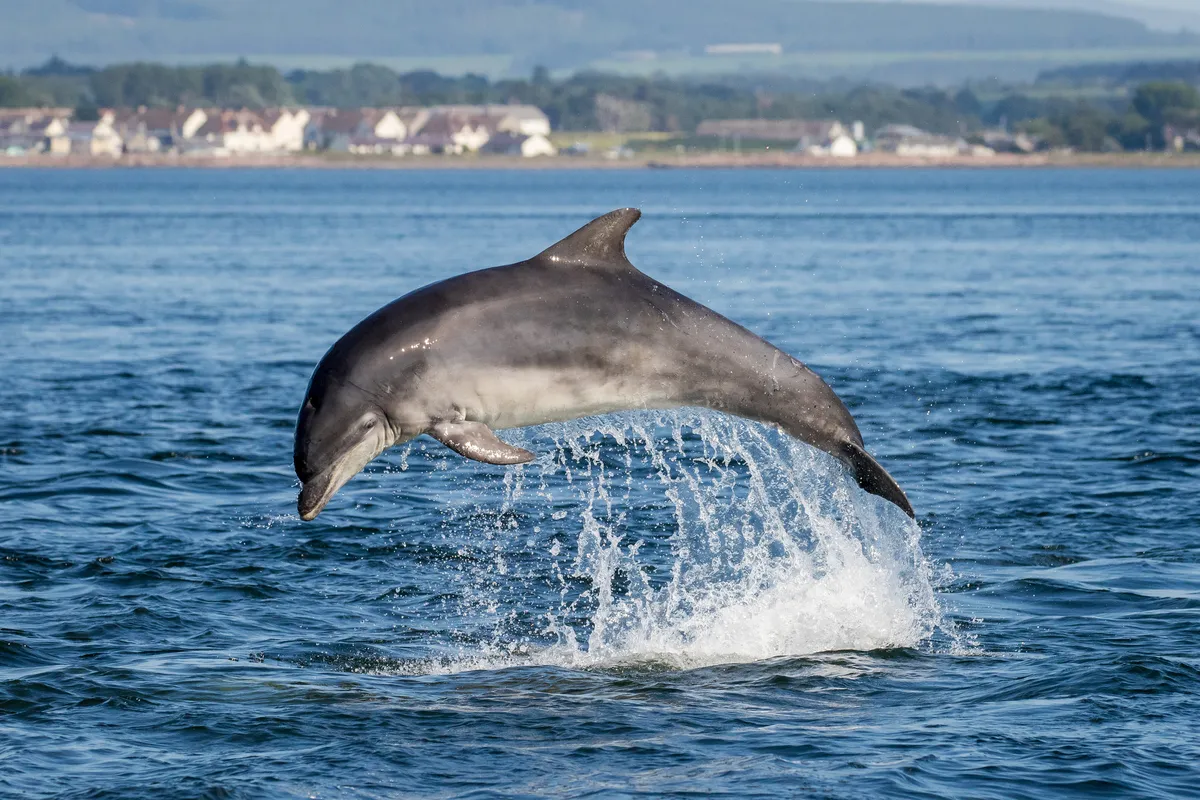
Two studies tested the theory that attaching glass or plastic bottles to gillnets could prevent dolphins from getting caught
The harm plastic pollution does to ocean animals is no secret but what if plastic could be used to save lives instead? Some scientists think it can.
Two new studies have explored the possibility of using plastic bottles to prevent dolphins getting caught in fishing nets and found that it can work.
- Ghost nets: What you need to know about these deadly ocean polluters
- “My fingers were trembling.” Divers were removing ghost nets in the Mediterranean, when THIS happened…
Gillnets are a type of fishing net that hang vertically in the water to trap fish but they often unintentionally catch other marine life, including dolphins.
“In the UK, static gillnets are responsible for more deaths than any other gear type,” writes Whale and Dolphin Conservation (WDC) on its website. “We know that around 1,000 porpoises and hundreds of dolphins, including 250 common dolphins, die in gill nets in UK seas every year.”
The nylon filaments that make up the net are almost invisible to dolphins, which often struggle to detect the nets using echolocation – the process of bouncing sound waves off nearby items to build a picture of what’s around them.
“Some fisheries use nets with very thin mesh which may be difficult for a dolphin to detect,” writes WDC. “Perhaps such materials don’t produce an echo and so it could be that dolphins and porpoises swim ‘blindly’ into them, simply not detecting that they are there. Or perhaps they can detect the nets but do not perceive the danger.”
Per Berggren, a professor at Newcastle University wondered whether adding plastic and glass bottles to gillnets could help the dolphins locate the nets and avoid getting entangled.
The idea is that the air inside the empty plastic bottles help to reflect the sound from the dolphins’ echolocation clicks while metal bolts were put inside the glass bottles to create a clinking sound as they moved in the water.
Two studies – now published in Fisheries Research and Marine Mammal Science – set about to test the theory.
The first study attached glass and plastic bottles to more than 1,600 fishing nets in Zanzibar, Peru and Brazil and compared the results with nets that didn’t have bottles.
The results were mixed. In Peru, where nets are hung near the surface of the water, the bottles didn’t make a difference to the number of dolphins, porpoises or turtles caught in the nets but did increase how many of their target fish they caught. The use of plastic bottles also increased the number of sharks caught.
Similarly, in Zanzibar, the addition of bottles to nets on the surface resulted in them catching more tuna but they didn’t catch any dolphins (including in the control nets, which didn’t have bottles) so they couldn’t come to a conclusion about how effective this was.
They had more luck in Brazil, where nets are anchored to the seafloor. “Plastic bottles showed promise in Brazil, potentially reducing dolphin bycatch while increasing fish catch, though further trials are needed to confirm this,” the authors write in the paper.
“The difference we saw in the success of the bottom set nets compared to the nets near the surface, may be that the surface water is a noisier environment reducing the efficacy of the plastic bottle reflectors,” explains Berggren.
Following on from this work, the researchers tried again on bottom-set nets and found that the bottle reflectors reduced dolphin bycatch by 88%. The amount of target fish caught was not affected.
“Given its low cost and lack of impact on target-species catch, this method can be readily tested in other regions and, if effective, widely adopted to improve the conservation of coastal dolphin species,” write the authors of the Marine Mammal Science paper. More research is now taking place in Cambodia and Congo.
Berggren is excited by the effectiveness of the simple solution. “Attaching plastic bottles to fishing nets can reduce dolphin bycatch globally and is something that every fisher can afford,” he says. “This is genuinely recycling that rescues dolphins.”
“It’s also rewarding to know that we are using some of the plastic waste that spoils our oceans,” adds Berggren. “The bottles are securely attached to the nets and we did not lose any plastic bottle during the trials.”