
The discovery of the floating bottle, with its crustacean hitchhiker, tells researchers more about the impact of plastic pollution on ocean creatures
While surveying young fish off the coast of Okinawa, Japan, scientists found a plastic bottle floating in the ocean. They were amazed to find something very unusual living inside.
- It's the size of a small car, weighs as much as an e-bike – and can live for an amazing 100 years...
“[To our surprise], a large live swimming crab, Portunus sanguinolentus, was trapped inside the bottle,” say Hajime Sato and Yoichi Sakai, who found the animal, in a statement. “The crab was clearly larger than the opening of the bottle!”
How did the crab get inside, they wondered.
Analysing the bottle, which was collected 500m off Sesoko Island in July 2022, they found signs showing it had been manufactured around eight months before, in November 2021.
The bottle was open but, despite water flowing in and out, the crab was totally stuck.
The mouth of the bottle measured 24mm in diameter but the stranded creature was both longer and wider than that. At 40.31mm long and 88.23mm wide, it was simply too chonky to leave through the opening.
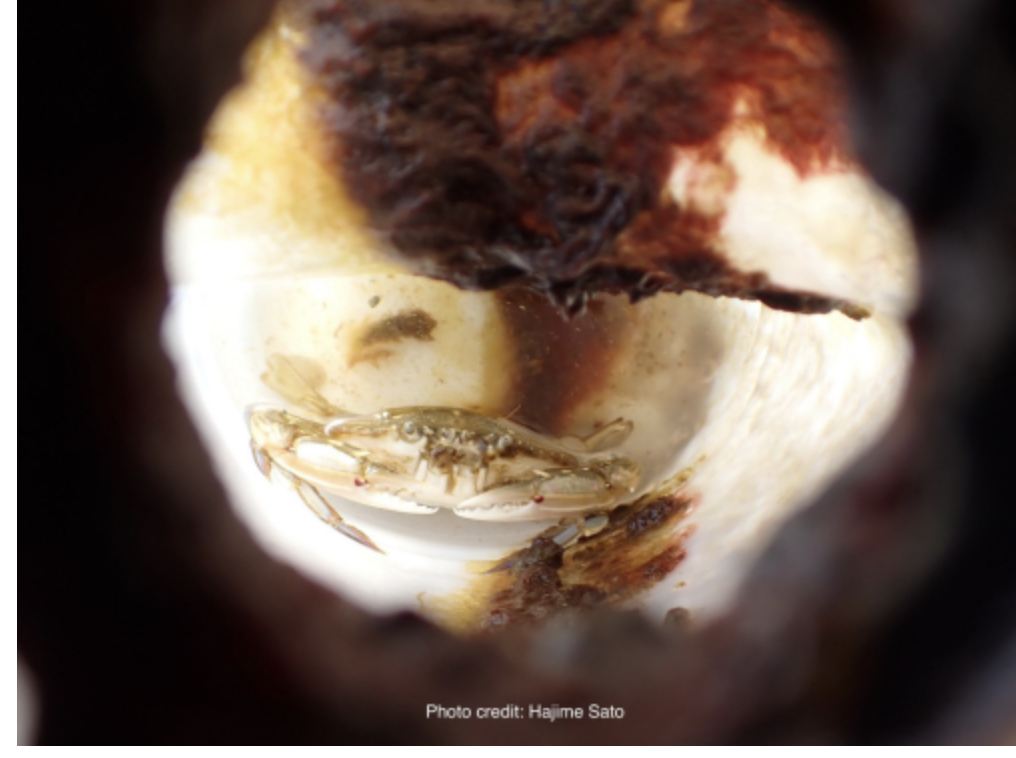
This must have been the way it came in but how long had it been there? Sato and Sakai set out to solve the mystery – alongside the late Tetsuo Kuwamura at Chukyo University, Nagoya, who was a co-author – publishing their findings in the journal Ecosphere.
At the time of the study, first author Sato was a doctoral student under Sakai – a professor at Hiroshima University’s Graduate School of Integrated Sciences for Life – and is now a postdoctoral research fellow at the Okinawa Institute of Science and Technology in Okinawa.
When they had found the bottle, there were four species of juvenile fishes nearby: rough triggerfish (Canthidermis maculata), sergeant major fish (Abudefduf vaigiensis), rainbow runners (Elagatis bipinnulata) and freckled driftfish (Psenes cyanophrys).
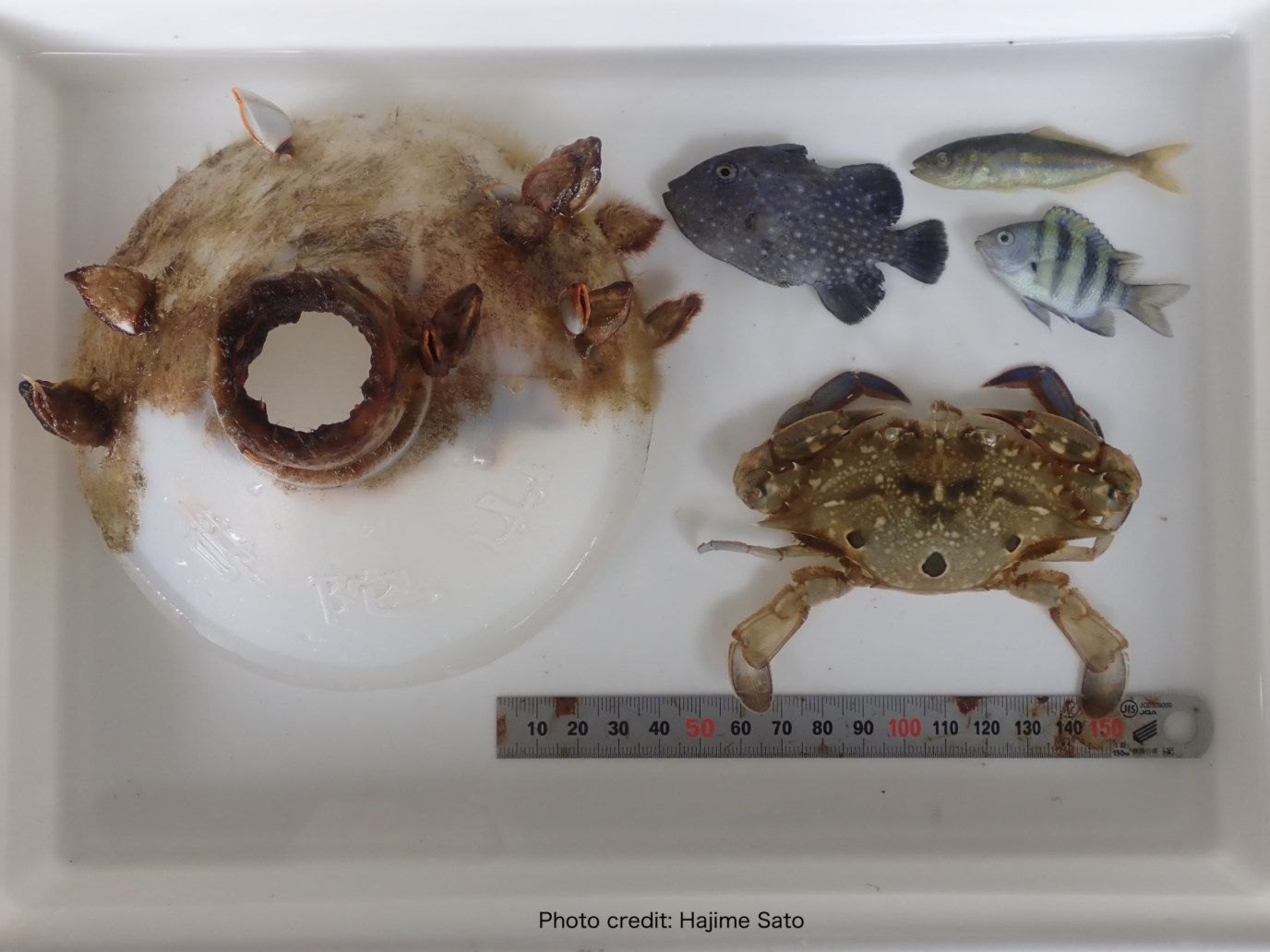
“We hypothesised that the crab survived by hunting juvenile fish that entered the bottle,” write the authors in the study. When they analysed its stomach contents using DNA metabarcoding, they found evidence that it had eaten the triggerfish and sergeant majors as well as green and brown algae (Ulva compressa and Myrionema strangulans) that could have been growing inside the floating bottle.
The high-density polyethylene (HDPE) Shaoxing wine bottle also had goose barnacles (Lepas anserifera) growing on the outside. These were key to solving the mystery.
Knowing how quickly these barnacles grow enabled the scientists to estimate that the bottle had probably been floating in the sea for 62 days.
“These results suggest that the crab entered the bottle at the larval or juvenile stage, survived with sufficient nutritional conditions, and continued to grow inside the bottle while drifting for approximately two months,” says the study. Eventually, the little crab became too large to escape and was totally trapped.
Scientists already know that plastic pollution can harm and kill many different marine animals: whales, sharks and marine mammals can get tangled in fishing nets and turtles can die from eating plastic bags.
But this finding shows that the harm even extends to tiny creatures like this crab.
“Plastic bottles discarded by humans can trap crabs and prevent their escape,” say the authors. “Through this striking example, we would like readers to recognise that objects that make our lives more convenient can sometimes have unexpected effects on small marine animals.”
This isn’t the only time animals like this crab have become trapped in plastic bottles like this: “Similar cases have already been reported from waters around Japan,” say the authors, “suggesting that this was not an isolated accident.
- Crab wanders through Suez Canal into Mediterranean Sea. Now scientists are worried
- “A colossal crab the size of a car tyre was pushing against my door”
- These toxic and highly poisonous crabs are capable of killing a human with just tiny amount of toxin - and there's no antidote!
Top image: representative bottle in ocean © Getty


